
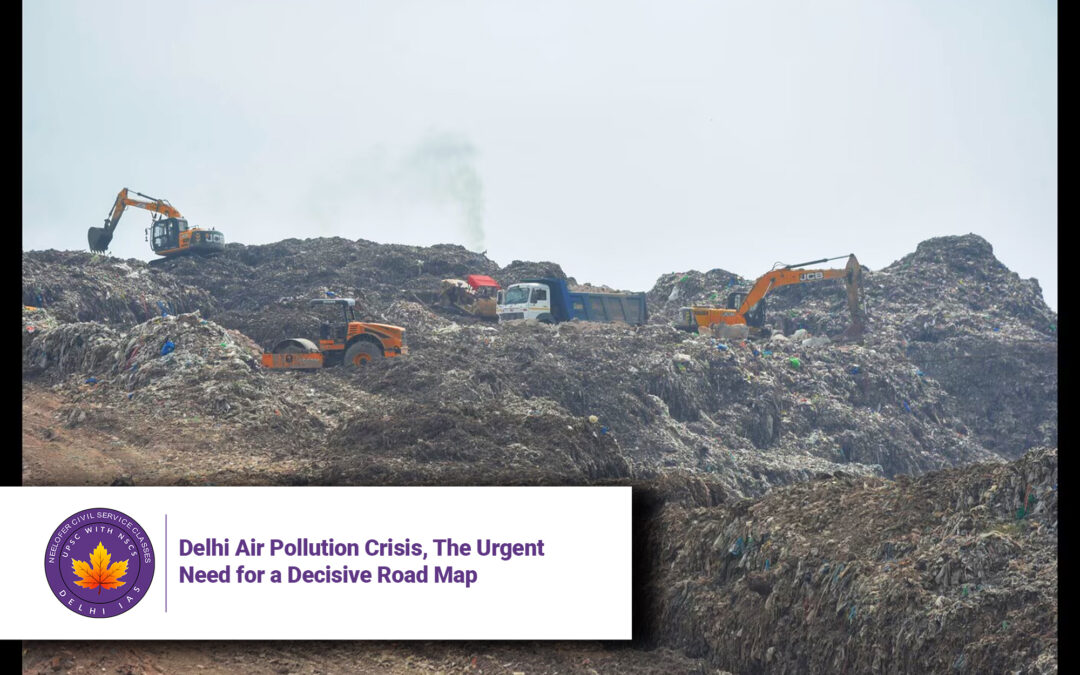
Delhi Air Pollution Crisis, The Urgent Need for a Decisive Road Map
Why in News:
Amitabh Kant, India’s G20 Sherpa and former CEO of NITI Aayog, recently laid out a strong and urgent plan of action to tackle Delhi’s worsening pollution crisis, describing it as a situation nearing an environmental emergency. The article underscores the public health, economic, and governance challenges caused by the city’s air quality.
Introduction:
Delhi is months away from becoming unliveable due to extreme air pollution. With PM2.5 levels more than 25 times the WHO limit, the capital has reached a breaking point. Every breath taken in the city is a step closer to disease, disability, or death. The combination of toxic air, weak governance, and lack of strong policy implementation has made the crisis worse, with consequences on health, economy, and quality of life.
Key Issues and Background:
-
PM2.5 Levels:
In 2021, PM2.5 levels reached 126.5 µg/m³—25 times the WHO safe limit.
Over 25,000 people die annually in Delhi due to air pollution. -
Economic Costs:
GDP loss is estimated at 3% (approx. $100 billion) due to low productivity, healthcare costs, and disrupted workdays. -
Biomass Burning:
Responsible for nearly 60% of PM2.5 emissions. NCR must phase out agricultural waste burning and promote LPG or electric cookstoves. -
Thermal Power Plants:
13.2 GW capacity exists in Delhi-NCR, but only 7% comply with 2015 pollution norms. Many use outdated tech that harms health. -
Industrial Kilns:
4,608 kilns in Delhi-NCR use outdated practices, causing serious emissions and groundwater degradation. -
Transport Pollution:
Diesel vehicles, especially older two- and three-wheelers, are major contributors. Delhi has only 5% of India’s EV fleet.
Specific Impacts or Effects:
-
Health: Surge in respiratory patients during winters. Long-term exposure shortens life expectancy by over 6 years.
-
Water Pollution: Poor sewage treatment and lack of sanitation add to river pollution (Yamuna) and groundwater contamination.
-
Real Estate Impact: Property prices in Delhi-NCR rose 57% since 2019, worsening unaffordability in an unliveable city.
-
Livelihoods & Economy: High healthcare costs, productivity drops, and migration of skilled workforce threaten Delhi’s economic status.
Challenges and the Way Forward:
Immediate Actions Required:
-
Biomass Alternatives:
-
75% LPG subsidies in NCR.
-
Promotion of clean cooking fuels.
-
Phasing out community biomass and agricultural burning.
-
-
Thermal Plants Modernization:
-
Mandatory flue gas desulphurisation.
-
Shut down 35+ year old plants.
-
Adopt zigzag kiln technologies.
-
-
EV Transition Plan:
-
Retrofit/replace all 2Ws & 3Ws within 2–3 years.
-
Electrify all delivery and public buses.
-
30,000 taxis and 8-year-old autos to switch to EVs.
-
-
Solid Waste Management:
-
Follow Surat model: strict segregation, penalties, data-driven audits.
-
Build modern decentralised sewage treatment.
-
-
Public Transport & Urban Design:
-
Improve metro and bus systems.
-
Increase green spaces and pedestrian zones.
-
-
Community Awareness:
-
Data transparency, citizen-led action, local disclosure of pollution sources.
-
-
Regional Cooperation:
-
Tie-ups with neighbouring states to reduce stubble burning and industrial pollution.
-
Conclusion:
The crisis in Delhi is no longer an environmental problem—it is a full-scale public emergency. Amitabh Kant warns that with population reaching 1.5 billion by 2036, failure to act now will have irreversible consequences. A master plan focused on accountability, green infrastructure, and citizen participation is the only viable way forward. Governance can no longer afford to be reactive or symbolic—it must be urgent, integrated, and inclusive. Only through visionary leadership and strong policy execution can Delhi breathe again.
5 Questions and Answers:
-
Q: What is the main cause of Delhi’s air pollution crisis?
A: Biomass burning, outdated thermal power plants, polluting vehicles, and poor waste management. -
Q: How bad is Delhi’s air pollution compared to global standards?
A: PM2.5 levels were more than 25 times the WHO limit in 2021. -
Q: What are the proposed solutions to curb vehicular pollution?
A: Electrifying all delivery vehicles, autos, and public buses within 2–3 years. -
Q: What reforms are needed in waste management?
A: Modern sewage systems, waste segregation at source, and public monitoring. -
Q: What is the long-term vision to save Delhi from this crisis?
A: Implement a green master plan, focus on urban sustainability, and integrate public health, innovation, and regional cooperation.

