
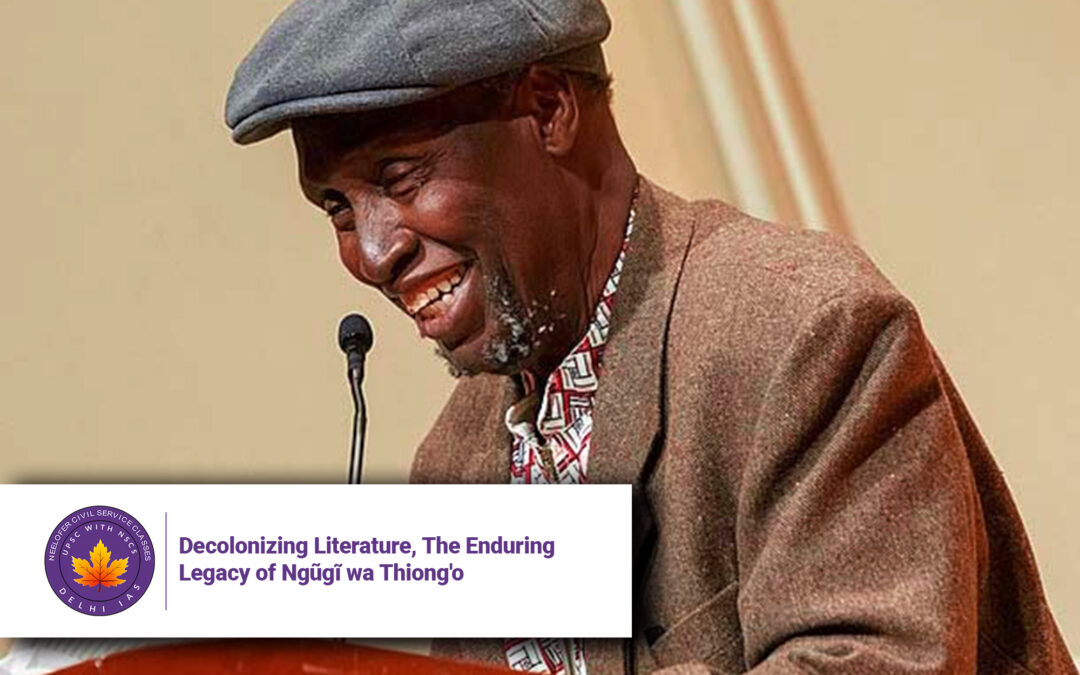
Decolonizing Literature, The Enduring Legacy of Ngũgĩ wa Thiong’o
Why in News?
The recent passing of Kenyan literary giant Ngũgĩ wa Thiong’o (1938–2024) has reignited global conversations about decolonizing literature, linguistic sovereignty, and the politics of literary recognition. Though never awarded the Nobel Prize despite perennial speculation, Thiong’o’s radical ideas on language and postcolonial identity continue to shape academic and cultural discourse worldwide. 
Key Aspects of Thiong’o’s Legacy
-
Linguistic Revolution:
-
Rejection of English: In 1977, Thiong’o abandoned writing in English (the language of colonial oppression) and switched to Gikuyu, his native tongue, declaring: “Language is the carrier of culture.”
-
Self-Translation: Pioneered translating his own works (e.g., Wizard of the Crow) to bridge global and local audiences.
-
-
Political Activism:
-
Imprisonment & Exile: Jailed for a year in 1978 after critiquing Kenya’s neo-colonial government in his play Ngaahika Ndeenda (“I Will Marry When I Want”). Later lived in exile in the U.S. and U.K.
-
Anti-Capitalist Critique: His novels (Petals of Blood, Devil on the Cross) exposed how colonialism morphed into economic exploitation by global elites.
-
-
Academic Influence:
-
Seminal Texts: Decolonising the Mind (1986) remains a manifesto for rejecting Eurocentric literary canons.
-
Translation as Democracy: Argued translation empowers marginalized languages, calling it a tool for “global cultural conversation.”
-
Debates Sparked by His Work
-
African Literature’s Language: Thiong’o clashed with Chinua Achebe and Wole Soyinka, insisting African literature must be written in indigenous languages.
-
Decolonization Today: Critics question if Western academia has co-opted “decolonization” as a buzzword while sidelining grassroots linguistic movements.
-
India’s Parallels: His ideas resonate in multilingual India, where vernacular literatures struggle for recognition against English-dominated publishing.
5 Critical Questions Answered
Q1: Why did Thiong’o stop writing in English?
A: To challenge linguistic imperialism, asserting that colonial languages perpetuate cultural subjugation.
Q2: How did his prison experience shape his work?
A: Detained: A Writer’s Prison Diary (1981) linked personal persecution to Kenya’s neo-colonial politics.
Q3: What makes Decolonising the Mind revolutionary?
A: It framed language as a battleground for cultural liberation, inspiring global postcolonial studies.
Q4: Why is translation central to his philosophy?
A: He viewed it as democratizing—giving voice to marginalized languages without erasing their origins.
Q5: How is Thiong’o relevant to India?
A: His critique of English hegemony mirrors India’s struggle to balance vernacular literatures with global reach.
Conclusion
Ngũgĩ wa Thiong’o’s legacy transcends literary awards. By centering indigenous languages and exposing colonialism’s economic afterlives, he offered a blueprint for authentic cultural decolonization. As Kunal Ray notes, the best tribute is to forge our own paths—whether by writing in Tamil, Hindi, or Garo, or by demanding equitable representation in global literary spaces. In a world still grappling with colonial hangovers, Thiong’o’s words remain a clarion call: “Let the language of the people flourish!”
— With inputs from literary scholars and postcolonial theorists

