
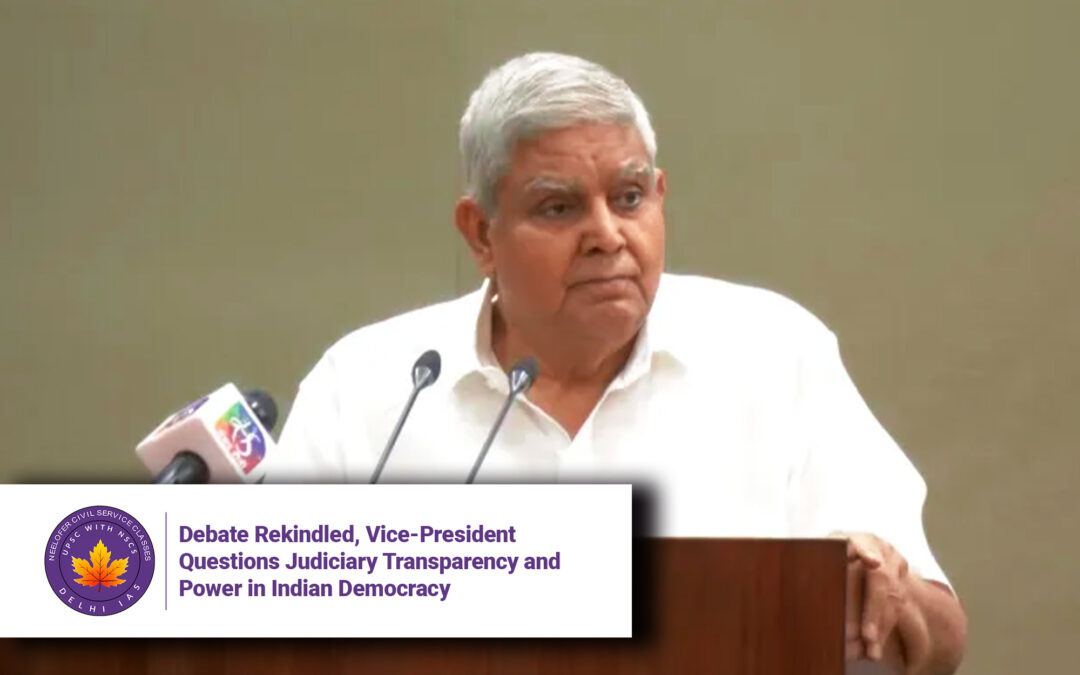
Debate Rekindled, Vice-President Questions Judiciary Transparency and Power in Indian Democracy
Why in News?
Vice-President Jagdeep Dhankhar recently raised significant concerns regarding the functioning and transparency of the Indian judiciary, particularly on issues of judicial overreach, the doctrine of separation of powers, and delays in delivering justice. His remarks have sparked a mixed response from legal experts and the public alike. 
Introduction
The judiciary in India occupies a powerful and independent position under the Constitution. However, the Vice-President’s critique has brought attention to the lack of transparency, delays in judgments, and the unchecked use of judicial powers under provisions such as Article 142. These concerns echo broader public sentiment and demand a review of judicial accountability.
Key Issues and Background
1. Timeline for Judicial Review
-
The Vice-President questioned the lack of prescribed timelines for judicial decisions, particularly in sensitive cases like those involving the disqualification of legislators.
-
He cited delays in decisions as undermining democratic processes.
2. Independence vs. Accountability
-
He emphasized that while judicial independence is vital, accountability must follow.
-
He criticized the collegium system and called for a more transparent and broad-based mechanism, possibly a National Judicial Appointments Commission (NJAC).
3. Article 142 and Extraordinary Powers
-
The Vice-President highlighted the frequent use of Article 142, which empowers the court to deliver complete justice.
-
He argued that unchecked use of this article could disrupt the balance of powers and democratic accountability.
The Core of the Concern
Lack of Transparency and Public Confidence
-
He referred to growing public dissatisfaction due to lack of transparency in decisions, especially in high-profile and sensitive cases.
-
He cited cases such as the Bhopal gas tragedy, permanent appointments of government officers, and cancellation of coal-block licenses, questioning the accountability of the judiciary.
Collegium vs. NJAC Debate
-
The collegium system—where judges appoint judges—has been criticized for being opaque.
-
Dhankhar advocated for a re-evaluation of the current system, possibly restoring the NJAC to bring public trust and transparency into judicial appointments.
Key Observations
-
Criticism of Judiciary not New: While some view Dhankhar’s comments as controversial, others believe they reflect long-standing public grievances.
-
Judiciary vs. Executive Tension: His remarks also highlight the ongoing tussle between the judiciary and the executive regarding interpretation and use of constitutional powers.
-
Call for Judicial Reforms: The renewed discussion may strengthen calls for reforms aimed at making the judiciary more transparent and accountable.
Conclusion
The Vice-President’s statements reopen an important debate about the position of the judiciary in a parliamentary democracy. While judicial independence remains sacrosanct, mechanisms ensuring accountability and transparency are also vital to uphold the public’s trust in democratic institutions. Moving forward, a balanced approach that ensures judicial integrity while allowing for necessary checks is the need of the hour.
Q&A Section
Q1. What recent concern did Vice-President Jagdeep Dhankhar raise about the judiciary?
Ans: He raised concerns about the lack of transparency, judicial overreach, and delays in decisions, urging greater accountability and a review of the judicial appointment system.
Q2. What is Article 142, and why was it criticized?
Ans: Article 142 empowers the Supreme Court to pass orders to ensure complete justice. Dhankhar criticized its frequent and unchecked use, saying it could distort the balance between branches of government.
Q3. What system is currently used for judicial appointments, and what are its issues?
Ans: The collegium system is currently used, where judges appoint judges. It has been criticized for lack of transparency and inclusiveness.
Q4. What alternative to the collegium system was proposed earlier?
Ans: The National Judicial Appointments Commission (NJAC) was proposed as a more transparent and inclusive alternative, though it was struck down by the Supreme Court.
Q5. What is the broader implication of this debate for Indian democracy?
Ans: It underlines the tension between the judiciary and executive, and the need to strengthen democratic accountability while preserving judicial independence.
