
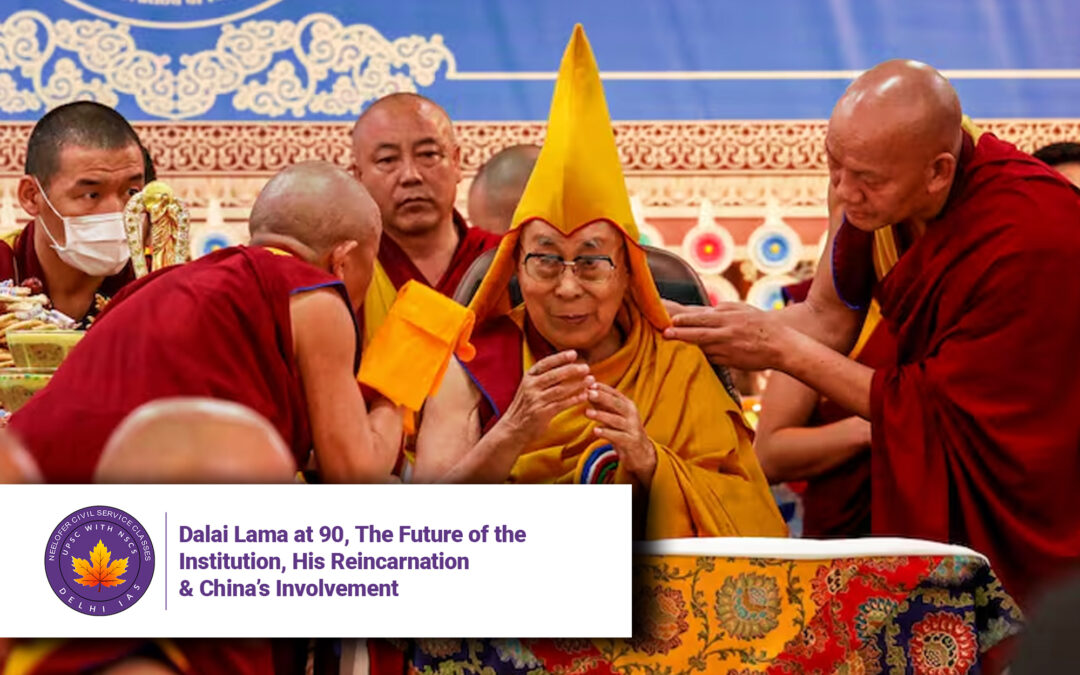
Dalai Lama at 90, The Future of the Institution, His Reincarnation & China’s Involvement
Why in News?
As the 14th Dalai Lama turns 90 on July 6, discussions around his reincarnation and the future of the institution have gained renewed attention. In light of growing concerns over China’s potential interference, the Dalai Lama has reiterated his commitment to consult Tibetan Buddhist traditions, leaders, and the people before deciding whether the institution should continue. 
Introduction
The institution of the Dalai Lama has historically held both spiritual and political significance in Tibetan Buddhism. The current Dalai Lama was recognized in 1939 and enthroned in 1940. As he approaches the age of 90, he has announced that a re-evaluation of the institution’s continuation is due — a process that he has long promised.
Key Highlights from the Article
-
Re-evaluation at 90
-
In a 2011 statement, the Dalai Lama said, “When I am about ninety, I will consult… and re-evaluate whether the institution of the Dalai Lama should continue or not.”
-
As his 90th birthday nears, he reaffirmed that consultation with Tibetan religious authorities and public will take place before any final decision on reincarnation or continuation.
-
-
Autonomy from Political Influence
-
The Dalai Lama emphasized that the reincarnation of the 15th Dalai Lama should not be decided by China.
-
In his book Voice for the Voiceless, he wrote: “The successor would be born outside China.”
-
He also stated that “no recognition should be given to a reincarnation selected for political purposes by the Chinese government.”
-
-
China’s Position on Reincarnation
-
China calls the current Dalai Lama a “splittist” and insists it has the sole authority to approve reincarnations, citing the 2007 “Golden Urn” regulation.
-
Beijing may try to appoint its own successor to gain religious control in Tibet.
-
-
Concerns Over Chinese Interference
-
Many Tibetans fear that after the Dalai Lama’s death, China will announce a state-appointed successor and exploit the situation politically.
-
In 2015, a retired Chinese official reiterated that China alone has the right to approve the next Dalai Lama.
-
-
Legacy of the Institution
-
The Dalai Lama belongs to a line of reincarnated leaders going back to Gedun Drupa in 1391.
-
The spiritual lineage is rooted in Tibetan Buddhist traditions where masters reincarnate to continue their teachings for the benefit of all sentient beings.
-
Conclusion
As the Dalai Lama reaches a milestone birthday, the future of his institution hangs in balance. While the spiritual community and Tibetan public are expected to play a role in the decision-making process, China’s aggressive stance and political claims over the reincarnation process have raised global concerns about religious freedom and cultural autonomy in Tibet. The Dalai Lama’s reassertion of independence and tradition underscores the ongoing tension between faith and politics.
5 Q&A Based on the Article
Q1. Why is the Dalai Lama’s 90th birthday significant?
A1. He had previously said that at “about 90,” he would reassess whether the institution of the Dalai Lama should continue, making this milestone critical for determining the future of Tibetan spiritual leadership.
Q2. What is the Dalai Lama’s stance on Chinese involvement in choosing his successor?
A2. He opposes any Chinese government involvement, stating that reincarnation should be decided by the Tibetan people and Buddhist leaders, not for political gain.
Q3. What are the fears among Tibetans regarding the succession?
A3. Many fear that China may appoint its own Dalai Lama to control Tibetan Buddhism and suppress the genuine religious identity of Tibet.
Q4. What tradition governs the Dalai Lama’s reincarnation?
A4. The institution is part of the tulku system in Tibetan Buddhism, where spiritual masters reincarnate to continue teaching. Historically, reincarnation is confirmed through spiritual signs and search committees.
Q5. What is the “Golden Urn” and how is it relevant?
A5. The “Golden Urn” is a Qing dynasty method revived by China in 2007 to control the selection of reincarnations, which China insists must be used to validate the next Dalai Lama — a claim rejected by Tibetans.

