
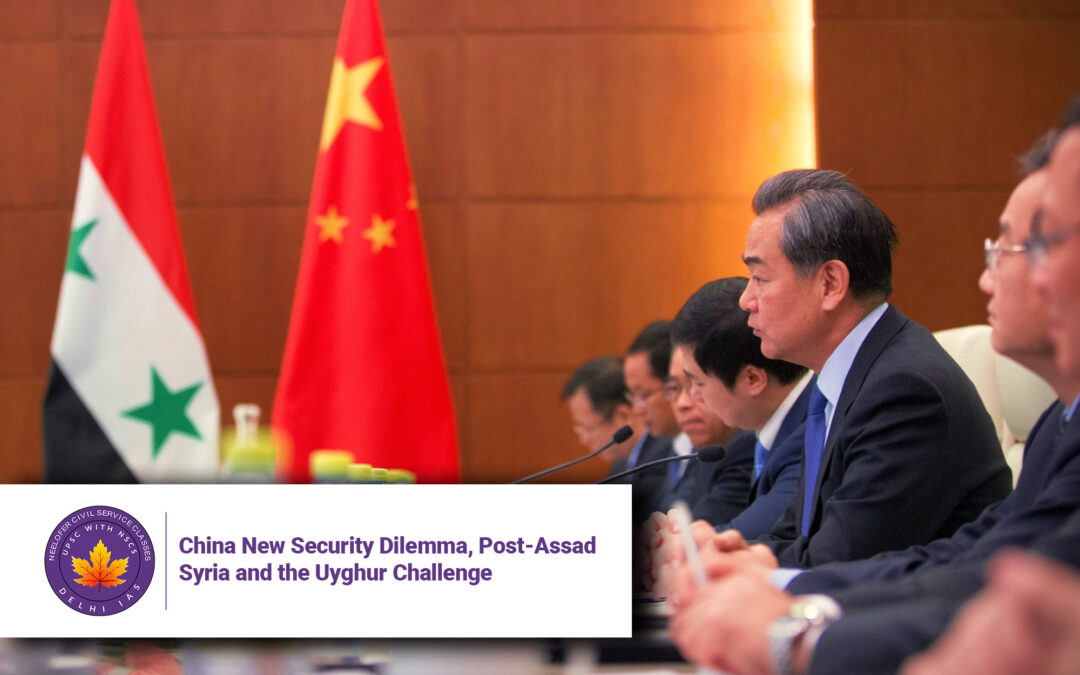
China New Security Dilemma, Post-Assad Syria and the Uyghur Challenge
Why in News?
The fall of Bashar al-Assad’s regime in Syria has renewed security concerns for China. As a power vacuum emerges in the new Damascus under President Ahmed al-Sharaa, Uyghur militants find increased space for political activity, causing China to recalibrate its regional diplomacy and counter-terrorism strategies.
Introduction
China’s steady support for Arab positions in recent years, particularly on issues like Gaza, has helped it build influence in the Middle East. However, with Assad’s exit and a new leadership in Syria, Beijing faces the renewed threat of Uyghur militancy gaining a stronghold in the region — a development that could destabilize China’s western province of Xinjiang. 
Key Issues and Background
Uyghur Militants Gaining Ground
Uyghur militants, mainly from the East Turkistan Islamic Movement (ETIM), have been exploiting the chaos in Syria to establish safe zones. Under Ahmed al-Sharaa and his group Hay’at Tahrir al-Sham (HTS), many of these militants have taken up prominent roles, especially in and around Damascus.
A Shift in Power Structure
The HTS has been at the forefront of Syria’s anti-Assad movement, gaining influence since the Arab Spring. With al-Sharaa rising to power, Uyghur militants now have more political and military visibility. Propaganda videos from 2011 onwards have glorified their role, creating a symbolic and ideological motivation for their presence.
The Core of the Concern
China’s Strategic Headache
-
Uyghur Safe Havens: Militants now have renewed opportunities to operate freely from Syria.
-
Propaganda Surge: ETIM and affiliated groups are using Syria as a staging ground for media campaigns, boosting ideological recruitment.
-
New Beijing Calculus: China sees a “new Damascus” as both a counterterrorism and a geopolitical challenge, especially with the Taliban already shifting Uyghur militants from Afghanistan after 2021.
The Role of Uyghurs in Combat
Many Uyghurs joined the Syria war and are now embedded in local militias. Among the top 50 commanders, at least one known Uyghur leader, Dawood Khodaberi (Zahid), has gained prominence — a symbolic threat for Beijing.
Key Observations
Power Competition and the West
-
Big Power Games: The U.S., Russia, and Iran have differing stakes in Syria. The West sees al-Sharaa as a potential balancing figure to manage mass migration and counter-terrorism, despite the chaos.
-
Strategic Limitation for China: With the Arab world largely supportive of Beijing’s Xinjiang policy, these new developments limit China’s ability to act openly in Syria without risking regional backlash.
Conclusion
The emergence of a new power center in Syria under Ahmed al-Sharaa has serious consequences for China’s internal and external security policy. The presence of radicalized Uyghur fighters and their integration into Syrian militias may open a fresh front in China’s counterterrorism efforts. Diplomatically, China must now tread carefully in the Middle East to protect both its image and interests while also preparing for long-term instability along its western borders.
Q&A Section
Q1. Why is the new Syrian regime under Ahmed al-Sharaa a concern for China?
Ans: Because it offers Uyghur militants new political space and visibility, which threatens China’s internal security, particularly in Xinjiang.
Q2. What is the East Turkistan Islamic Movement (ETIM), and why is it significant in this context?
Ans: ETIM is a militant Uyghur separatist group that has found refuge and operated from Syria. Its increased activity poses a direct threat to China’s territorial integrity.
Q3. How has China responded to the growing presence of Uyghur militants in Syria?
Ans: China has elevated Uyghurs to official terrorist status and sees their activities in Syria as a priority in its counterterrorism and foreign policy.
Q4. What geopolitical challenge does the new Syria pose to China’s Middle East policy?
Ans: It complicates China’s strategic balance in the region, as it may have to engage or confront actors in Syria without alienating its Arab allies or compromising its Xinjiang stance.
Q5. How are Western powers reacting to the new regime in Syria?
Ans: The West is trying to stabilize the region by supporting al-Sharaa to manage migration and terrorism, and by ensuring rivals like Russia and Iran don’t dominate unilaterally.
