
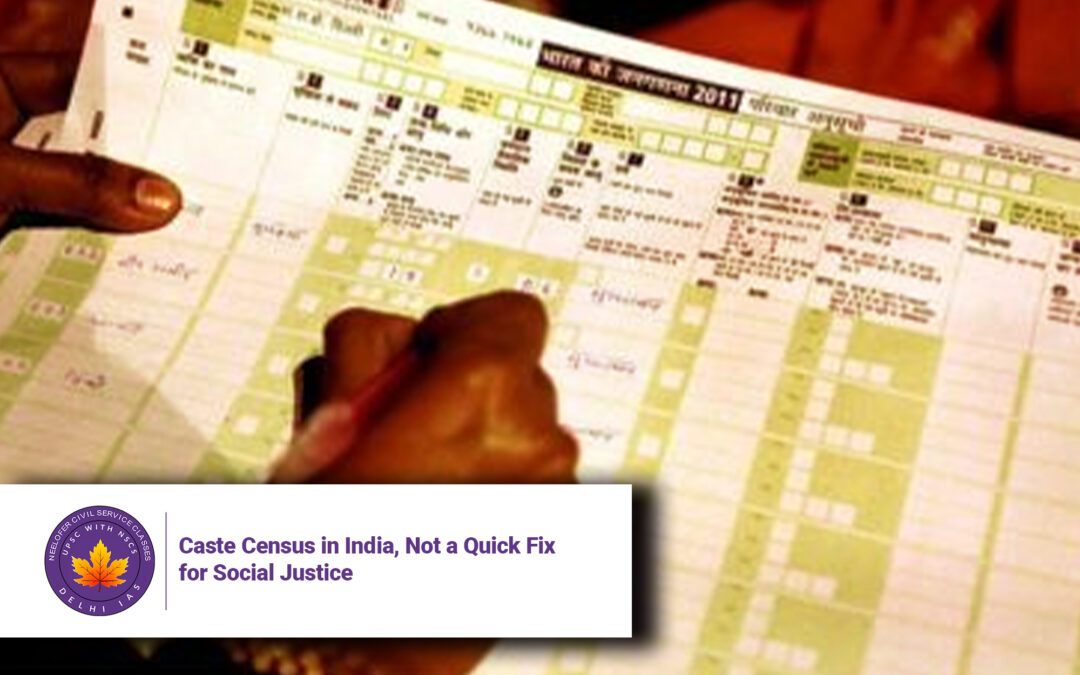
Caste Census in India, Not a Quick Fix for Social Justice
Why in News?
The Narendra Modi government recently announced that the upcoming national census will include caste enumeration. This has sparked major public and academic debate over the role of caste data in achieving social justice and supporting policy reforms, especially for Other Backward Classes (OBCs). Critics argue, however, that simply collecting caste data is not a magic solution for long-standing systemic inequalities. 
Introduction
Census data is crucial for policymaking. It informs the government on important issues like healthcare, education, employment, and housing. The inclusion of caste in the census has been long debated. While the move may help collect data on marginalised groups, experts warn that without strong implementation frameworks, caste data alone won’t lead to justice or equity.
Key Issues and Institutional Concerns
1. Promise vs. Reality of Caste Census
-
Supporters say caste data will offer empirical insight for targeted policymaking.
-
Critics argue that caste enumeration could be misused politically, becoming more of an election tool than a social justice measure.
2. Limitations in Government’s Role
-
The Registrar General of India’s role is to collect and present factual, neutral data, not to direct government action.
-
Elevating the census to a tool for political gains could undermine its objectivity and credibility.
3. Misplaced Emphasis on Enumeration
-
Disproportionate political focus on counting OBCs raises concerns about vote-bank politics.
-
Social and welfare policies need to be based on a blend of data, ground-level engagement, and strong institutions, not just headcounts.
Challenges and the Way Forward
1. Implementation Gaps
-
Many policies—like reservations or land reforms—have failed in the past due to poor execution, not lack of data.
-
Even landmark reforms like the Mandal Commission faced political resistance and limited implementation.
2. Dangers of Politicising Census
-
Turning the census into a political battlefield can threaten its neutrality and administrative efficiency.
-
The caste census should not be seen as a standalone tool to fix deep-rooted structural inequalities.
3. Alternative Data Models Already Exist
-
Past exercises like the Socio-Economic and Caste Census (SECC) and the Bihar Caste Survey already highlight OBC vulnerabilities—poverty, insecurity, and joblessness.
-
Instead of starting afresh, existing data must be used more strategically and effectively.
Conclusion
While a caste census may provide important data, it is not a “silver bullet” for social justice. Without meaningful policy reforms, institutional accountability, and political will, mere enumeration won’t bring real change. Social transformation requires a sustained, long-term effort grounded in both empathy and evidence-based policymaking.
Q&A Section
Q1. What is the purpose of including caste in the upcoming census?
To collect more accurate data on caste groups, particularly OBCs, in order to design better-targeted welfare policies.
Q2. Why are some experts skeptical of the caste census?
They believe it could be used for political manipulation rather than genuine policy reforms, especially in a politically charged environment.
Q3. Has caste data been collected before in India?
Yes. Past exercises like the SECC and Bihar Caste Survey provided rich insights into the socio-economic status of OBCs.
Q4. Why might caste enumeration alone not lead to social justice?
Because deep-rooted problems like poverty and discrimination require effective implementation of policies, not just data collection.
Q5. What alternative approach does the editorial suggest?
It recommends a balanced policy approach using existing data, focusing on implementation, and avoiding politicisation of census operations.

