
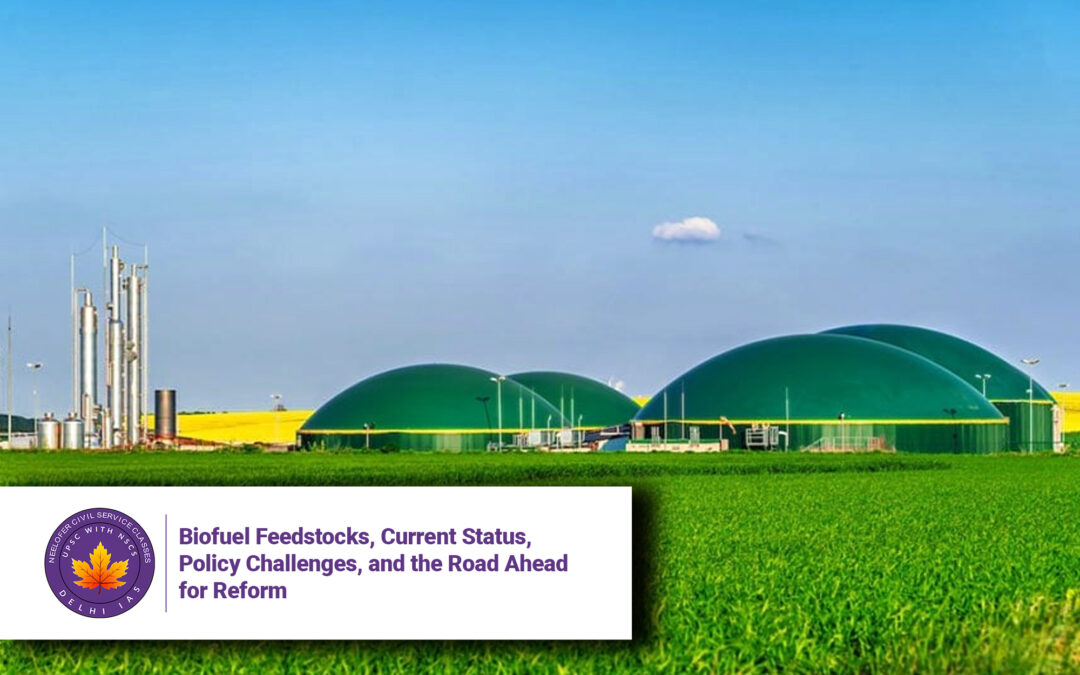
Biofuel Feedstocks, Current Status, Policy Challenges, and the Road Ahead for Reform
By Nutan Kaushik
(Expanded & adapted as a current affairs feature for students, educators, and policymakers)
Introduction: The Global Push for Decarbonisation through Biofuels
In the face of rising global temperatures, energy insecurity, and unsustainable fossil fuel consumption, biofuels have emerged as a cornerstone of the clean energy transition. Offering the potential to drastically reduce emissions in the transportation sector—one of the world’s largest carbon emitters—biofuels are increasingly promoted in both developed and developing nations.
Yet, the biofuel revolution is not without pitfalls. The success of biofuels depends heavily on the feedstocks used (the raw materials from which fuels are made), the policies that regulate production and use, and the sustainability safeguards adopted to protect land, food systems, and biodiversity.
This report investigates the current status of biofuel feedstocks, policy limitations across regions like the United States, European Union, and India, and provides a critical lens on innovation and reform required for biofuels to realize their climate-saving potential.
Understanding Biofuel Feedstocks: The Raw Fuel of the Future
Biofuel feedstocks refer to the raw materials used to produce bioethanol, biodiesel, renewable diesel, and aviation biofuels. Currently, these fall into several categories:
-
First-generation (1G) crops: These include corn, sugarcane, soy, rapeseed, and palm oil—all energy-dense but controversial due to their impact on food security, deforestation, and carbon emissions.
-
Used cooking oil (UCO), waste animal fats, and cellulosic biomass: Considered more sustainable, though limited in availability.
-
Municipal solid waste, agricultural residues, and non-edible crops: Part of the growing pool of advanced or second-generation feedstocks, seen as more climate- and land-friendly.
Despite progress, the International Energy Agency (IEA) reports that supply of sustainable residues and waste feedstocks remains constrained globally, with large-scale use still in early stages due to infrastructure, cost, and technology barriers.
Surging Demand and Emerging Bottlenecks
Global demand for biofuels is expected to grow by 30% between 2023 and 2028, potentially crossing 200 billion liters. This expansion will be driven by:
-
Renewable diesel and sustainable aviation fuel (SAF).
-
Growth markets in the European Union, Brazil, Indonesia, and India.
-
Climate mandates and fuel blending targets.
But here’s the challenge: to meet these ambitious targets, the world will require over 100 million tonnes of feedstock by 2030, creating a widening gap between demand and supply. Diversifying feedstock sources is now not just desirable but essential.
Biofuel Policy in the United States: Stuck in a Cornfield?
The United States’ biofuel strategy hinges on the Renewable Fuel Standard (RFS), launched under the Energy Policy Acts of 2005 and 2007. The RFS mandates blending of up to 36 billion gallons per year by 2022, largely based on corn ethanol and soy biodiesel.
However, the transition to cellulosic ethanol—a more sustainable option—has lagged behind. Why?
-
High production costs
-
Infrastructure issues
-
Regulatory inconsistencies
Recent proposals by the Environmental Protection Agency (EPA) to expand Renewable Identification Number (RIN) targets for advanced biofuels and cut greenhouse gas (GHG) emissions show progress. But challenges persist in bringing waste-derived fuels to commercial scale, and corn-based ethanol still dominates, raising concerns around land use and carbon leakage.
European Union: Sustainability-Centric Reform
Unlike the U.S., the European Union has been more aggressive in its efforts to reform biofuel policy through the Renewable Energy Directive (RED).
-
RED II and now RED III set minimum greenhouse gas reduction thresholds, restrict palm oil and soybean-based biofuels, and favor advanced biofuels made from non-food residues.
-
The EU’s goal is to halve transport-related GHG emissions by 2030 and move toward a carbon-neutral economy by 2050.
These reforms underscore a clear policy shift toward residue- and waste-based fuels, though implementation still faces national-level discrepancies and agri-lobby resistance.
India’s Ethanol Push: From Sugar to Sustainability
India stands out with its aggressive biofuel roadmap. Under the National Policy on Biofuels (2018), and recent policy upgrades:
-
The country achieved 10% ethanol blending in petrol by 2022.
-
It now aims for 20% blending by 2025.
-
Subsidies and procurement guarantees are driving large-scale sugarcane and grain-based ethanol production.
However, India has also initiated efforts to diversify:
-
Launch of non-food feedstocks like straw, algae, and industrial waste.
-
Introduction of 2G ethanol plants using cellulosic feedstocks.
-
Participation in the Global Biofuels Alliance (GBA), launched under its G20 presidency in 2023, aimed at harmonizing standards and boosting innovation.
Amity University and India’s Biofuel Innovation Frontier
Institutes like Amity University are playing a leading role in India’s biofuel research landscape. Their innovations span:
-
Microbial fermentation for lignocellulosic biofuels.
-
Conversion of waste to energy.
-
Advanced enzyme systems for efficient biomass breakdown.
Amity is contributing to India’s mission of clean energy through multidisciplinary R&D, with the goal of commercializing low-carbon biofuels and helping industries transition from fossil-based energy.
Sustainability Risks and the ILUC Challenge
Despite its green image, biofuel production can cause Indirect Land Use Change (ILUC). For instance, forests cleared to grow energy crops (like palm oil) release stored carbon, offsetting climate benefits. Additional challenges include:
-
Water overuse
-
Biodiversity loss
-
Displacement of food crops
Sustainability, therefore, cannot be assumed; it must be built into policy, enforced via monitoring, and strengthened by technology and data transparency.
The Call for Global Biofuel Reform: What Needs to Change?
To unlock biofuels’ full potential while avoiding unintended consequences, several reform priorities are urgent:
-
Stronger sustainability standards: Including ILUC, lifecycle emissions, and land-use monitoring.
-
New technologies: Satellite tracking and blockchain platforms for transparency.
-
R&D investment: In enzymes, feedstock diversification, and next-generation biofuels.
-
Policy incentives: Aligned with circular economy principles and renewable energy goals.
-
Global cooperation: Through platforms like the Global Biofuels Alliance, which now has members from Africa, Latin America, Asia, and Europe.
Conclusion: Aligning Innovation with Action
The promise of biofuels is real—but only if systemic reform accompanies technological innovation. From corn ethanol to algae fuels, from national blending mandates to global partnerships, the biofuels sector is at a tipping point.
Countries like India are showing bold leadership, while universities and private players are innovating at unprecedented levels. Yet, sustainability must remain the guiding principle—or else the solution may become a new problem.
With the right regulatory tools, inclusive policies, and a global push for clean, just, and transparent energy systems, biofuels can help fuel a greener, more resilient future.
Quiz Section: 5 Questions & Answers on Biofuels
| Question | Answer |
|---|---|
| 1. What are biofuel feedstocks and why are they critical in the energy transition? | Feedstocks are raw materials used to produce biofuels, such as corn, sugarcane, used cooking oil, and agricultural residues. They are crucial as they determine the sustainability and scalability of biofuel production. |
| 2. What is ILUC and why is it a concern? | ILUC stands for Indirect Land Use Change, where land use for biofuel crops displaces forests or food crops, causing emissions and food insecurity. |
| 3. What is the Renewable Fuel Standard (RFS) in the United States? | A policy mandating minimum biofuel blending into U.S. transport fuels, introduced in 2005 and 2007, primarily promoting corn-based ethanol. |
| 4. How is India supporting advanced biofuels? | Through policy incentives, ethanol blending targets, 2G ethanol projects, and leadership in the Global Biofuels Alliance (GBA). |
| 5. What reforms are needed to improve global biofuel sustainability? | Lifecycle carbon accounting, land-use monitoring systems, blockchain-based platforms for transparency, stronger R&D investments, and harmonized international standards. |

