
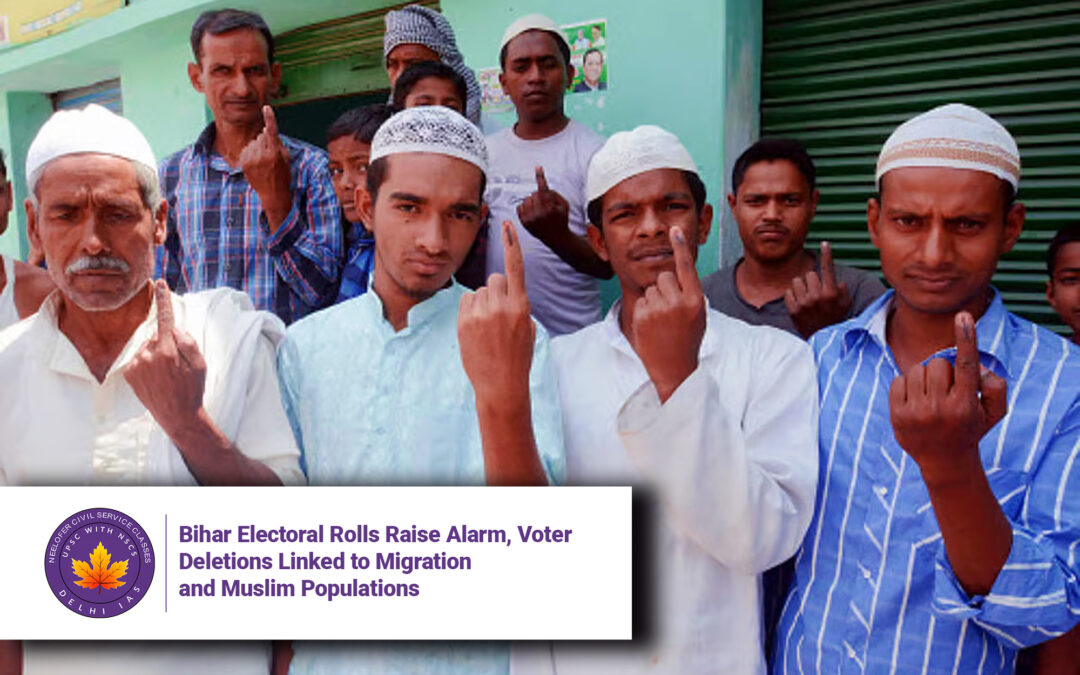
Bihar Electoral Rolls Raise Alarm, Voter Deletions Linked to Migration and Muslim Populations
Introduction
Bihar, one of India’s most populous and politically significant states, is witnessing renewed scrutiny over its voter registration process. The recently released draft electoral rolls, prepared after the completion of the Special Intensive Revision (SIR) exercise, have revealed a troubling pattern of deletions. Over 56 lakh electors were found missing from the August 2024 draft rolls compared to the previous rolls published in January 2024. These figures—released by the Election Commission of India (ECI)—have triggered an outcry from activists, opposition parties, and civil society groups, raising concerns about disenfranchisement, discrimination, and administrative opacity.
This article offers an in-depth analysis of the findings, correlations, and socio-political implications arising from the voter deletion data. At the heart of the issue is a stark question: Is Bihar systematically excluding voters from historically marginalized communities—especially Muslims and Scheduled Castes (SCs)—under the guise of technical revisions?
Overview of the Special Intensive Revision (SIR)
The SIR is an administrative exercise conducted by the ECI to clean up electoral rolls by removing the names of ineligible, duplicate, or deceased voters. While such revisions are routine and necessary to maintain electoral integrity, concerns arise when the methodology and its outcomes disproportionately impact specific communities or regions.
In Bihar’s case, the SIR exercise was completed in early August 2024, and the resulting draft rolls showed a staggering deletion of over 56 lakh voters—about 7.24 crore electors were listed compared to 7.80 crore in January 2024. These figures translate to a reduction of over 7% of the total electorate in just seven months.
Disproportionate Deletions: Key Observations
The analysis published by The Hindu (based on Election Commission data and the 2011 Census) uses statistical charts to uncover correlations between voter deletions and demographic variables like Muslim population, Scheduled Caste population, gender ratios, and migration indices.
Let’s examine these findings in detail:
1. Muslim-Majority Districts See Higher Voter Deletions (Chart 1)
-
Chart 1 shows a positive correlation (Pearson’s r = 0.48) between the percentage of Muslim population in a district and the difference in elector numbers between January and August rolls.
-
This means districts like Kishanganj, Purnia, Araria, and Katihar—which have a high Muslim population share—witnessed greater deletions.
-
These areas saw elector differences ranging from -10% to -15%, which is significantly above the state average.
Implications:
This trend raises red flags about the potential targeted disenfranchisement of Muslims, who make up approximately 17% of Bihar’s population but form majorities in certain districts. Critics argue that such deletions could suppress minority voting power in the upcoming 2024 Lok Sabha elections, especially in constituencies where electoral outcomes are tightly contested.
2. Scheduled Caste-Dominant Districts Show an Opposite Trend (Chart 2)
-
Chart 2 reveals a negative correlation (r = -0.46) between the proportion of Scheduled Castes (SCs) in a district and the percentage drop in elector numbers.
-
Districts with higher SC populations—such as Aurangabad, Nawada, and Gopalganj—saw fewer deletions, in some cases even witnessing net additions to the voter rolls.
Implications:
This suggests that SC-dominated districts were less impacted by the SIR deletions, possibly due to better voter registration or lower migration rates. However, it also raises questions about inconsistencies in how the revision process was applied across districts.
3. Migration’s Role in Deletion Patterns (Chart 4)
-
Chart 4 compares deletion rates against an “out-migration index,” calculated from 2020 poll data.
-
The analysis found a moderate positive correlation (r = 0.40)—districts with higher migration levels experienced greater deletions.
-
For example, Supaul, Madhubani, Purnia, and Bhagalpur showed both high migration and significant voter deletions.
Implications:
This points to a likely administrative explanation—migrant voters not being available for physical verification during the SIR exercise. However, critics argue that no proactive steps were taken to account for seasonal or permanent migration, leading to unjustified deletions.
4. Gender Disparities in Voter Turnout and Registration (Chart 3)
-
Chart 3 examines the ratio of female-to-male electors against the turnout ratio of women to men in the 2024 elections.
-
Some districts—particularly those in Bihar and Jharkhand—show a higher female turnout despite fewer registered female voters.
-
This suggests women are underrepresented in the rolls, possibly due to outdated records, patriarchal norms, or documentation challenges.
Implications:
There is a systemic under-registration of female voters, especially in poorer or more conservative areas. This contributes to lower female-to-male elector ratios, which could be further exacerbated by careless deletions.
The Politics of Voter Deletion
The timing and nature of these deletions have sparked a political storm. Opposition parties, particularly the RJD, Congress, and AIMIM, have accused the BJP-led administration and the Election Commission of engaging in “voter suppression” to influence the outcome of the upcoming 2024 Lok Sabha elections.
Their concerns are rooted in several realities:
-
Muslim-majority districts often vote against the ruling party.
-
Large-scale deletions could swing margins in constituencies where elections are won or lost by a few thousand votes.
-
With no transparent list of deletions or clear methodology published, the process lacks accountability.
The ECI, in response, has stated that the deletions were based on ground verification, death records, and duplicate entries. However, activists demand that the Commission release:
-
District-wise deletion lists
-
Breakdown by age, gender, religion, and caste
-
Reason codes for each deletion
Ground-Level Challenges in Electoral Inclusion
Several structural issues have worsened the disenfranchisement risks:
-
Migration and Informal Workers: Bihar sees millions of seasonal migrants moving to states like Delhi, Punjab, Maharashtra, and Gujarat for work. Many are gone during electoral revisions and are mistakenly assumed to have shifted permanently.
-
Poor Documentation: In Muslim and SC communities, documentation gaps—birth certificates, address proof, etc.—are more common due to poverty and displacement.
-
Gender Bias: Women, especially married ones, often face difficulties transferring voter registration after changing residence.
-
Lack of Awareness: Voters often do not know they have been deleted until election day. Many don’t verify their status due to lack of digital access or knowledge.
Recommendations: Ensuring Electoral Justice
To prevent large-scale disenfranchisement, the following steps are recommended:
1. Transparent Revision Methodology
-
The ECI must publish public deletion lists with reasons and allow objections.
-
Use digital verification tools (like Aadhaar seeding with safeguards) to reduce manual errors.
2. Migrant-Voter Protections
-
Allow postal voting or multiple verification windows for migrant workers.
-
Launch awareness campaigns in high-migration areas before the SIR.
3. Targeted Inclusion Drives
-
Focus voter registration campaigns in Muslim-majority, SC-majority, and high-migration districts.
-
Involve local NGOs, panchayats, and youth volunteers to bridge gaps.
4. Gender Inclusion Audits
-
Monitor female-to-male voter ratios annually.
-
Provide doorstep voter ID services for women in rural and urban slums.
Conclusion: Democracy at Risk
Bihar’s voter roll revision, if left unaddressed, could become a national precedent for exclusionary practices masquerading as administrative housekeeping. While the intent of the SIR exercise—to ensure accurate and clean voter lists—is laudable, its implementation has exposed systemic flaws, including potential bias, apathy, and mismanagement.
With the 2024 elections approaching, voter integrity is not just a technical issue—it is a democratic imperative. The right to vote is the cornerstone of India’s electoral democracy, and every deletion without due diligence is an erosion of that right.
In a state like Bihar—where history, identity, and political voice are tightly interwoven—silencing any community, intentionally or otherwise, can deepen mistrust and sow long-term discontent. It is time for the Election Commission, civil society, and political leaders to act decisively to restore faith in the process and ensure that no eligible voter is left behind.

