
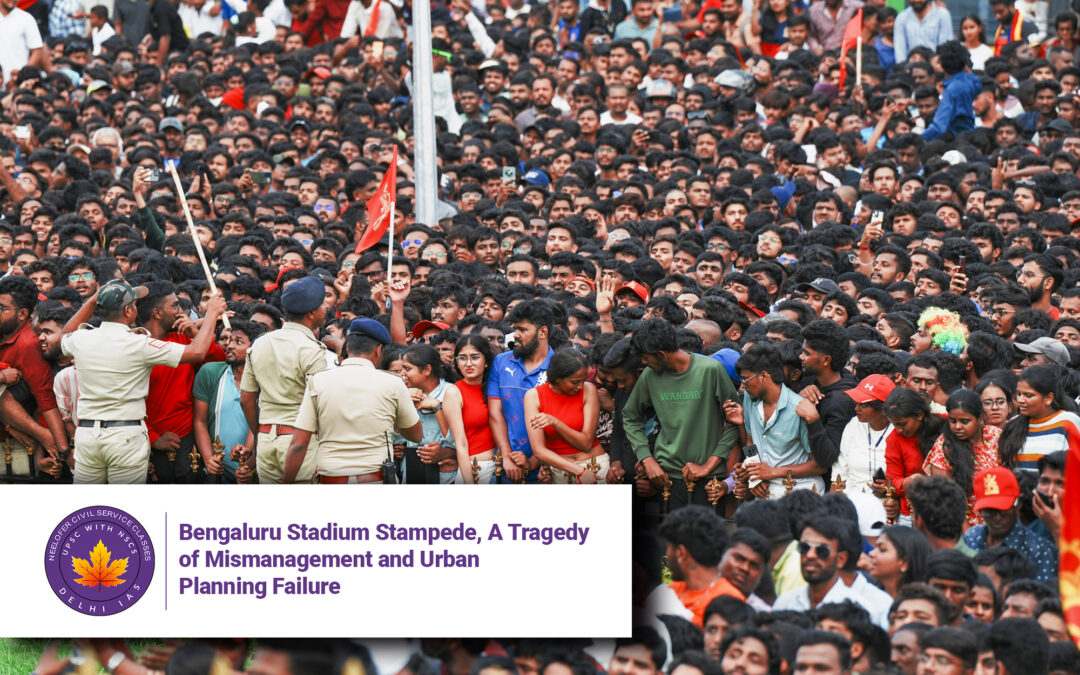
Bengaluru Stadium Stampede, A Tragedy of Mismanagement and Urban Planning Failure
Why in News?
A long-awaited triumph turned into a moment of tragedy for the city of Bengaluru. On June 4, 2025, the city witnessed a catastrophic stampede at the M. Chinnaswamy Stadium during the victory celebrations of Royal Challengers Bengaluru (RCB), following their historic Indian Premier League (IPL) win. The incident led to the deaths of 11 individuals and left 71 others injured. A judicial inquiry conducted by the John Michael D’Cunha Commission has squarely blamed both the RCB management and the Karnataka police for the tragedy, citing poor crowd control and reckless 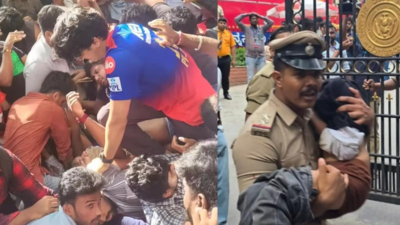 announcements.
Introduction
For decades, cricket fans in Karnataka had hoped to see the Royal Challengers Bengaluru lift the IPL trophy. Their wait finally ended in 2025, with the team securing a memorable win under the legendary Virat Kohli, marking the crowning achievement of his IPL career. The victory was supposed to be a celebration for the ages—a moment of pride for not just the team and the fans, but also the city itself.
However, the celebrations turned fatal due to a stampede that broke out inside the stadium, overshadowing what was meant to be a historic and joyous occasion. The event has now become a case study in poor urban event planning, government oversight failure, and the unchecked risks posed by mass mobilisations in India’s cities.
Background of the Incident
The M. Chinnaswamy Stadium, with a capacity of around 32,000 people, was selected to host RCB’s victory celebrations. The decision followed a public felicitation ceremony of the team by Karnataka Chief Minister Siddaramaiah, held earlier in the day at Vidhana Soudha. The open-air event, attended by thousands, sparked widespread enthusiasm among fans.
To their credit, the police had earlier refused permission for a victory parade on an open bus. However, the excitement from the Vidhana Soudha ceremony spilled over, and an unregulated crowd began to gather at the stadium later in the day. Fuelled by social media announcements and public euphoria, massive crowds moved towards the stadium, hoping to see their cricketing heroes in person.
But as the numbers swelled, disaster loomed. The lack of proper entry regulations, poor crowd control, and reckless announcements created the perfect storm. As per the judicial commission’s report, these missteps directly contributed to the stampede that left families shattered and the city in shock.
Key Issues and Findings from the Inquiry
1. Lack of Crowd Regulation
The judicial commission, led by Justice John Michael D’Cunha, criticized the event organizers for failing to regulate entry gates. The lack of entry control caused thousands to surge forward without any system in place for verifying tickets or managing inflow, leading to a bottleneck at critical access points.
2. Reckless Public Announcements
The commission also noted that reckless announcements encouraged people to enter the already overcrowded stadium. Such communication was not backed by ground assessment or real-time data, leading to dangerous levels of crowd density inside and around the venue.
3. No Medical Backup or Emergency Planning
Despite the scale of the event, there was inadequate medical backup and no robust emergency protocol in place. When the situation spiraled out of control, help was not readily available, further worsening the casualties.
4. Legal and Administrative Failures
The commission has recommended legal action against several named individuals, holding them accountable for negligence. These include RCB’s event management team, police officers in charge, and certain bureaucrats who allowed the event to take place without sufficient preparation.
The Broader Picture: Urban Flash Crowds and the Social Media Effect
Beyond the immediate mismanagement, the stampede also sheds light on a wider urban problem—that of mass mobilization in India’s metros without adequate safeguards.
With the rise of social media, word about events—official or unofficial—spreads like wildfire. In this case, announcements and images from the Vidhana Soudha event created an atmosphere of mass euphoria. Videos of celebrities and players being felicitated were widely circulated online, urging more people to rush toward the stadium in hopes of catching a glimpse of their idols.
This digital virality created an uncontrollable crowd, far exceeding what traditional planning systems could anticipate. Urban planners and local authorities are increasingly unprepared for the scale and unpredictability of such mobilizations, especially in cities already burdened by traffic, limited public space, and aging infrastructure.
Stakeholder Responsibility: Who Should Be Held Accountable?
1. The RCB Management
The organizers, including the RCB franchise and their event planners, failed to coordinate with authorities regarding crowd expectations and logistic requirements. By moving ahead with the stadium celebration without assessing safety protocols, they exposed thousands to life-threatening risk.
2. The Police and Law Enforcement
While the police did restrict the parade route earlier in the day, their failure to prepare adequately for the stadium event remains inexcusable. The inquiry found that there was insufficient deployment of police personnel at key entry and exit points and a lack of coordination with fire and ambulance services.
3. The Karnataka Government
Though the stadium event was not initiated directly by the government, it was endorsed in spirit through the morning’s felicitation ceremony. According to the report, the event had become a “fait accompli”—an inevitable progression from the morning’s activities, which the administration did little to stop. As such, the government shares moral and administrative responsibility for the tragedy.
4. Event Planners and Announcers
Those responsible for making public announcements urging people to attend the stadium celebration must be held accountable for inciting unsafe behavior, especially when they were aware (or should have been aware) of the venue’s limitations.
Lessons Learned: The Need for Urban Event Preparedness
The Bengaluru stampede is not an isolated event. India has witnessed similar tragedies in the past, especially during religious and cultural festivals. From the 2013 Kumbh Mela stampede in Allahabad to numerous temple festival mishaps, a clear pattern of failure in crowd management emerges.
Key lessons from such events include:
-
Mandatory Crowd Forecasting: For large events, authorities must deploy AI or data-driven forecasting tools to predict potential turnout.
-
Pre-event Risk Assessments: No mass gathering should be permitted without a thorough hazard assessment by local disaster management authorities.
-
Emergency Medical Stations: Field hospitals or medical stations must be mandatory at all large venues.
-
Responsible Communication: Public announcements must be regulated and only made by authorized personnel with real-time updates on crowd conditions.
-
Cross-departmental Coordination: Police, fire services, hospitals, civic authorities, and private organizers must work together through a centralized command center.
Public Reactions and Aftermath
The stampede has left citizens outraged, not just over the deaths, but also over how the event was handled and who is being held accountable. Social media is filled with criticism directed at both the RCB franchise and the Karnataka government. Citizens are demanding stricter event regulations and justice for the victims.
Memorials have been held for those who died, with calls for financial compensation and state support for their families. The Karnataka government has announced an ex gratia of ₹10 lakh per victim’s family and promised an overhaul of its event permission process.
The Broader Urban Planning Crisis
The tragedy also points to a larger failure in India’s urban planning ethos. Cities are rapidly expanding, and public spaces are increasingly being used for mass events. However, the planning for these spaces has not evolved in tandem with the growing population, crowd psychology, or social media’s influence.
In this case, despite having a limited capacity of 32,000, the stadium became the focal point for lakhs of people, largely because the city lacked any alternate public celebration space that was equipped for crowd control.
Urban India needs a new policy framework for crowd management, with built-in safety buffers, emergency response zones, and trained personnel equipped to handle spontaneous mobilisations. Just like fire drills in buildings, mass gathering preparedness must become an institutional requirement.
Conclusion
The stampede during the RCB victory celebration was a tragic reminder that good intentions are not enough when it comes to public events. Victory turned into mourning due to a cascading series of failures—lack of foresight, poor planning, unauthorized announcements, and blind enthusiasm.
While the John Michael D’Cunha Commission has placed legal responsibility on event organizers and police, the moral blame lies with multiple stakeholders, including the Karnataka administration, who should have foreseen the risks of a public celebration in a limited-capacity venue.
As India continues to urbanize and celebrate its collective milestones—be it sporting wins, political rallies, or religious festivals—safety must not be compromised for spectacle. This incident must serve as a wake-up call for the entire country to rethink how public events are planned and executed in modern urban spaces.
5 Questions and Answers
Q1: What caused the stampede at M. Chinnaswamy Stadium?
A: The stampede was caused by unregulated entry, reckless public announcements, overcrowding, and lack of emergency preparedness during the RCB victory celebration.
Q2: Who has been held responsible for the incident?
A: The John Michael D’Cunha Commission blamed RCB management, the police, and several other stakeholders for negligence and poor planning.
Q3: What role did the Karnataka government play?
A: While the government didn’t organize the stadium event directly, its involvement in the earlier Vidhana Soudha celebrations and failure to prevent the second event made it partially responsible.
Q4: How could such an incident have been prevented?
A: Through better crowd forecasting, regulated public communication, deployment of medical teams, and coordination between organizers and local authorities.
Q5: What is the broader lesson from this tragedy?
A: Urban planners and administrators must adapt to the realities of mass mobilization in cities, especially when driven by social media and public sentiment, and ensure safety is prioritized over spectacle.

