
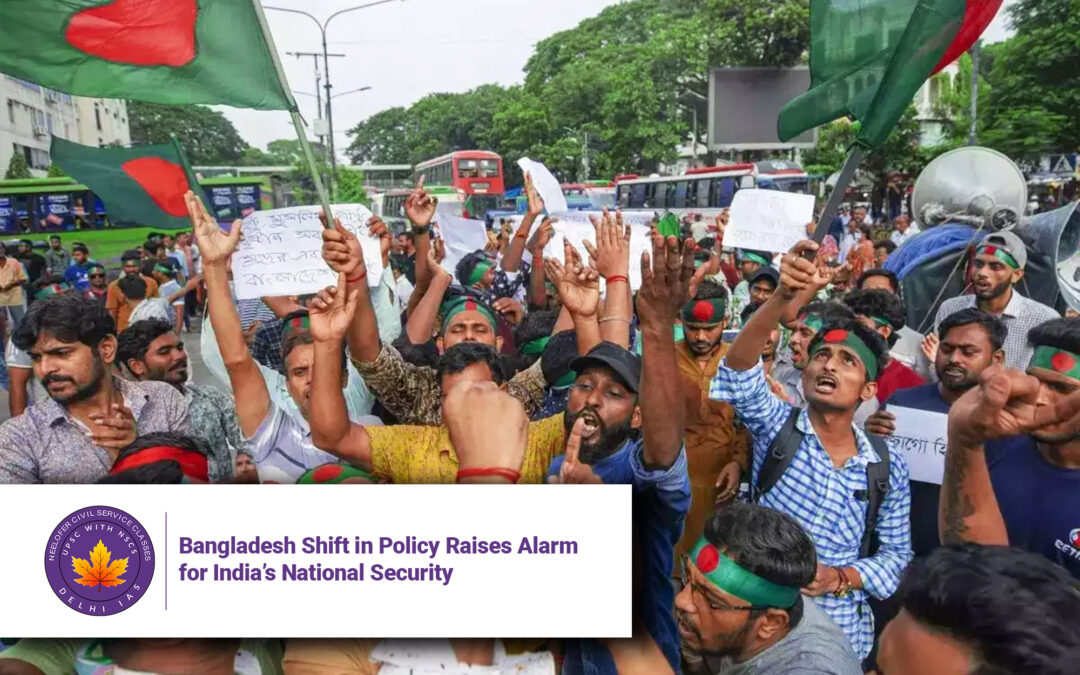
Bangladesh Shift in Policy Raises Alarm for India’s National Security
Why in News?
Recent diplomatic actions by Bangladesh, including granting access to Pakistan’s ISI and cozying up to China, have caused serious concern in India. These developments, coupled with stalled cooperation projects and unclear signals from Dhaka, point to a strategic shift with potential risks to India’s national security. 
Introduction
For over eight months, tensions between India and Bangladesh have escalated, reaching what many consider a point of deliberate provocation. With transshipment privileges revoked, security breaches emerging, and diplomatic coldness growing, India has started taking strong countermeasures.
Key Issues
1. Transshipment Facility Suspended
India decided to suspend the facility that allowed Bangladeshi exports to transit through Delhi and Kolkata airports. Originally introduced in 2020 to help Bangladesh avoid congestion and high costs, this facility saw growing usage — with shipments increasing 64% over four years and saving exporters up to $400 million.
Despite Bangladesh’s claim that congestion is no longer a problem, data shows only 15 trucks used the transshipment route daily — not enough to justify ending the facility. India believes the move has deeper political motives.
2. Security Breach: ISI Access
The most alarming development was Dhaka permitting officials from Pakistan’s Inter-Services Intelligence (ISI) to visit Rangpur, close to the vital Siliguri Corridor that links India’s northeastern states to the rest of the country. ISI has historically been involved in anti-India activities, including terror training and illegal infiltration via Bangladesh.
This move, coupled with the Pakistani High Commissioner’s visit to border areas, has raised serious red flags in Indian intelligence circles.
3. China’s Growing Influence
Bangladesh’s increasing engagement with China is also worrying New Delhi. During a visit to Beijing in March, Chief Adviser Muhammad Yunus praised China’s role in developing North-East India. His speech, which included controversial references, was seen as a strategic message to India — indicating Dhaka’s shift in allegiance.
India’s efforts for a bilateral dialogue have gone unanswered, further deepening mistrust.
4. Political Motives Behind Yunus’ Actions
Muhammad Yunus, who assumed office in April, has shown reluctance towards inclusive elections and democratic reforms. His Home Minister even suggested extending the interim government’s tenure by two more years — a sign of authoritarian tendencies.
This political setup, analysts say, aims to suppress opposition forces like Awami League and prevent BNP leader Tarique Rahman from returning to power.
5. Rising Anti-India Sentiment
The new regime appears to be aligning with anti-India and pro-Islamist factions like Jamaat-e-Islami. Online influencers and bloggers are driving anti-election narratives and promoting hostility toward India, likely with government backing.
Challenges and the Way Forward
-
Restoring Trust: India must engage diplomatically while firming up border and cyber security.
-
Monitoring China-Pak Axis: Strategic intelligence gathering and regional cooperation must be enhanced.
-
Encouraging Democratic Transition: Global pressure on Dhaka to hold fair elections is essential to ensuring long-term peace.
-
Leveraging Regional Forums: India can use platforms like BIMSTEC and BBIN to isolate hostile policies.
-
Secure Connectivity: The Siliguri Corridor must be safeguarded through military and infrastructural reinforcements.
Conclusion
Dhaka’s recent policy maneuvers, from engaging Pakistan’s ISI to cozying up with China, are not mere diplomatic shifts — they represent a deliberate attempt to redefine Bangladesh’s regional posture. For India, these actions pose immediate security risks and demand a calibrated but firm response. Trust, once lost, is hard to rebuild — and Delhi appears ready to draw the red lines.
5 Q&A on India-Bangladesh Tensions
Q1: Why did India suspend the transshipment facility for Bangladesh?
India suspended the service citing national security concerns, especially after Dhaka allowed Pakistani ISI access near sensitive Indian corridors. The official reason given by Bangladesh — that congestion has eased — was unconvincing.
Q2: What is the significance of the Siliguri Corridor?
Often called the “Chicken’s Neck,” it is a narrow strip of land connecting mainland India to its northeastern states. Its security is vital for India’s territorial integrity.
Q3: Why is the presence of Pakistan’s ISI in Bangladesh alarming?
The ISI has a long history of promoting terrorism and destabilizing activities in India. Its access near Indian borders raises fears of coordinated subversive efforts.
Q4: How is China influencing Bangladesh?
Through strategic investments and diplomatic charm, China is luring Bangladesh into its fold. Yunus’ recent visit to Beijing and his public statements indicate a growing alignment with Chinese interests.
Q5: What are the implications for regional stability?
If Bangladesh continues to alienate India while embracing China and Pakistan, it could destabilize the region — economically, politically, and in terms of security. A democratic vacuum in Dhaka may further worsen the situation.
