
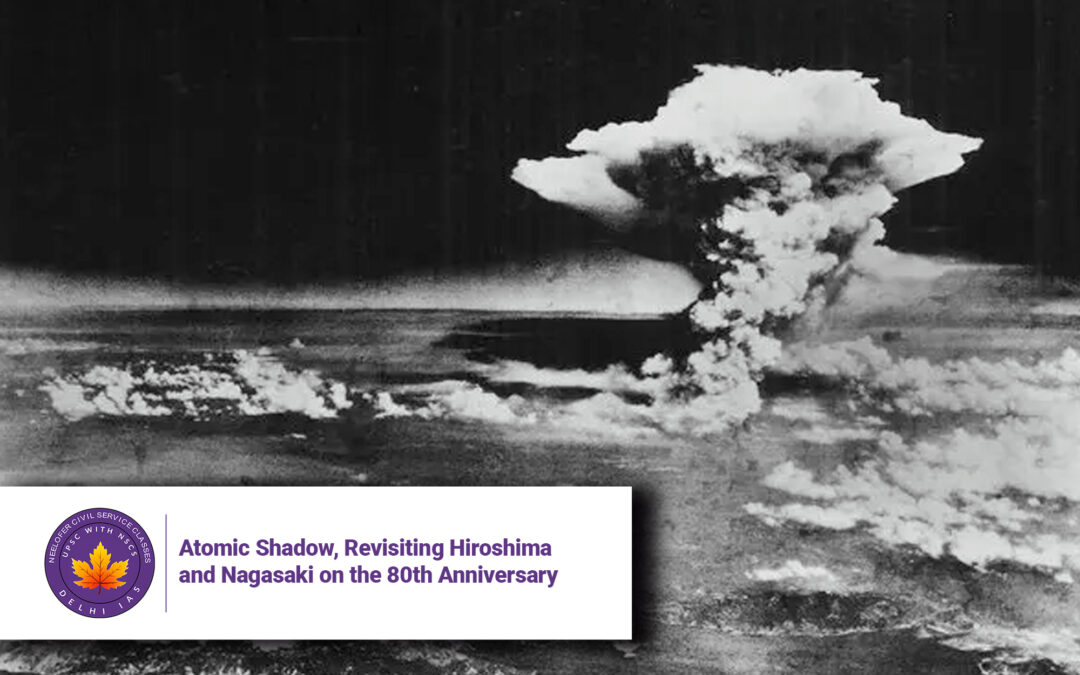
Atomic Shadow, Revisiting Hiroshima and Nagasaki on the 80th Anniversary
Introduction
On August 6 and 9, 1945, the United States dropped atomic bombs on the Japanese cities of Hiroshima and Nagasaki, respectively. These remain the only wartime nuclear strikes in human history, claiming over 200,000 lives, leveling entire neighborhoods, and ushering in the nuclear age. As the world reflects on the 80th anniversary, questions about historical memory, strategic deterrence, and nuclear ethics remain deeply resonant.
In a curious return to education, many newspapers and platforms mark the occasion by posing quiz-style questions—recalling bomb names, research programmes, survivor terminology, and wartime secrecy. These memory prompts offer both commemoration and a lens for understanding how atomic warfare shaped international norms and strategic thinking.
This article revisits the bombings’ history, the scientific programs behind them, and what they mean today, concluding with five quiz Q&A analogous to the ones published.
Hiroshima and Nagasaki: The Atomic Blasts
-
Hiroshima: On August 6, 1945, the B‑29 bomber Enola Gay dropped the uranium bomb “Little Boy”. It exploded at about 580 meters above the city, releasing explosive force equivalent to ~15 kilotons of TNT. Immediate deaths numbered around 70,000, with total fatalities rising to 140,000 by the end of the year due to injuries and radiation.
-
Nagasaki: On August 9, another B‑29, Bockscar, released the plutonium bomb “Fat Man” over Nagasaki. Though Nagasaki wasn’t the original target, its valley geography amplified destruction. Instant fatalities hit approximately 40,000, with total deaths reaching about 70,000 by year’s end.
The bombings forced Japan to surrender on August 15, ending World War II. Historians still debate whether the bombs expedited surrender or if Japan was nearing collapse already.
The Manhattan Project: From Theory to Bomb
The atomic bomb was the culmination of the Manhattan Project—the code name for the United States’ World War II programme to develop nuclear weapons. Launched in 1942, it combined efforts from institutes such as Los Alamos, Oak Ridge, and Hanford, and employed over 130,000 people. Its success was based on breakthroughs in physics (Einstein, Fermi, Oppenheimer) and industrial-scale production to separate uranium-235 and produce plutonium.
The Manhattan Project delivered “Little Boy,” a uranium-based bomb, and “Fat Man,” based on plutonium implosion, within a remarkably short period. The first test—Trinity—was conducted on July 16, 1945, in New Mexico, just weeks before the Hiroshima attack.
The Franck Report and Secret Dissent
Behind the scenes, a group of Manhattan Project scientists submitted the Franck Report (June 1945), warning that using atomic weapons on Japanese cities could prompt a global nuclear arms race and damage the U.S.’s moral standing. They proposed a demonstration in an uninhabited area instead. The memo was ignored by the U.S. government amid pressures to end the war quickly.
“Hibakusha” – The Survivors
The Japanese term “hibakusha” refers to the survivors of the atomic bombings—literally “explosion-affected persons.” These individuals continue to suffer from physical trauma, radiation-induced illnesses, and social stigma. The hibakusha movement has played a vital role in global nuclear advocacy, championing non‑proliferation and peace-building.
Strategic and Ethical Reflections
-
Deterrence: The bombings introduced nuclear deterrence—whereby possessing nuclear weapons is believed to prevent great-power conflict. The Cold War arms race (U.S./Soviet Union) was built around mutually assured destruction.
-
Legal and moral debate: Critics argue the bombings targeted civilians indiscriminately. International law principles like proportionality and distinction between combatants and non-combatants continue to be debated.
-
Nuclear proliferation: Post-war, several nations (Soviet Union, UK, France, China, India, Pakistan, North Korea) acquired nuclear arsenals. Today, nine countries hold nuclear weapons, and the threat of unauthorized use or accidental launch persists.
-
Nuclear taboo: Since 1945, no nuclear weapon has been used in conflict. This taboo is sustained by diplomacy, the Non‑Proliferation Treaty (NPT), and civil society movements.
Contemporary Lessons
-
Nuclear prohibition efforts: New efforts like the Treaty on the Prohibition of Nuclear Weapons (TPNW) aim to stigmatize and outlaw all nuclear arsenals.
-
South Asia flashpoints: The India‑Pakistan nukes standoff remains fragile, especially after incidents like the 1999 Kargil conflict and 2001 Parliament attack.
-
Technological escalation: Emerging threats include hypersonic missiles, cyber-warfare, and AI integration into nuclear command systems.
-
Civil society’s voice: Hibakusha testimonies, disarmament conferences, and academic discourse continue to shape public opinion on nuclear risks.
Why Quiz Questions about Hiroshima and Nagasaki Matter
Quizzes on atomic history serve three functions:
-
Commemoration: Reinforces collective memory of the worst single atrocity of nuclear warfare.
-
Education: Encourages understanding of key historical, scientific, moral, and geopolitical dimensions.
-
Reflection: Encourages citizens to question the role of nuclear weapons in today’s world—deterrent, risk, or moral failure?
Quiz: Five Questions & Answers
| Question | Answer |
|---|---|
| 1. What are the names of the two types of atomic bombs dropped on Hiroshima and Nagasaki? | Little Boy (uranium bomb) and Fat Man (plutonium bomb). |
| 2. What research programme was undertaken during World War II to produce the bombs? | The Manhattan Project. |
| 3. What was the Franck Report? | A memo by Manhattan Project scientists warning against use of atomic bombs on civilian targets and urging a demonstration instead. |
| 4. What was the secret agreement between the UK and the U.S. signed by Churchill and Roosevelt to coordinate nuclear weapon development? | The Quebec Agreement (1943), followed by the Combined Policy Committee and Los Alamos coordination. |
| 5. What is the Japanese term used to define a “bombing survivor” or “person affected by exposure to radioactivity”? | Hibakusha. |
Conclusion
Eighty years later, the shadows of Hiroshima and Nagasaki still grip global consciousness. They serve as a stark warning of how quickly humanity can cross moral and existential boundaries under wartime urgency. As geopolitical tensions evolve and nuclear technology proliferates, remembering that history is not just about the past—but a guide for future responsibility—is increasingly vital.

