
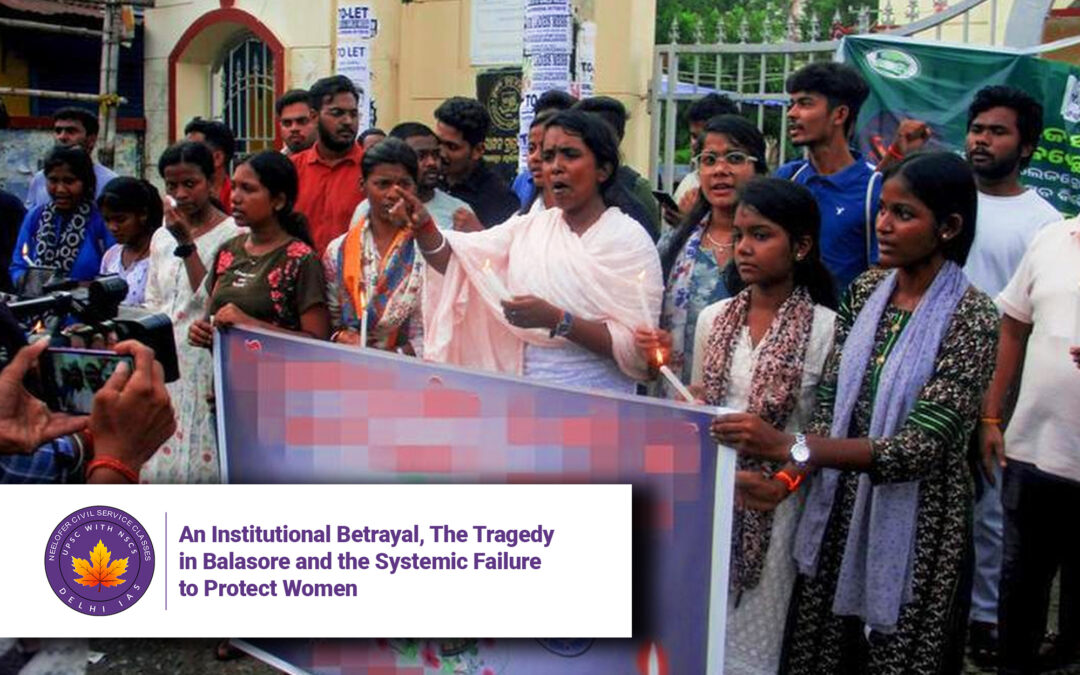
An Institutional Betrayal, The Tragedy in Balasore and the Systemic Failure to Protect Women
Why in News? 
A tragic incident in Balasore, Odisha, has reignited a national debate on the enforcement and effectiveness of sexual harassment laws in educational institutions. A 19-year-old Bachelor of Education (B.Ed) student set herself on fire in her college hostel after being sexually harassed by a professor and head of her department. With 90% burns, she battled for three days before succumbing to her injuries. The incident has been described by many as not just a personal tragedy but a systemic failure—a betrayal by the very institutions meant to protect and empower young women.
Introduction
India has witnessed multiple tragic incidents related to gender-based violence, but each new case adds to a growing sense of institutional decay. Despite having robust legal frameworks like the Prevention of Sexual Harassment at Workplace Act (POSH), 2013, implementation remains deeply flawed. The Balasore incident is not an isolated event; it reflects an alarming pattern of inaction, insensitivity, and silence that surrounds the complaints of women in educational and professional environments.
This case underscores the widening gap between legal provisions and their actual enforcement. It forces us to confront not only the failure of the law but also the complicity of those who are supposed to enforce it—teachers, administrators, the Internal Complaints Committee (ICC), law enforcement, and society at large.
What Happened in Balasore?
A young B.Ed student in a quiet district of Odisha took the extreme step of self-immolation in her college hostel. Her death was not just the result of sexual harassment; it was also the culmination of repeated systemic failures:
-
The Allegation: The student had been sexually harassed by a professor who also headed her department. This person, in a position of power and responsibility, allegedly abused that power instead of using it to protect and nurture.
-
The Complaint: The survivor had lodged a formal complaint, and her statement was recorded while she lay in the hospital bed. However, institutional response was lethargic and weak.
-
Delayed Action: Only after the incident escalated did the principal face arrest, and only then were the professor and other authorities suspended. Had swift and decisive action been taken when the complaint was first filed, her death might have been prevented.
Institutional Betrayal and Systemic Complicity
The tragedy is more than a personal loss; it is a damning indictment of institutional failure:
-
Failure of the ICC: The Internal Complaints Committee, a statutory body under the POSH Act, is supposed to be the first line of defense against sexual harassment. In this case, the ICC either failed to act or was entirely absent in addressing the victim’s complaints.
-
Administrative Apathy: The college administration delayed action and, by doing so, sent a message that complaints would not be taken seriously unless they became a public spectacle.
-
Law Enforcement Inertia: As with many such cases, the police were reactive rather than proactive. Arrests were made only after public outcry.
-
Societal Silence: Sexual harassment is often trivialized or ignored. Victims are routinely told to “stay quiet,” to “adjust,” or to “ignore it” for fear of stigma, retaliation, or damage to reputation.
Legal Provisions and Their Limitations
The Prevention of Sexual Harassment (POSH) Act, 2013, was hailed as a landmark reform in the aftermath of the 2012 Nirbhaya case. Key provisions include:
-
Section 9: Any woman, including students, can file a complaint within three months of the incident.
-
Section 4: Every institution is required to set up an ICC to inquire into complaints and maintain confidentiality.
-
Section 13: Strict penalties for those found guilty, and accountability mechanisms for institutions that fail to act.
Yet, implementation remains patchy at best. Many colleges treat the ICC as a formality or a checkbox, focusing more on paperwork than justice. There is inadequate training, low awareness, and no real mechanisms to ensure enforcement.
A Culture of Silence and Stigma
Society’s response to sexual harassment often reinforces a culture of silence:
-
Victim-Blaming: When a woman speaks out, she risks ridicule, isolation, and being labeled a troublemaker. This social reaction deters many from coming forward.
-
Institutional Gaslighting: Complaints are dismissed as “exaggerated,” “misunderstood,” or “emotional outbursts.” In many cases, the complainant is blamed for “tolerating it for too long.”
-
Lack of Empathy: Institutions, including ICCs and administrative bodies, often fail to approach these issues with the required sensitivity and urgency.
Women and the Cost of Speaking Out
As Pinky Anand, senior advocate and former Additional Solicitor General of India, points out in her column, every time a woman speaks up, she risks not just her career but her entire identity:
-
She may be isolated socially.
-
She may be academically penalized.
-
She faces the burden of proof in an environment that is already hostile.
This cost of speaking out is so high that many women choose silence over justice. The student in Balasore likely felt that no one would listen unless she made the ultimate sacrifice. And tragically, she was right.
What Needs to Change?
1. Reforming ICCs
-
ICCs must be made independent, gender-sensitive, and well-trained.
-
Members should undergo regular training and be selected based on competence and empathy.
-
There must be third-party audits to assess the ICC’s performance.
2. Fixing Accountability
-
Educational institutions must be held legally accountable for ignoring or mishandling complaints.
-
Administrative heads who delay or dismiss cases should face disciplinary action.
-
State governments should publish annual compliance reports on ICCs in colleges and universities.
3. Law Enforcement Training
-
Police officials must be sensitized to handle gender-based crimes with urgency and empathy.
-
Fast-track mechanisms must be activated in such cases to avoid delays in justice.
4. Cultural Transformation
-
Education systems should introduce gender sensitization programs.
-
Anti-harassment policies must be communicated clearly to every student and faculty member.
-
Peer support groups and anonymous reporting mechanisms should be established.
5. Media and Civil Society Role
-
Media must cover such cases responsibly, focusing on systemic issues rather than sensationalism.
-
NGOs and advocacy groups must work with institutions to monitor and support survivors.
Conclusion
The Balasore incident is not a standalone tragedy; it is a mirror reflecting the collective failure of our educational institutions, legal systems, and societal values. Despite laws and mechanisms in place, justice remains elusive for many women because the very institutions designed to protect them often end up betraying them.
As Pinky Anand rightly states, sexual harassment is not a “misunderstanding” or “sensitivity issue”—it is violence. And until we recognize it as such and respond with urgency and empathy, more lives will be lost—not just to fire, but to silence, isolation, and despair.
This case should be a turning point. Not just to punish the guilty, but to demand reform. Not just to feel anguish, but to ensure action. The young woman in Balasore should not have had to set herself ablaze for people to pay attention. But she did. And now, we must carry the weight of her silence and transform it into a movement for justice.
Q&A Section
Q1. What was the triggering incident in Balasore, Odisha?
A 19-year-old B.Ed student set herself on fire after allegedly being sexually harassed by a professor who also served as the head of her department. She succumbed to her injuries after three days.
Q2. What systemic failures are highlighted by this case?
Failure of the ICC, administrative apathy, lack of swift police action, and societal insensitivity all contributed to the tragedy.
Q3. What does the POSH Act 2013 mandate?
It requires all institutions to set up an ICC to handle complaints of sexual harassment fairly, confidentially, and swiftly. It allows women to file complaints within three months of the incident.
Q4. What cultural issues contribute to such tragedies?
A culture of silence, victim-blaming, and trivialization of harassment often deters women from reporting. Institutions sometimes dismiss genuine complaints as exaggerations.
Q5. What reforms are necessary?
Strengthening ICCs, holding institutions accountable, training law enforcement, cultural sensitization, and better media coverage are key steps.

