
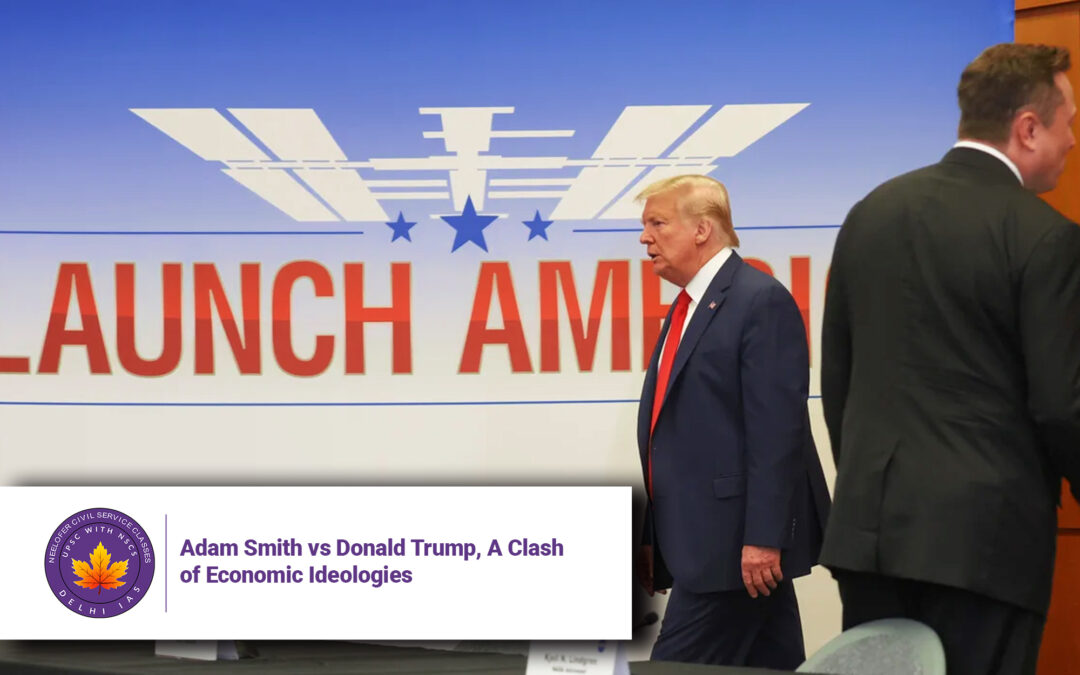
Adam Smith vs Donald Trump, A Clash of Economic Ideologies
Why in News
The year marks the 250th anniversary of Adam Smith’s groundbreaking work The Wealth of Nations (1776), widely considered the foundation of modern economics. Smith, regarded as the “father of modern economics,” championed the idea of free markets, minimal government intervention, and the freedom for individuals to produce, trade, and innovate for greater prosperity. However, these classical free-trade principles stand in sharp contrast to the economic policies pursued by former US President Donald Trump, particularly his reliance on tariffs as a strategic economic tool.
Trump’s economic policies, especially his aggressive use of tariffs during his presidency, reignited debates about the role of protectionism in a modern, globalized economy. This renewed discussion has placed Adam Smith’s free-trade philosophy in direct ideological conflict with Trump’s America-first, tariff-driven agenda.
Introduction
Adam Smith’s philosophy was rooted in the belief that individuals pursuing their own interests, within a framework of open competition, would collectively promote economic prosperity and efficiency. He argued that free trade between nations encouraged innovation, efficiency, and mutual benefit — a principle that has guided much of the modern global economic order.
In contrast, Donald Trump’s economic vision during his presidency leaned heavily towards protectionism. He frequently referred to tariffs as the “most beautiful word in the dictionary,” citing them as a means to protect American industries, jobs, and national security. This approach often harkened back to the early 20th century, when tariffs played a central role in shaping economic policy.
Trump’s trade policies triggered debates about whether his approach represented a necessary corrective to the downsides of globalization or a step backward toward economic isolationism.
Key Issues and Background
The Return of Tariffs in US Policy
During his tenure, Trump implemented tariffs at a scale not seen since the 1930s. These included high tariffs on imports from China, Mexico, and the European Union, leading to retaliatory measures from these trading partners. Trump’s administration justified such tariffs as part of a broader strategy to reduce the US trade deficit and bring manufacturing jobs back to American soil.
Historically, the US had moved away from such protectionism after the disastrous Smoot-Hawley Tariff Act of 1930, which worsened the Great Depression by inviting retaliatory tariffs from other nations. Post-World War II, the US led the push for global free trade through institutions like the GATT (General Agreement on Tariffs and Trade) and later the WTO (World Trade Organization).
However, Trump broke from this tradition, suggesting that high tariffs could be used as a negotiating tactic to extract concessions from other nations — essentially using trade policy as leverage in a geopolitical chess game.
Economic Rationale vs. Economic Criticism
Supporters of Trump’s tariffs argue that decades of free trade had hollowed out America’s industrial base, leading to job losses, wage stagnation, and dependency on imports. In their view, tariffs protect key industries, level the playing field against countries that engage in unfair trade practices, and strengthen national security.
Critics, however, argue that tariffs function as a tax on consumers, raising prices on imported goods and harming industries that rely on global supply chains. Nobel laureate economists like Joseph Stiglitz and Paul Krugman have criticized Trump’s tariff strategy, warning that such policies create uncertainty, discourage investment, and ultimately undermine economic growth.
Krugman noted that tariffs send a signal to businesses that the trade environment is unstable, prompting them to postpone investments. In the long run, this could slow innovation and diminish America’s competitiveness in the global market.
Specific Impacts or Effects
-
Impact on Trade Deficit
Trump aimed to reduce the US trade deficit through tariffs, but the results were mixed. While some domestic industries saw temporary boosts, the overall trade deficit did not shrink significantly during his presidency. -
Impact on Jobs and Manufacturing
Some manufacturing sectors, such as steel and aluminum, benefited from protective tariffs. However, industries dependent on imported components, such as automobile manufacturing, faced higher costs. -
Impact on International Relations
Tariffs strained relationships with key allies and trading partners. Countries like China, Canada, and Mexico retaliated with their own tariffs, affecting American exporters, particularly in agriculture. -
Impact on Consumers
Prices of many consumer goods rose due to tariffs on imports, effectively functioning as an indirect tax on American households. -
Impact on Global Trade Norms
Trump’s actions challenged decades of consensus on free trade, raising questions about the future role of the US in the global economic order.
Challenges and the Way Forward
For the US
The Biden administration has maintained some of Trump’s tariffs, suggesting that concerns about unfair trade practices, especially from China, transcend partisan politics. However, a return to full-scale protectionism could undermine America’s leadership in the global economy. The challenge lies in balancing domestic industrial revival with international trade commitments.
For the Global Economy
If the US, the world’s largest economy, continues to embrace protectionist policies, it could embolden other nations to follow suit, potentially leading to a fragmentation of the global trading system. This would reverse decades of progress toward economic integration and cooperation.
For Policy Thinkers
The contrast between Adam Smith’s vision and Trump’s approach highlights the enduring tension between free trade and protectionism. Policymakers must consider whether tariffs should be used sparingly as a strategic tool or embraced as a central pillar of economic policy.
Conclusion
The clash between Adam Smith’s free-market ideals and Donald Trump’s protectionist tactics is more than just a theoretical debate — it reflects real-world tensions in a global economy facing rapid technological change, geopolitical rivalry, and domestic political pressures.
As the world marks the 250th anniversary of The Wealth of Nations, the relevance of Smith’s principles is being tested against the backdrop of rising nationalism and skepticism toward globalization. The key question is whether the global economic system can adapt to new realities without abandoning the foundational benefits of free trade.
The coming years will reveal whether the US charts a course back toward Adam Smith’s vision of open markets or continues along the protectionist path set by Trump. The outcome will have profound implications not only for the US economy but for the stability and prosperity of the global trading system.
5 Questions & Answers
Q1. What is the significance of Adam Smith’s The Wealth of Nations in modern economics?
A1. Adam Smith’s The Wealth of Nations, published in 1776, laid the foundation for classical economics. It advocates for free markets, minimal government intervention, and the idea that competition and self-interest drive economic prosperity.
Q2. How did Donald Trump’s trade policy differ from traditional US economic policy?
A2. Unlike the post-WWII US commitment to free trade, Trump embraced protectionism through high tariffs on imports, aiming to protect domestic industries, reduce trade deficits, and use tariffs as leverage in trade negotiations.
Q3. What are the main criticisms of Trump’s tariff policy?
A3. Critics argue that tariffs increase costs for consumers, disrupt global supply chains, and create uncertainty that discourages investment. They also note that retaliatory tariffs from other countries harm US exporters.
Q4. Did Trump’s tariffs achieve their goal of reducing the US trade deficit?
A4. The results were mixed. While some industries benefited temporarily, the overall trade deficit did not significantly decrease, and many sectors faced higher costs.
Q5. What are the potential global consequences if the US continues with protectionist policies?
A5. Prolonged US protectionism could encourage other nations to adopt similar policies, leading to a fragmented global trade system, reduced economic cooperation, and slower global growth.

