
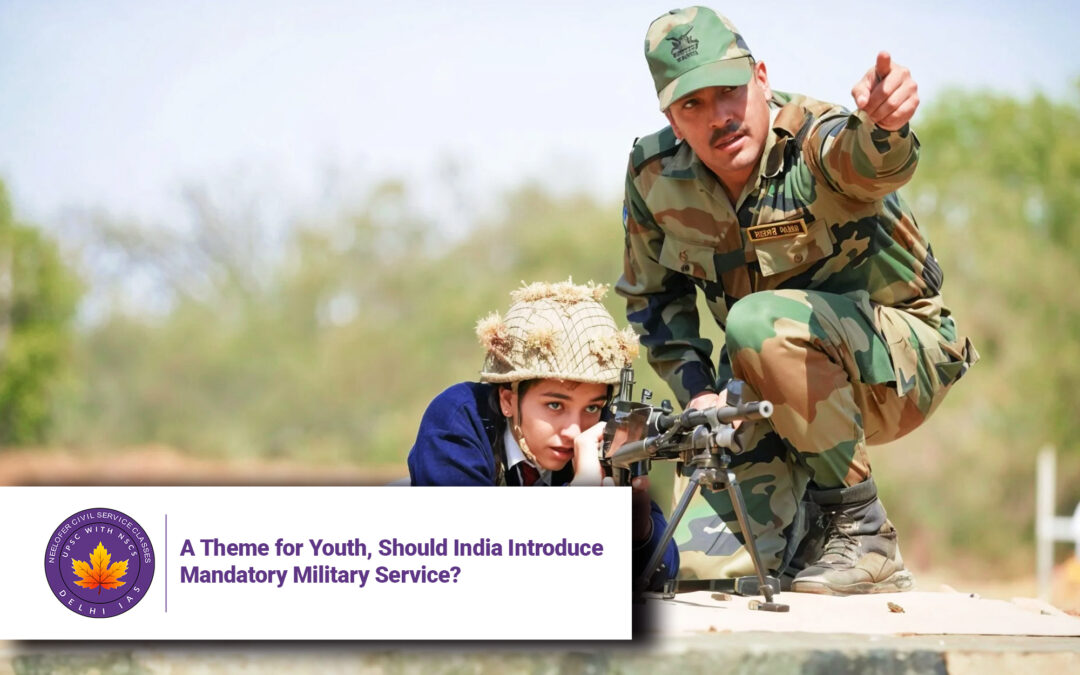
A Theme for Youth, Should India Introduce Mandatory Military Service?
Why in News?
As India prepares to celebrate its 79th Independence Day, the idea of instilling greater discipline, resilience, and patriotism among its youth has resurfaced. Inspired by countries like Israel, where military service is universal, policymakers and thinkers are proposing two significant reforms: lowering the voting age to 16 and introducing mandatory military service for all youth under the age of 25.
The discussion gains momentum in the backdrop of Prime Minister Narendra Modi’s Mann Ki Baat and public calls for citizens to contribute ideas for his Independence Day speech. While the idea has been debated before, the present socio-political climate, rising global uncertainties, and the need for stronger civic engagement make it particularly relevant now.
Introduction
One of Prime Minister Narendra Modi’s enduring leadership qualities is his willingness to seek citizen input through platforms like Mann Ki Baat. Such engagement is rare among world leaders and reflects India’s democratic strength.
Ahead of Independence Day, the Prime Minister invited public suggestions for his speech from the Red Fort. However, with a large volume of submissions, distilling them into actionable themes is challenging.
Two proposals stand out in this context:
-
Lowering the voting age from 18 to 16
-
Introducing mandatory military service for all youth under 25
These reforms aim to empower young Indians, enhance civic participation, and create a disciplined and resilient citizenry.
Lowering the Voting Age to 16
India has a tradition of recognising the maturity of its youth. The voting age was reduced from 21 to 18 through the 61st Constitutional Amendment Act, 1988, based on the belief that young people were “literate and enlightened” enough to participate in democracy.
The same reasoning could apply today for 16- and 17-year-olds, who are better informed and politically aware, largely due to digital access and social media.
Research shows that individuals who start voting early, while still in a structured environment such as school, are more likely to become lifelong voters. Early participation builds habits of civic engagement, which strengthens democracy over time.
Countries like Austria, Brazil, and Argentina have already lowered their voting age to 16. The UK is moving towards this in local elections.
In India, the 16–17 age group accounts for about 50 million people within a total population of 1.46 billion. Allowing them to vote would be a powerful sign of trust in youth and would encourage political parties to take youth issues more seriously—such as climate change, education, employment, and technology.
Mandatory Military Service: A Nation-Building Step
Alongside lowering the voting age, the proposal to introduce mandatory military service for youth under 25 is seen as a way to instil discipline, survival skills, patriotism, and respect for the defence forces.
India often looks to Israel as a role model in resisting terrorism—a resilience that stems from its universal military service policy. In Israel, men serve for about 32 months and women for about 24 months.
Mandatory service could give Indian youth the training needed to respond to natural disasters, emergencies, and national security threats. It would also build teamwork, problem-solving abilities, and leadership skills, while strengthening physical and mental fitness.
Global Examples of Mandatory Service
Several countries already practise some form of mandatory military or national service:
-
Brazil – All men aged 18 must serve for 10–12 months.
-
Finland – All male citizens must serve 6–12 months.
-
Greece – Men serve 9–12 months.
-
Russia – Men aged 18–27 serve 12 months.
-
Switzerland – All able-bodied men must serve, starting with training and recurring service.
-
Taiwan – Men serve at least one year.
-
South Korea – All able-bodied men serve for 18–21 months.
-
Norway – Both men and women serve in a gender-neutral system.
-
Sweden – Reintroduced conscription in 2017 for both sexes.
These examples show that national service can be applied across different political systems and cultures, always with the aim of building resilience and unity.
Potential Benefits for India
If implemented effectively, mandatory military service could:
-
Create a trained reserve force for emergencies.
-
Reduce gender discrimination by training men and women equally.
-
Build physical and mental resilience among youth.
-
Enhance national unity by integrating people from diverse regions and backgrounds.
-
Strengthen the country’s readiness for crises.
This reform could also foster a shared sense of purpose and national duty, contributing to the idea of a stronger, more self-reliant India.
Challenges and Considerations
While the idea is appealing, implementation would require careful planning:
-
Infrastructure – Training facilities, accommodation, and instructors would need to be scaled up.
-
Funding – A one-year programme for millions of young people would require significant budget allocation.
-
Social Impact – Disruptions to education and career plans must be addressed.
-
Exemptions – Clear rules for medical or personal exemptions would be necessary.
-
Political Consensus – Wide agreement among states and political parties is essential.
Conclusion
Mandatory military service, combined with lowering the voting age to 16, could mark a historic shift in India’s approach to youth empowerment. It would not only prepare young citizens to meet the challenges of the future but also embed a deeper sense of responsibility and national pride.
In the Amrit Kaal leading up to India’s centenary in 2047, these reforms could help shape a generation with the discipline, skills, and unity required for a strong and prosperous nation.
Q&A Section
Q1. What two major reforms are being proposed for India’s youth?
A. Lowering the voting age to 16 and introducing mandatory military service for all youth under 25.
Q2. Why is Israel often cited as a model for mandatory military service?
A. Israel’s resilience against terrorism and national unity are largely credited to its universal military service, where men serve 32 months and women serve 24 months.
Q3. Which countries already practise mandatory military or national service?
A. Countries include Brazil, Finland, Greece, Russia, Switzerland, Taiwan, South Korea, Norway, and Sweden, among others.
Q4. What are some potential benefits of mandatory military service in India?
A. It could build discipline, physical and mental resilience, gender equality, national unity, and provide a trained reserve force for emergencies.
Q5. What challenges might India face in implementing mandatory military service?
A. Challenges include the need for infrastructure, funding, managing social impact, defining exemptions, and achieving political consensus.

