
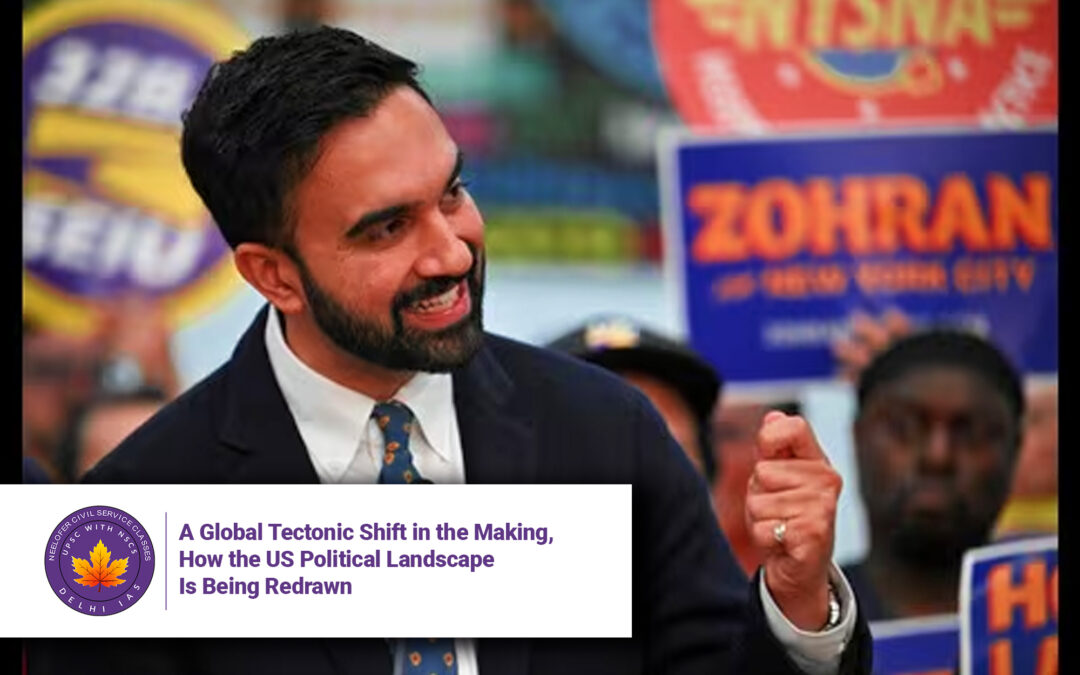
A Global Tectonic Shift in the Making, How the US Political Landscape Is Being Redrawn
Why in News?
The American political landscape is undergoing a seismic transformation with the dramatic emergence of new actors and ideological shifts. The triangular tussle between the world’s richest man, Elon Musk, a democratic socialist of Indian-origin, Zohran Mamdani, and the established political order represents a critical moment in the evolution of American democracy. This new dynamic could potentially redefine not just the upcoming elections, but the very structure of governance and capitalism in the United States.

Introduction
American democracy, for long viewed as the beacon of global liberal politics, is witnessing a tectonic shift. Traditionally shaped by the ideological binaries of Democrats and Republicans, the system is now being challenged by forces outside the conventional spectrum. Elon Musk’s new political outfit “America Party,” Zohran Mamdani’s bold democratic socialist vision, and the weakening influence of traditional political elites signal a major upheaval.
This evolving political scenario, fueled by generational discontent, growing inequality, and dissatisfaction with the status quo, could have far-reaching consequences not only for the US but for global political trends. The convergence of business tycoons, leftist ideologues, and populist politicians is creating a never-before-seen political realignment.
Key Issues
1. Elon Musk’s Political Foray
Elon Musk, the world’s richest man and a globally influential entrepreneur, has launched his own political party, America Party. Known for his disdain for government inefficiency, Musk has repeatedly criticized bureaucracy and the slow pace of administrative systems. His decision to enter formal politics is rooted in his frustration with the way government systems operate and his belief that innovation and speed must replace red tape and outdated processes.
Musk’s antagonism toward existing power structures intensified after his involvement with the Department of Government Efficiency (DOGE), created by Donald Trump to identify and remove inefficiencies. However, Musk’s suggestions, though rooted in corporate logic, were seen as threatening by many bureaucrats and politicians, eventually leading to his ouster from the DOGE panel.
The conflict escalated when Musk was accused of being part of the Epstein sex trafficking case, which he publicly denied. His online feud with Donald Trump also gained headlines, especially when he claimed Trump wanted him deported.
Despite controversies, Musk’s America Party is attracting attention, particularly among those frustrated with government inaction and stagnation. His influence, however, also raises concerns about the privatization of democratic processes and the rising influence of billionaires in shaping public policy.
2. The Rise of Zohran Mamdani: A Democratic Socialist Wave
While Musk brings the power of capital, Zohran Mamdani brings ideological strength. A democratic socialist with Ugandan-Indian roots, Mamdani has emerged as a prominent challenger to the status quo. He recently declared his intention to run for the post of Mayor of New York, representing a shift in Democratic politics.
Born to an Indian filmmaker mother and Ugandan father Mahmood Mamdani—an eminent left-wing intellectual—Zohran’s upbringing was shaped by diversity and radical political thought. A Columbia University graduate, he is also the first Muslim mayoral aspirant from the Democratic Party, symbolizing both ethnic and ideological diversity.
Mamdani’s campaign connects strongly with immigrant populations and lower-income communities. He promises sweeping reforms like freezing rents, expanding public transport, and imposing higher taxes on the rich. He has vowed to eliminate school and child care fees and make housing more accessible.
In a city where nearly 92% of income goes into housing, transport, and food, Mamdani’s promise of economic justice resonates deeply with the working class. His ideological clarity and principled stance stand in contrast to the centrist positions of many Democrats.
3. The Erosion of Established Political Order
The entrance of Musk and Mamdani into mainstream politics signifies the decline of traditional power brokers. The Democratic and Republican parties, which have dominated for over a century, are now grappling with internal divisions and the rise of external threats.
Donald Trump, who still commands a loyal base, has turned more combative, especially against figures like Musk. The Republican Party, while pushing populist narratives, is losing its coherence, with former allies turning into rivals.
Meanwhile, centrist Democrats are facing backlash from the younger generation, who are more aligned with socialism, climate action, and anti-capitalist sentiment. The old political order—characterized by compromise, backroom deals, and incremental reforms—is struggling to maintain relevance in an age of radical demands.
Alternative Approaches
As these ideological storms gather, different models of governance are being explored globally:
-
Communist Economic Models: Countries like China and Vietnam offer contrasting examples. With state-backed enterprises and minimal democratic freedom, they have created strong economic growth without political liberalization.
-
European Social Democracy: Nordic countries continue to showcase the viability of high-tax, high-welfare capitalism with democratic norms intact.
-
Populist Capitalism: Nations like India are navigating a model where populist politics is merged with crony capitalism, leading to a complex mix of development and democratic backsliding.
In the US, there is growing debate on whether a new hybrid model can emerge—where technological innovation and welfare can coexist, and capitalism can be “reformed” rather than replaced.
Challenges and the Way Forward
1. Democracy vs. Billionaire Influence
Elon Musk’s political rise reignites the debate around the role of money in politics. Can a billionaire genuinely represent the common citizen, or does his presence distort democratic norms? If Musk succeeds, it could set a dangerous precedent where ultra-rich individuals bypass parties and systems to seize power.
2. Polarization of Ideologies
With Mamdani representing the far-left and Musk emerging as a libertarian-capitalist figure, the ideological spectrum is widening. This polarization could lead to increased social unrest and legislative gridlocks, especially if neither side gains majority control.
3. Changing Demographics
The rise of younger, more diverse voters is challenging the white, middle-class dominated political consensus. Mamdani’s campaign proves that connecting with immigrants and minorities can create an effective electoral force. This could alter campaign strategies, funding mechanisms, and policy priorities.
4. Collapse of the Political Center
As the political extremes grow in strength, centrist politics is losing its appeal. Moderate Republicans and Democrats alike are failing to capture imagination or offer bold solutions, creating a vacuum in leadership and policy direction.
5. Global Implications
A transformed America will impact global alliances, trade, military policies, and international governance. Countries aligned with the US must prepare for abrupt changes in foreign policy and ideological posture, especially if populists or radicals take charge.
Conclusion
The political events unfolding in the United States are not just domestic developments—they represent a broader shift in the global democratic and economic order. The rise of Elon Musk and Zohran Mamdani are symbolic of this change: one brings unrestrained capitalism, and the other champions systemic overhaul through democratic socialism.
Both figures challenge the status quo in their own ways, and both are reflective of the public’s deep frustration with current systems. The traditional binaries of Left vs Right, Democrat vs Republican, are giving way to new conflicts: Rich vs Poor, Establishment vs Outsiders, Capital vs Social Welfare.
As America heads toward a crucial electoral phase, the world watches with bated breath. Will the system adapt and evolve, or will it collapse under the weight of its contradictions? Is this the beginning of a democratic renaissance—or a descent into chaos?
Only time will tell, but one thing is certain: a tectonic shift is indeed in the making.
Five Questions and Answers
Q1. Who is Zohran Mamdani, and why is his rise significant in US politics?
A1. Zohran Mamdani is a democratic socialist of Indian-Ugandan origin running for Mayor of New York. His rise is significant as he represents immigrant communities and pushes for radical reforms such as rent control, higher taxes on the rich, and universal access to child care and housing—challenging the centrist Democratic establishment.
Q2. What is Elon Musk’s role in the changing US political landscape?
A2. Elon Musk has launched his own political outfit, the America Party, aiming to reform government functioning based on efficiency and innovation. His entry blurs the line between wealth, technology, and politics, raising concerns about the influence of billionaires in democratic processes.
Q3. What are the main ideological differences between Mamdani and Musk?
A3. Mamdani promotes democratic socialism focused on public welfare, immigrant rights, and wealth redistribution. Musk, on the other hand, supports capitalist efficiency, less government control, and innovation-driven reforms. They represent opposite poles of the current political debate.
Q4. How is the traditional political order in the US being challenged?
A4. The dominance of Democrats and Republicans is weakening due to internal divisions, public disillusionment, and the rise of independent actors like Mamdani and Musk. This is leading to political fragmentation and a reevaluation of governance models.
Q5. What could be the global impact of the political changes in the US?
A5. A politically transformed US could affect global trade, security alliances, climate policy, and diplomatic strategies. As the US adjusts internally, its role as a global leader might shift, influencing international institutions and geopolitical alignments.
