
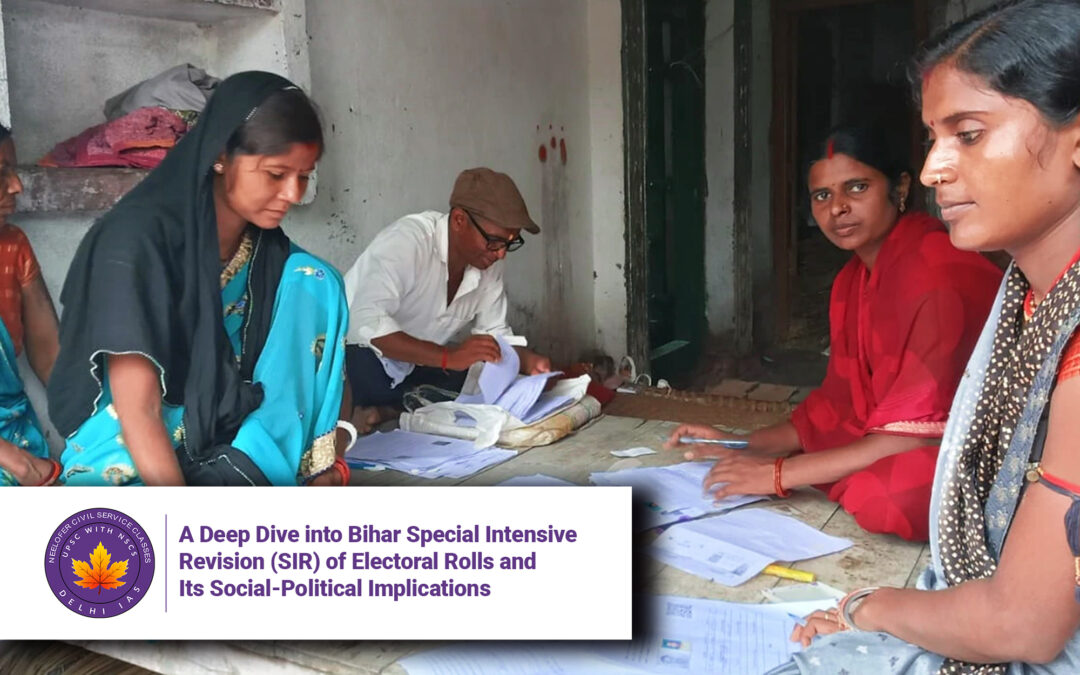
A Deep Dive into Bihar Special Intensive Revision (SIR) of Electoral Rolls and Its Social-Political Implications
Why in News?
The recent Special Intensive Revision (SIR) of electoral rolls in Bihar by the Election Commission of India (ECI) has sparked intense debates, legal scrutiny, and political arguments across the spectrum. While the BJP and opposition parties have both traded allegations about the revision process, deeper beneath the surface lies a significant socio-political narrative: that ordinary citizens are not merely passive subjects of bureaucratic exercises but actively shape, contest, and negotiate their place in the democratic framework.
Introduction
Bihar’s SIR process, ostensibly a routine exercise to ensure updated and accurate voter rolls, has now become a symbolic site of political, legal, and civil society contestation. The SIR has not only prompted lawsuits (with the Supreme Court approving the process after challenges) but also reawakened conversations about inclusion, citizenship, identity, and democratic participation.
The process is a powerful reminder that democracy in India is not simply implemented from the top down. It is contested, reshaped, and affirmed from the ground up – often by the very citizens who are expected to be its silent subjects.
Lessons from Bihar’s SIR
The ECI’s revision exercise in Bihar has unearthed certain uncomfortable truths. It has highlighted that:
-
Electoral statistics are not fixed truths but are negotiated, contested, and debated.
-
Even the most “neutral” bureaucratic procedures are subject to human errors, bias, and political influence.
-
Citizens, especially those from marginalized communities, are active agents who challenge exclusion and assert their rights.
One of the most poignant examples lies in the controversy surrounding the deletion of voters from electoral rolls. Close to 191,000 individuals were reportedly excluded from the SC-supervised NRC. Objections arose especially from non-Assamese Hindus listed as Muslims – an echo of how categorization and data entry errors can become politically and communally charged.
Beyond the 65L Deletions: Social and Political Implications
A closer look reveals the kind of citizens most vulnerable to deletion:
-
Deceased individuals (22L),
-
Duplicate entries,
-
Those with errors in Aadhaar or mobile numbers,
-
Migrants or those without clear proof of nationality or address, and
-
Muslim communities, especially those assumed to have Bangladeshi origins.
This resulted in allegations that the SIR had become a de facto National Register of Citizens (NRC), especially since people had to prove their nationality and update digital documents under tight deadlines.
However, it’s important to note that this bureaucratic effort was also met with resistance, innovation, and negotiation. Field-level officers (BLOs) and citizens often worked together to resolve documentation issues. Aadhaar numbers were submitted, QR codes scanned, and mobile numbers linked – all to reassert one’s identity in the electoral system.
In the face of exclusion, people mobilized. Social activists, NGOs, political parties, and citizens’ groups jumped in to assist those affected. The result? Nearly 9/10ths of voters managed to get their enumeration completed, a testament to the participatory nature of democracy.
Rewriting the Narrative: People as Active Political Agents
Contrary to the impression that bureaucratic exercises are only top-down impositions, the article argues for a nuanced view. Indian citizens – especially the marginalized – are not passive. Rather, they are:
-
Active negotiators of their citizenship,
-
Resistant actors who contest unjust exclusions,
-
Informed participants aware of their democratic rights.
The comparison with Assam’s NRC highlights how social mobilization can resist exclusion. In Bihar too, people came out in large numbers, challenged the EC, used media and courts, and ensured their voices were not erased.
The lesson is clear: enumeration is not merely technical; it is deeply political. Voter rolls are not just about numbers. They are about identity, inclusion, and visibility in the political sphere.
Challenges and Criticisms
Despite the active engagement by citizens, the SIR process in Bihar has not been without its share of flaws:
-
Hasty implementation: The rushed timelines left many rural and poor voters unable to respond or submit documents.
-
Technological dependence: Digital literacy and access are uneven across Bihar, making the shift to app-based enumeration difficult for many.
-
Communal accusations: Accusations that the enumeration targeted Muslim voters fuelled distrust and political tension.
-
Poor communication: Many citizens were unaware that their names were being reviewed, and found out only when denied voting rights.
Electoral Rolls as Sites of Democracy and Dispute
The enumeration process is much more than a statistical exercise. It is where democracy is affirmed – or denied. The way voters are included or excluded reflects not just administrative competence, but political intention and societal values.
When voter rolls become politicized, they are no longer neutral lists; they become battlegrounds. In Bihar, this battleground saw both conflict and resolution:
-
Conflict: With objections, exclusions, and legal cases.
-
Resolution: Through citizen mobilisation, BLO-citizen collaboration, and eventual recognition of marginalized voices.
The Way Forward
Rather than dismissing the process as chaotic or flawed, the SIR in Bihar should be seen as a crucial democratic moment. It reinforces several key lessons:
-
Democracy is participatory: Citizens engage with and shape electoral processes.
-
Data is not neutral: Enumeration is a political act with real-life consequences.
-
Accountability matters: Institutions like the EC must be transparent and responsive.
-
Legal and social mobilization work: Citizens must continue to use the courts, media, and civic groups to challenge exclusion.
To make future revisions meaningful, the following reforms are essential:
-
Longer timelines for document submission.
-
Better communication with voters about the revision schedule.
-
Training BLOs to handle sensitive cases fairly.
-
Preventing political interference in deletion decisions.
-
Ensuring digital processes are accessible to all, especially the rural poor.
Conclusion
Bihar’s SIR has done more than clean up electoral rolls. It has offered a rare insight into how democracy functions at the grassroots – not just in theory, but in action. While political parties bicker over accusations, the real story is that of ordinary citizens who refused to be erased, who fought for their right to be counted, and who reminded the country that democracy is not a gift – it’s a fight.
This moment must be remembered not only as an administrative event but as a democratic milestone. Electoral rolls matter – because inclusion on them is the first step toward political voice and power.
Question & Answer Section
Q1. What is the Special Intensive Revision (SIR) of voter rolls in Bihar?
A1. The SIR is an electoral exercise undertaken by the Election Commission of India to update and verify voter rolls in Bihar. It involves verifying names, removing duplicates or deceased individuals, and updating voter data through door-to-door enumeration and digital systems.
Q2. Why has the SIR been controversial in Bihar?
A2. The SIR has been controversial due to widespread deletions, rushed timelines, and accusations of bias – particularly that Muslim communities and the rural poor were disproportionately targeted or excluded. Some critics called it a backdoor implementation of NRC.
Q3. How have citizens responded to the SIR process?
A3. Citizens across Bihar actively engaged with the enumeration process, submitted documents, challenged exclusions, and collaborated with BLOs to ensure their names remained on the rolls. Their participation proved that ordinary people can resist exclusion and influence democratic outcomes.
Q4. What broader lessons does the Bihar SIR offer about Indian democracy?
A4. The SIR reveals that democracy in India is not just a top-down process managed by bureaucrats. It is deeply participatory, with citizens, even from marginalized backgrounds, asserting their rights and negotiating with the state for inclusion and recognition.
Q5. What reforms are needed to make future voter roll revisions fair and inclusive?
A5. Reforms should include clear communication, ample time for corrections, digital and offline accessibility, trained enumerators, transparency in deletion criteria, and legal recourse for wrongful exclusions. Most importantly, the process must be free of political and communal bias.