
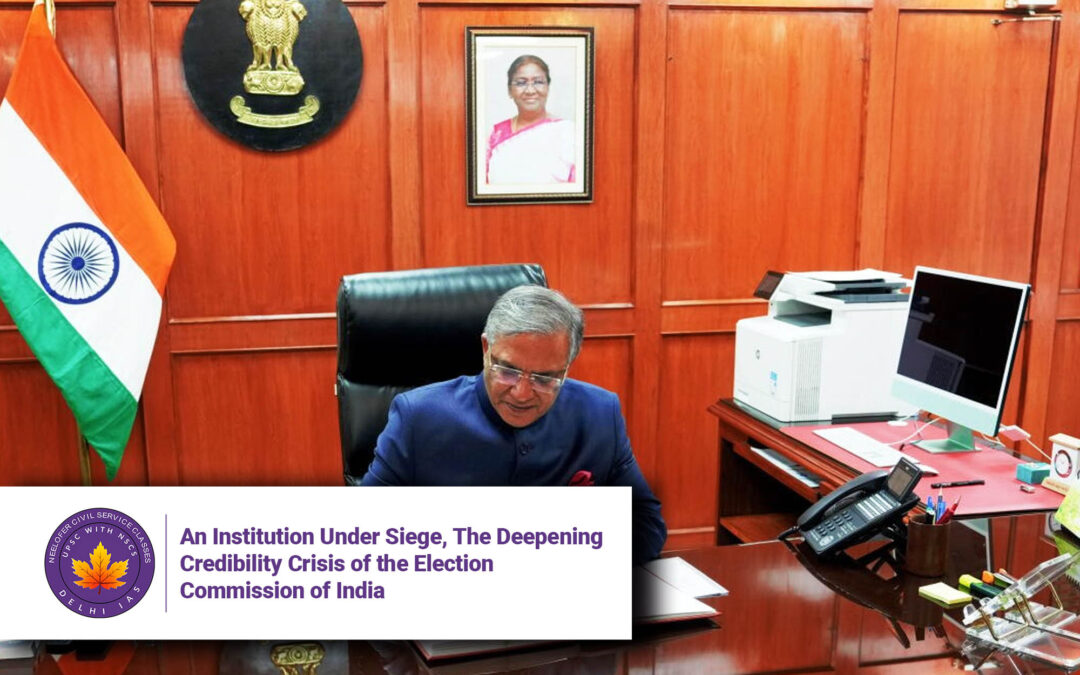
An Institution Under Siege, The Deepening Credibility Crisis of the Election Commission of India
India’s democracy has long been hailed as a marvel, a vibrant exercise in popular will conducted on a scale unimaginable anywhere else in the world. At the heart of this miracle has been an institution once revered for its iron-clad integrity and steely resolve: the Election Commission of India (ECI). Founded by visionary leaders and stewarded by figures of unimpeachable character like the first Chief Election Commissioner, Sukumar Sen, the ECI’s word was once law, its impartiality unquestioned, and its authority absolute. Today, that legacy stands tarnished, and the institution is embroiled in what is arguably the most severe credibility crisis of its seven-decade history.
This crisis is not a sudden eruption but the culmination of a series of controversies, opaque decisions, and a perceived alignment with the ruling dispensation that has eroded public trust. The dam finally broke in August 2025, triggered by a game-changing exposé by the Leader of the Opposition, Rahul Gandhi, and a damning interim order from the Supreme Court of India. The ECI’s subsequent attempt at damage control—a poorly conceived press conference—only served to deepen the fissures, revealing an institution that appears unsure, defensive, and alarmingly out of touch with the democratic principles it is sworn to uphold.
The Spark: Supreme Court Rebuke and the 65 Lakh Question
The immediate genesis of the current firestorm lies in the ECI’s conduct of the Special Intensive Revision (SIR) of electoral rolls for Bharat. During this process, the Commission reportedly excluded a staggering 65 lakh electors from the draft roll. The scale of this deletion alone raised eyebrows, but it was the ECI’s refusal to provide transparency around these actions that ignited a constitutional conflagration.
Political parties, led by the opposition, and independent journalists demanded answers: Who were these 65 lakh voters? On what grounds were their names deleted? Why was the Aadhaar card, arguably the most ubiquitous and widely used identification document in India, excluded from the list of valid documents for this process, potentially disenfranchising millions?
Instead of providing clarity, the ECI stonewalled. It refused to publish the names and reasons for the exclusion, hiding behind a veil of bureaucratic procedure and questionable claims. This forced the matter to the Supreme Court, which delivered a stinging interim order on August 14, 2025. The Court rejected the ECI’s arguments, directing it to:
-
Publish the names of all deleted electors.
-
Provide the reasons for their deletion.
-
Present this data in a searchable format, linked to Electors Photo Identification Card (EPIC) numbers.
-
Accept Aadhaar as a valid identification document for aggrieved persons.
This order was a monumental judicial reprimand. It was a clear indictment of the Commission’s opacity and a forceful reaffirmation that in a democracy, the voter’s right to franchise is paramount and cannot be curtailed by an unaccountable bureaucracy.
The Fuel: A Disastrous Press Conference
Reeling from the Supreme Court’s order, the ECI called a press conference on August 17, 2025. If the goal was to reassure the nation and reclaim the moral high ground, it was an unmitigated failure. The conference, rather than dousing the flames, poured gasoline on the fire.
The performance of Chief Election Commissioner Gyanesh Kumar was widely panned. The presser oscillated between vague, self-congratulatory rhetoric about the ECI’s historic transparency and outright blame-placing on political parties for not raising issues earlier. The messaging was confused, and the answers were unconvincing, often displaying a startling ignorance of electoral processes.
Two moments, in particular, became emblematic of the ECI’s disconnect:
-
The Privacy Paradox: When questioned on refusing to share video footage crucial for identifying dual voting, the CEC claimed it would violate the privacy of women. This justification was widely derided as “outrageously absurd,” a flimsy pretext to avoid scrutiny of a critical aspect of electoral integrity.
-
A Fundamental Ignorance: The CEC asked why politicians only raise issues of electoral fraud after elections and not when draft rolls are shared beforehand. This statement betrayed a profound misunderstanding of how fraud operates. Bogus voting and manipulation patterns often only become apparent after voting concludes and data can be analyzed holistically. That the country’s top election official seemed unaware of this basic fact was cause for deep concern.
The press conference succeeded only in vindicating the opposition’s longstanding allegation: that the ECI had shed its bipartisan character and was acting as an extension of the executive, rather than an independent constitutional authority.
The Pattern: A History of Stonewalling and Opaqueness
The events of August 2025 are not an anomaly but part of a disturbing pattern of obfuscation. The article provides a telling prelude from earlier in the year. In December 2024, the Indian National Congress, represented by one of the authors, formally wrote to the ECI requesting electoral roll data for Maharashtra and Haryana. The ECI ignored the request entirely, failing even to acknowledge it.
After a follow-up in January 2025 yielded no results, the party was forced to approach the Delhi High Court. The ECI’s defense—that the data had already been provided to parties before the election—missed the point entirely. Post-election analysis of the same data is essential to identify discrepancies and patterns of fraud. The High Court issued a notice, and the ECI, under judicial pressure, finally directed state Chief Electoral Officers to decide on the request.
The resulting orders from Maharashtra and Haryana in May 2025 were masterclasses in bureaucratic evasion. They refused to provide machine-readable digital lists, directing the petitioners to seek “additional copies” from local authorities, effectively sending them on a wild goose chase. This five-month ordeal demonstrated a “plain and simple case of stonewalling any meaningful scrutiny by hiding behind bureaucratic jargon.”
The Core Principle: The Voter as the Mountain
The most revealing moment of the press conference was the CEC’s analogy that the ECI stands with voters “like a mountain.” This metaphor, intended to convey strength and permanence, instead highlighted the Commission’s tragic disconnect. In a constitutional democracy, the institution is not the mountain; the people are.
The ECI is a custodian, a facilitator of the people’s will. Its legitimacy is derived solely from the trust of the electorate and the political parties that compete for its votes. When that trust evaporates, the institution becomes a hollow shell. The ECI has already lost the faith of every major opposition party. It is now, perilously, losing the trust of the voters it claims to serve.
This crisis is entirely of the Commission’s own making. Its refusal to embrace transparency, its adversarial stance towards legitimate questioning, and its seeming inability to perform basic duties without judicial coercion have created a perilous situation. An election conducted by an institution lacking credibility is an election whose outcome will always be questioned, poisoning the well of democracy for years to come.
The Path to Redemption: Reclaiming the Legacy of Sukumar Sen
The legacy of Sukumar Sen and other stalwart CECs looms large over the current crisis. Those were officials who built an institution through action, not words. They understood that their mandate was to serve the democracy, not to rule over it. For the current ECI to reclaim even a sliver of that legacy, it must undertake a dramatic course correction.
-
Embrace Radical Transparency: The ECI must go beyond the Supreme Court’s directive. All electoral data, from draft rolls to final lists, deletion logs, and video evidence (with appropriate privacy safeguards for identities, not for scrutiny), should be proactively disclosed in machine-readable formats. sunlight is the best disinfectant.
-
Engage in Dialogue, Not Confrontation: The Commission must re-open channels of communication with all political parties, listening to grievances and incorporating feedback. It must see them as stakeholders in the electoral process, not as adversaries.
-
Uphold the Law, Don’t Interpret It to Obstruct: The ECI’s role is to facilitate the democratic right to vote, not to create hurdles. This means accepting widely used documents like Aadhaar and streamlining processes to include, not exclude, citizens.
-
Demonstrate Administrative Savvy: The Commission must invest in technology and training to pre-empt fraud and address anomalies efficiently. The excuses offered in the press conference revealed an institution that is behind the curve.
The mountain of Indian democracy is vast and resilient. But even mountains can be eroded by persistent, acidic forces. The Election Commission of India was built to protect that mountain. It is not too late to remember its true purpose, but the window for redemption is closing fast. The future of the world’s largest democracy depends on it.
Q&A Section
1. Q: What is the “Special Intensive Revision (SIR)” of electoral rolls, and why is it so controversial?
A: A Special Intensive Revision is a process undertaken by the ECI to thoroughly clean up and update the voter lists, ostensibly to remove duplicates, deceased voters, and ineligible entries. It becomes controversial when it is conducted with opacity and on an enormous scale. The deletion of 65 lakh voters without transparently providing their names and the reasons for deletion raises legitimate fears of mass disenfranchisement, where legitimate voters may be arbitrarily removed from the rolls, thereby losing their fundamental right to vote.
2. Q: Why is the refusal to share video footage such a significant issue?
A: Video footage from polling stations is a critical tool for identifying and preventing electoral malpractices like “dual voting” (one person voting multiple times) or “impersonation.” By refusing to share this footage under the dubious pretext of protecting women’s privacy, the ECI is effectively shutting down a key avenue for independent verification of the voting process. This lack of transparency fuels suspicions that the Commission may have something to hide and prevents political parties and observers from fulfilling their oversight role.
3. Q: The ECI argued that data had already been provided to parties before the election. Why did the opposition need it again after the election?
A: This is a crucial distinction. Data provided before an election is used for preparation and campaigning. However, analyzing the final electoral data after an election is essential for forensic scrutiny. It allows analysts to cross-reference the final voter list with the actual votes cast, identify patterns such as an unusually high number of votes in specific booths, or detect discrepancies that suggest bogus voting. Denying this post-election data prevents anyone from verifying the integrity of the electoral process, making it impossible to prove or disprove allegations of fraud.
4. Q: What does the Supreme Court’s intervention tell us about the state of the ECI?
A: The Supreme Court’s forceful interim order is a massive vote of no-confidence in the ECI’s actions. It signifies that the highest court in the land found the Commission’s justifications for its opacity to be legally untenable. Judicial intervention of this nature is rare and is reserved for situations where a constitutional authority is seen to be failing in its core duties. It underscores the severity of the crisis and places the ECI under direct judicial oversight for this process.
5. Q: Beyond this specific crisis, what is the long-term danger of an ECI losing its credibility?
A: The long-term danger is the erosion of democratic legitimacy itself. If citizens and political parties do not trust the neutrality and competence of the institution that runs elections, they will inevitably stop trusting the outcomes of those elections. This leads to political instability, perpetual polarization, and a loss of faith in the democratic system as a whole. The ECI’s credibility is not a minor issue; it is the foundational bedrock upon which the peacefulness and acceptance of electoral transitions rest. Without it, the very idea of India as a functional democracy is at risk.
