
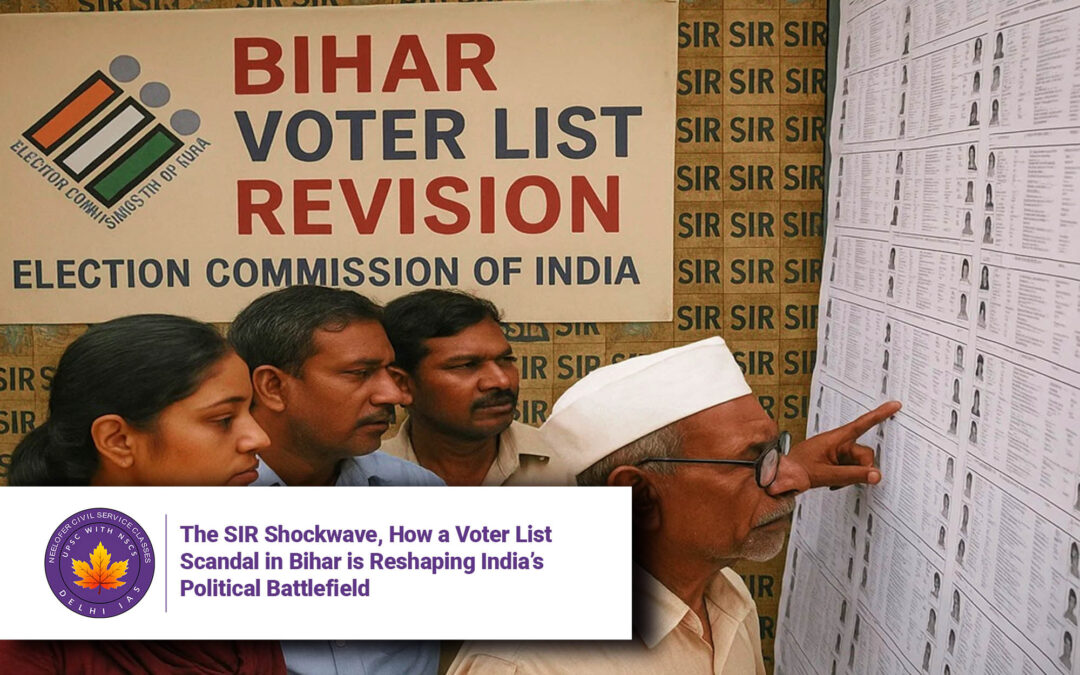
The SIR Shockwave, How a Voter List Scandal in Bihar is Reshaping India’s Political Battlefield
The INDIA Bloc’s Constitutional Gambit and the BJP’s Isolation in the Fight for Democracy’s Soul
Introduction: The March That Shook the Capital
On August 11, 2025, a spectacle unfolded in New Delhi that Indian politics had not witnessed in recent memory. Three hundred Members of Parliament from across the Opposition INDIA bloc—a coalition often derided as fragile and fractious—staged a unified, defiant march towards the Election Commission of India (ECI). Their demand was singular and profound: to halt what they alleged was the systematic disenfranchisement of 65 lakh (6.5 million) voters in Bihar through a controversial Special Intensive Revision (SIR) of the electoral rolls. The images of senior leaders like Sharad Pawar and Mallikarjun Kharge marching alongside the younger generation of Rahul Gandhi and Tejashwi Yadav were not just a photo opportunity; they were a potent symbol of resistance. This show of force, as senior journalist Shikha Mukerjee notes, produced a palpable sense of “shock and awe,” momentarily piercing the aura of invincibility that has surrounded the ruling BJP and Prime Minister Narendra Modi.
The Bihar SIR controversy is far more than a bureaucratic squabble over voter lists. It has erupted into a defining constitutional and political crisis, challenging the very integrity of India’s electoral process. It pits the combined might of the Opposition, championing the fundamental “right to vote,” against a ruling party that stands isolated as the sole defender of an opaque process now under the scrutiny of the Supreme Court. This clash transcends the immediate fate of Bihar’s elections; it is a watershed moment that could recalibrate the narrative of Indian democracy, repositioning the Opposition as a pro-people resistance and forcing the BJP onto the back foot for the first time in years. This article deconstructs the SIR crisis, its legal and political ramifications, and its potential to reshape the battle for India’s political soul.
Deconstructing the SIR: From Administrative Exercise to Political Firestorm
At its core, the Special Intensive Revision is a process intended to purify the electoral roll by weeding out duplicate, bogus, or ineligible voters. In Bihar, however, the scale and opacity of the exercise—resulting in the deletion of 65 lakh names—raised immediate red flags.
The Opposition’s accusation was severe: that this was not a routine cleanup but a targeted effort to disenfranchise sections of the electorate perceived to be unfavorable to the ruling BJP. Their credibility received an unexpected and monumental boost from an unlikely quarter: the Supreme Court of India. While not ruling on the merits of the case, the Court’s directive to the ECI was a tacit validation of the Opposition’s concerns. The Court ordered the Commission to:
-
Publish and upload the list of all deleted names.
-
Widely publicize the grounds for each cancellation.
-
Ensure a “fair procedure” for any action that deprives a citizen of their franchise.
By emphasizing transparency and due process, the Court, as Mukerjee observes, indirectly endorsed the “excellent analysis” presented by activist Yogendra Yadav, which Justice Surya Kant cited. The Court’s order highlighted the “irrationality of non-disclosure” and established that the deletion of voting rights, a action with grave “civil consequences,” must follow principles of natural justice.
The ECI’s response—a public challenge to the Opposition to “show proof or apologise”—was widely perceived as petulant and unbecoming of a constitutional body. Instead of offering a transparent explanation, it engaged in a political tit-for-tat, further eroding its stature. The Commission’s claim that the SIR was an “intensive search for illegal immigrant voters” added a new, controversial dimension, potentially conflating the issue of bogus voters with the highly sensitive and politically charged topic of immigration.
The Opposition’s Masterstroke: Seizing the Pro-People Mantle
For years, the BJP, under Narendra Modi, has successfully cultivated an image as the sole pro-poor, pro-people party, branding the Opposition as a corrupt, elitist, and anti-national “coalition of chaos.” The SIR issue provided the INDIA bloc with a rare opportunity to shatter this narrative and turn the tables.
1. The Power of Unity:
The march of 300 MPs was a physical manifestation of the slogan “unity is strength.” The presence of the Aam Aadmi Party (AAP), despite having announced its exit from the bloc, underscored the compulsion for every opposition party to be seen on the right side of this issue. It demonstrated a level of coordination and shared purpose previously thought impossible, stunning the BJP and its allies.
2. Championing a Fundamental Right:
By framing the issue around the principle of “One Man-One Vote,” the Opposition elevated its fight from partisan politics to a defense of a fundamental constitutional right. This allowed it to occupy the moral high ground and present itself as the true defender of democracy against an executive and an ECI perceived as overreaching.
3. Shifting the Narrative:
The arrests of protesting MPs and the dramatic visuals from Delhi had a powerful effect on public perception. For the first time in a long while, the BJP risked appearing anti-people—as an entity willing to tamper with the sacred right to vote to maintain power. Meanwhile, the INDIA bloc, often labeled as self-serving, successfully projected itself as standing up for the poorest and most marginalized citizens whose voice was being systematically erased.
As Mukerjee aptly notes, “one swallow does not make a summer.” A single rally does not cleanse the Opposition of its perceived flaws. However, it marks a crucial starting point for a new narrative, one where the BJP is on the defensive over its commitment to democratic principles.
The BJP’s Isolation and Mounting Troubles
The SIR controversy has left the BJP politically isolated. As the only major party that did not question the ECI’s process, it stands alone in defending opacity, in stark contrast to the Supreme Court’s call for transparency. This isolation is compounded by a series of other setbacks that have made 2025 a challenging year for the Modi government:
-
Panalgarh Killings: The government faces uncomfortable questions over the opacity surrounding the killing of Indian soldiers in a border incident, with details remaining shrouded in mystery.
-
Operation Sindoor: The conduct, outcomes, and costs of a major military operation, along with the identity of the ceasefire broker, have been criticized for lack of transparency.
-
US Tariff War: The imposition of punitive tariffs by the Trump administration on Indian exports, particularly shrimp, has threatened the livelihoods of marginalized fishing communities along the entire east coast, from West Bengal to Tamil Nadu, exposing economic vulnerabilities.
These issues have chipped away at the image of a strong, infallible government fully in control. The Opposition, sensing blood in the water, has become increasingly assertive in holding the government accountable both inside and outside Parliament.
Bihar: The Bellwether Battlefield
The political theater in Delhi is a prelude to the real-world consequences in Bihar, a state that has long served as a bellwether for national political trends. The Bihar election is now a referendum on the SIR issue.
-
For the BJP: The challenge is immense. It must defend an process that appears to target its political opponents’ vote banks, all while facing a unified and energized Opposition. Its usual attack machine—labeling opponents as corrupt and anti-national—has proven ineffective against a movement framed as a defense of democracy.
-
For the INDIA Bloc: The goal is to translate street mobilization into electoral gains. The issue has the potential to consolidate Muslim, Yadav, and other OBC votes firmly behind the Mahagathbandhan (Grand Alliance). If they can effectively campaign on the message that the BJP is “stealing” their vote, it could lead to a decisive electoral outcome.
The “Vote Chor” (Vote Thief) yatra launched by Rahul Gandhi and Tejashwi Yadav across 1,300 km in Bihar is a strategic move to keep the issue alive on the ground, directly connecting with the voters whose rights are allegedly under threat.
The Road Ahead: A Watershed for Indian Democracy
The fight over the Bihar SIR is more than an electoral skirmish; it is a potential watershed moment for Indian democracy.
1. For the Election Commission: The institution faces a severe crisis of credibility. To restore trust, it must go beyond the Supreme Court’s order and undertake a comprehensive review of its processes to ensure they are transparent, fair, and immune to political pressure. Its independence must be visibly demonstrated, not just asserted.
2. For the Opposition: The challenge is to sustain this unity and momentum. The INDIA bloc must build on this issue to present a coherent, viable alternative agenda for governance, moving beyond resistance to proposition. It must institutionalize its coordination mechanisms to fight the next general election as a united front.
3. For the BJP: The party faces a strategic dilemma. Does it double down on its support for the ECI and risk being branded as anti-democratic, or does it course-correct and pressure the Commission for greater transparency to defuse the issue? Its handling of this crisis will reveal much about its political priorities.
Conclusion: The Right to Vote as the Final Frontier
The Bihar SIR controversy has done something remarkable: it has reduced the complex tapestry of Indian politics to a simple, powerful binary—between those who would protect every citizen’s right to vote and those who would obscure the process by which it can be taken away. In this battle, the INDIA bloc has, for now, successfully seized the mantle of the pro-people defender of democracy.
The coming Bihar election will be the first real test of whether this “shock” tactic can translate into electoral victory. But regardless of the immediate outcome, the crisis has already achieved a significant victory: it has reaffirmed that in a democracy, the ultimate sovereignty resides with the voter, and any attempt to tamper with that sovereignty will be met with fierce, unified resistance. The march of the 300 may be remembered as the moment Indian democracy began to fight back.
5 Q&A
Q1: What is the Special Intensive Revision (SIR) and why is it controversial?
A1: The Special Intensive Revision (SIR) is a process undertaken by the Election Commission of India to rigorously clean up electoral rolls by removing duplicate, bogus, or ineligible voters. In Bihar, it became controversial because it led to the deletion of 65 lakh (6.5 million) voter names. The Opposition alleges this was not an impartial administrative exercise but a targeted effort to disenfranchise voters from communities that traditionally do not support the ruling BJP, thus making it a severe threat to democratic fairness.
Q2: How did the Supreme Court’s order validate the Opposition’s stance?
A2: While not ruling on the merits of the case, the Supreme Court’s directive to the ECI to publish the list of deleted names and the grounds for cancellation was a major vindication. The Court emphasized the need for a “fair procedure” and highlighted the “irrationality of non-disclosure” when a citizen’s right to franchise is at stake. This order tacitly accepted the Opposition’s core argument that the process was opaque and undemocratic, forcing unprecedented transparency onto the ECI.
Q3: Why was the Opposition’s march in Delhi considered a “game-changer”?
A3: The march was a game-changer for two reasons: 1) Demonstration of Unity: It showcased an unprecedented level of cohesion within the historically fractious INDIA bloc, with 300 MPs from different parties marching together, signaling a powerful, unified resistance. 2) Narrative Shift: It successfully reframed the Opposition as the defender of the fundamental “right to vote” against an allegedly overreaching government and Election Commission, thereby challenging the BJP’s long-held monopoly on the “pro-people” narrative.
Q4: What is the strategic importance of the Bihar election in this context?
A4: Bihar is a key bellwether state in Indian politics. The election has become a direct referendum on the SIR issue. A strong performance by the INDIA bloc would validate its strategy of fighting on the platform of democratic rights and prove that the BJP’s alleged manipulation of institutions is an electoral liability. Conversely, a BJP victory would suggest that such tactics do not resonate with the electorate or that the BJP’s political machinery can overcome the controversy.
Q5: How has the BJP’s position been weakened by this crisis?
A5: The BJP finds itself in a position of acute political isolation. It is the only major party that did not question the ECI’s opaque process, making it the sole defender of a practice now criticized by the Supreme Court. This aligns the party against transparency and due process, damaging its democratic credentials. This isolation is compounded by other crises—like the Panagarh killings and US tariffs—that have collectively tarnished the image of a strong, infallible government and given the Opposition a consistent line of attack.

