
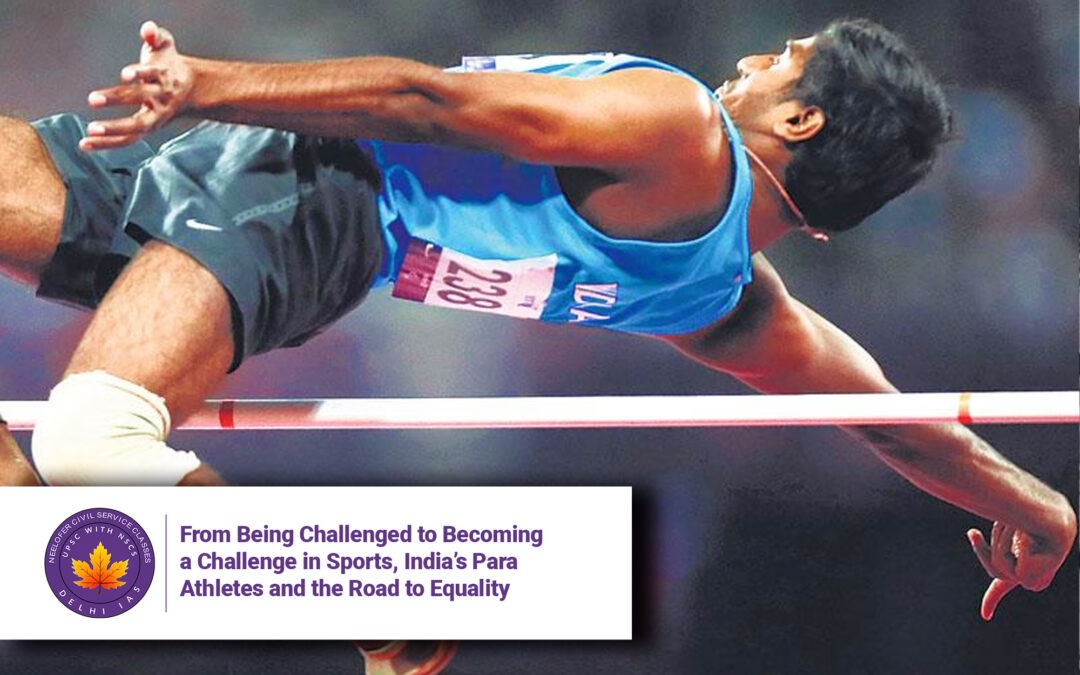
From Being Challenged to Becoming a Challenge in Sports, India’s Para-Athletes and the Road to Equality
Introduction
In India, the path to sporting glory for a para-athlete begins long before they set foot on a track, field, or court. For most, the first contest is not against a rival player or stopwatch, but against deeply rooted social prejudice, family skepticism, and systemic neglect.
Physical disability, visual impairment, or intellectual challenges are not simply personal hurdles — in India, they are often accompanied by a society that sees differently abled individuals not as future champions, but as burdens. Families may brand disability a curse, neighbours may dismiss athletic aspirations as impractical, and even government systems may treat para-athletes as liabilities rather than assets.
Against this backdrop, the achievement of representing one’s country in an international sporting event is monumental — not only for its athletic significance but also for what it represents in breaking entrenched stereotypes.
I. Breaking Stereotypes: The Social Challenge Before the Sporting One
The struggle of a para-athlete is intertwined with the challenge of changing perceptions. Jeevesh Gupta, founder of Differently Abled, a privately funded para-athletics initiative, recounts how a single event at the Jawaharlal Nehru Stadium in New Delhi became an eye-opener for many attendees.
In India, para-sports receive minimal promotion, and events are often sparsely attended. The prevailing perception is that these events lack the excitement of able-bodied competitions — a deeply flawed assumption. The athleticism, strategy, and emotional power of para-sports rival and often surpass mainstream competitions.
The barrier here is visibility. When communities see differently abled athletes train, compete, and win, perceptions begin to shift. For the athlete, sport often transforms not only their own life but the perceptions of entire families and communities.
II. The Road Ahead: A Critical Window of Opportunity
India is at a pivotal moment. It will host the World Para-Athletics Meet in Delhi in September 2025 and participate in the Asian Para Games in Japan in 2026. These events present more than just medal opportunities — they are platforms to break the isolation many differently abled individuals experience.
The numbers tell a revealing story. In the Paris 2024 Paralympics, 559 medal events were contested across 22 sports, producing 1,734 medals in total. India sent only 58 athletes, competing in just 15% of the events. Yet, the country’s conversion rate — medals won per events entered — was a respectable 34.5%. If participation were doubled, medal counts could rise dramatically.
III. Strategies and Investments: How to Close the Gap
Target High-Medal Sports
Countries like Hong Kong, Japan, and Turkey have maximised efficiency by focusing on specific high-yield events. At Paris 2024:
-
Hong Kong won three gold and two silver medals in just 11 events.
-
Japan and Turkey dominated in Goalball — a team sport designed for athletes with visual impairments.
For India, similar focus areas could be:
-
Boccia (a precision ball sport for severe physical disabilities).
-
Cycling (especially track and road events).
-
Swimming (multiple medal categories per classification).
-
Powerlifting.
Increase Participation
The key lies in sending larger contingents. If India can match or exceed the 72 athletes it sent to the 2018 Asian Para Games in Jakarta, results will likely improve. Funding must support not just elite-level training, but grassroots scouting and sustained athlete development.
Private Sector Support
While government funding has improved, private sponsorship remains sparse. Large corporations often prioritise mainstream sports. This needs to change — major brands like JSW and Reliance, which have made significant investments in Olympic athletes, have yet to fully commit to para-sports.
IV. Building and Training: Beyond the Stadium
Success requires more than world-class stadiums.
Para-athletes need:
-
Dedicated disability-focused sports training centres.
-
Accessible accommodation and transport.
-
Inclusive sports infrastructure — such as tactile markings for visually impaired athletes or accessible gym equipment.
-
Specialised coaching that understands the unique biomechanics of para-athletics.
-
Sports science support, including physiotherapy, nutrition, and mental conditioning tailored to different disabilities.
Countries with stronger para-sport systems, like the UK and Australia, have shown that integrated support ecosystems yield sustained medal results.
V. Shaping the Narrative: Changing Mindsets Through Media and Culture
Representation matters. Films like Taare Zameen Par, Barfi, and Siyaare Zameen Par have portrayed differently abled characters, but far fewer works celebrate para-athletes. Exceptions like Chandu Champion, which told the story of Murlikant Petkar, India’s first Paralympic gold medallist, are rare.
Awareness campaigns can have a multiplier effect:
-
A “YES I CAN” campaign could highlight role models from India and abroad.
-
Recognising and celebrating medal winners promptly in the media reinforces their status as national heroes.
-
School and college outreach can encourage participation from a younger age.
VI. Policy Interventions: From Event Hosting to Systemic Change
Hosting the World Para-Athletics Meet is an opportunity — but without systemic changes, its impact may be temporary. Policy steps could include:
-
Incentives for private sponsorship — tax breaks for companies funding para-sports.
-
Dedicated para-sports academies — one in each state capital.
-
Integration with mainstream sports policy — ensuring equal access to training facilities.
-
Mandatory para-sports coverage on public broadcasters.
-
Regular national championships in all major para-sports disciplines.
VII. Conclusion: From Inspiration to Institutionalisation
The journey from “being challenged” to “becoming a challenge” in sports is not just about overcoming personal limitations — it’s about dismantling the societal and systemic barriers that prevent talent from flourishing.
India’s para-athletes have shown they can win when given the chance. The challenge now is not whether they can compete, but whether the system will provide the infrastructure, visibility, and sustained investment needed for consistent success.
If India seizes this moment — leveraging the upcoming 2025 and 2026 events, expanding participation, and reshaping narratives — it can transform para-sports from a marginal activity into a pillar of national sporting culture. And in doing so, it will redefine what it means to be a sporting superpower.
5 Exam-Oriented Q&A
Q1. What is the significance of India hosting the World Para-Athletics Meet in 2025?
A: It offers a platform to showcase and promote para-sports domestically, break social stigma, and potentially increase India’s participation and medal prospects in future global events.
Q2. How did India perform in the Paris 2024 Paralympics in terms of conversion rate?
A: India achieved a 34.5% medal conversion rate but participated in only 15% of the total events.
Q3. Name two sports where India could significantly improve its medal tally by focusing resources.
A: Boccia and Goalball, along with swimming and cycling, are identified as high-medal-potential sports.
Q4. What are some key infrastructural requirements for para-athletes beyond stadium facilities?
A: Accessible transport, specialised training centres, disability-adapted sports equipment, and integrated sports science support.
Q5. Why is media representation important for para-sports in India?
A: Positive and frequent media coverage changes public perception, encourages participation, and attracts sponsorships, thereby strengthening the para-sports ecosystem.

