
Goa Rejection of a State Minorities Commission, Constitutional Duty, Political Signals, and Social Risks
Introduction
The recent refusal by the Goa state government to establish a State Commission for Minorities has sparked a wave of criticism from civil society, rights activists, and minority groups. Despite Goa’s reputation as a peaceful and communally harmonious state, this decision raises critical questions: Is the government undermining constitutional protections for minorities? Is the refusal a matter of administrative oversight, or does it signal deeper insecurities and political calculations?
The debate transcends Goa’s borders. Across India, minority commissions — at both the state and central level — have been essential in monitoring discrimination, addressing grievances, and ensuring that welfare schemes reach marginalized groups. Goa’s reluctance to set up such a body has reignited a conversation about the constitutional mandate to protect minorities, the risks of complacency, and the dangers of political posturing in matters of equality and inclusivity.
I. Understanding the Constitutional Context
Under the National Commission for Minorities Act, 1992, states have the option — and arguably the responsibility — to set up their own commissions to safeguard minority rights.
These commissions:
-
Monitor and evaluate the progress of minority welfare schemes.
-
Investigate complaints related to deprivation of rights or discrimination.
-
Recommend policy measures to ensure constitutional safeguards are upheld.
Goa’s refusal to form such a body is not just an administrative choice; it can be seen as a departure from a constitutional ethos that treats minority protection as a proactive duty of the state.
II. The Official Rationale vs. Ground Reality
Goa’s Transport Minister Mauvin Godinho has argued that a Minorities Commission is unnecessary because:
-
Welfare schemes are already in place and adequately disbursed.
-
There is no evidence of discrimination in the state.
While this reasoning might sound pragmatic, critics argue it is deeply flawed:
-
Representation gap: Welfare schemes often fail to reach targeted groups due to poor outreach or bureaucratic hurdles. Without a commission to monitor access and address grievances, these gaps remain invisible.
-
Absence of complaints ≠ absence of discrimination: Many victims do not file complaints due to fear of reprisal, lack of awareness, or inaccessible grievance mechanisms. A dedicated commission can bridge this gap.
-
Beyond welfare: The role of such a body extends far beyond distributing benefits. It is also about safeguarding constitutional rights, ensuring equal representation, and building trust between minority communities and the state.
III. The Broader Political Signals
This decision cannot be seen in isolation. The refusal comes in a political climate where:
-
Anti-conversion laws in other states, such as Chhattisgarh, have been used to target minorities under the guise of protecting societal harmony.
-
Incidents like the arrest of Catholic nuns in Chhattisgarh, despite clear evidence of innocence, have deepened fears about institutional prejudice.
-
Laws historically justified as protecting majority interests have often been weaponised against vulnerable groups.
In this context, rejecting a minority commission in Goa — a state with a significant Christian population — can be interpreted as a signal of political alignment with a broader national narrative that downplays minority-specific protections.
IV. Goa’s Reputation and the Danger of Complacency
Goa is often cited as a model of communal peace, where Hindus, Christians, and Muslims coexist relatively harmoniously. However, as the article notes:
-
There have been recent instances of tension in various parts of the state.
-
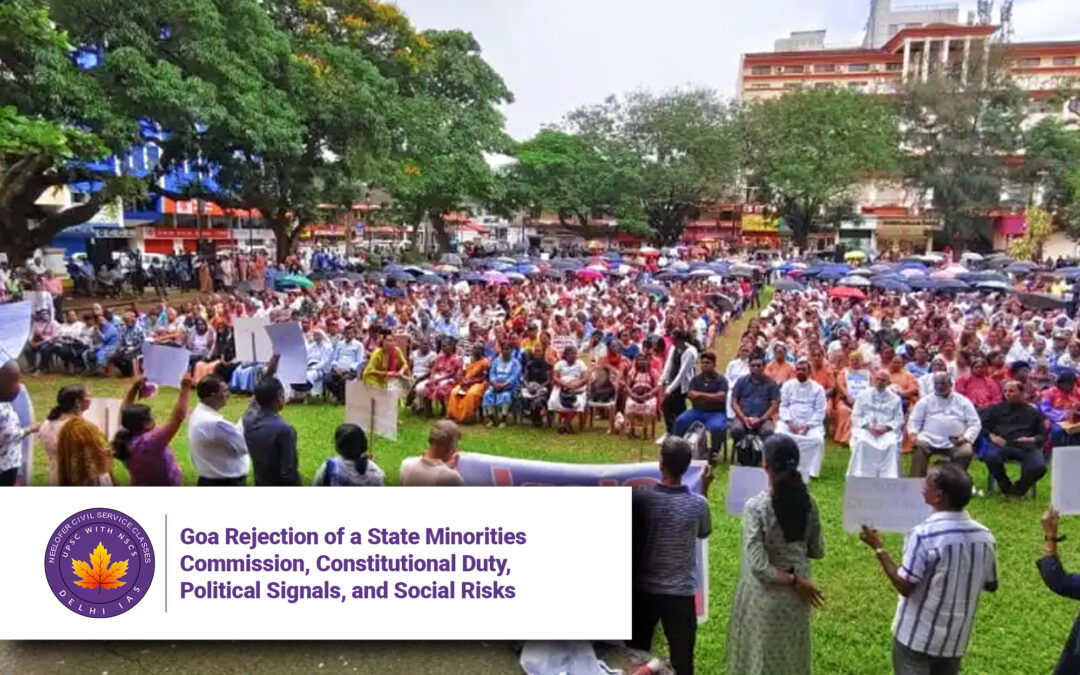
Peaceful protests by minorities in places like Chicalim, Panaji, and Old Goa have highlighted genuine fears about representation and rights.
-
Dismissing these protests as politically motivated risks alienating communities and eroding the trust that underpins Goa’s social stability.
Goa’s harmony is a result of active community relationships, not an automatic or unshakeable reality. Without institutional safeguards, even harmonious societies can experience erosion of trust over time.
V. The Role of State Minority Commissions
State Minority Commissions are not ornamental bodies; they have specific, proactive functions:
-
Monitoring constitutional and legal safeguards for minorities.
-
Evaluating the implementation of welfare schemes for equitable distribution.
-
Addressing and investigating grievances relating to rights violations.
-
Making policy recommendations to prevent discrimination.
-
Serving as a bridge between communities and the government.
Without such a body, the burden of proof and advocacy falls entirely on citizens and civil society — often with limited influence over policymaking.
VI. The Constitutional Right and Not Just a Political Choice
The right to have minority protection mechanisms is embedded in India’s constitutional philosophy:
-
Article 14: Equality before the law.
-
Article 15: Prohibition of discrimination on grounds of religion, race, caste, sex, or place of birth.
-
Article 29 and 30: Protection of cultural and educational rights of minorities.
-
Article 51A(e): Duty to promote harmony and the spirit of common brotherhood.
A State Minorities Commission acts as a practical vehicle for these constitutional promises. Refusing to establish one risks reducing these rights to mere symbolic guarantees.
VII. Historical Context of Minority Protections in India
India’s federal framework allows states to create bodies tailored to local demographics and concerns. Some notable historical points:
-
Post-Emergency era (late 1970s): Strengthened focus on protecting vulnerable groups, leading to the institutionalisation of minority commissions.
-
1992: Creation of the National Commission for Minorities, with the expectation that states would follow suit.
-
2000s onwards: Several states used their commissions to investigate discrimination in housing, education, and employment.
The success of such commissions varies, but their very existence signals a state’s commitment to inclusivity.
VIII. Anti-Conversion Laws and Goa’s Paradox
The Goa Chief Minister’s earlier call for an anti-conversion law — despite the absence of credible evidence of forced conversions — is seen as contradictory when paired with assurances of religious harmony. Historically:
-
Anti-conversion laws have been disproportionately applied against minorities.
-
They have been used to justify arrests, disrupt community activities, and suppress legitimate religious expression.
By rejecting a minorities commission while considering restrictive laws, the state risks sending mixed messages about its commitment to pluralism.
IX. Risks of Not Establishing the Commission
If Goa continues without a minorities commission:
-
Grievance redressal will remain fragmented, relying on general administrative channels that lack the mandate or expertise for minority-specific issues.
-
Fear and mistrust could grow among communities, especially if national trends of weaponising laws continue.
-
Erosion of Goa’s secular ethos could occur gradually, affecting tourism, investment, and its international reputation.
-
Political polarisation may deepen, especially if legitimate protests are labelled as political opposition.
X. The Way Forward
To maintain trust and uphold constitutional commitments, Goa could:
-
Establish a State Minorities Commission with adequate independence and resources.
-
Ensure representation from across minority communities.
-
Create accessible grievance mechanisms at local levels.
-
Engage in public outreach to build awareness about rights and schemes.
-
Resist politicising minority issues and instead promote inclusivity as a core governance value.
This is not just about Goa’s minorities — it is about strengthening democracy by ensuring every community feels protected and represented.
Conclusion
Goa’s rejection of a State Minorities Commission is more than a bureaucratic decision; it is a test of its constitutional conscience. In a time when minority protections are under strain across India, Goa has the opportunity to lead by example — not by denying the need for such a body, but by embracing it as a symbol and instrument of inclusivity.
Failing to do so risks not only alienating its minorities but also eroding the very harmony for which the state is celebrated. If Goa wishes to preserve its reputation as a peaceful, pluralistic society, it must go beyond rhetoric and establish robust institutional safeguards.
5 Exam-Oriented Q&A
Q1. What is the primary function of a State Minorities Commission?
A: To monitor and evaluate the implementation of constitutional and legal safeguards for minorities, address grievances, and recommend policy measures for their protection.
Q2. Why is the absence of formal complaints not proof of the absence of discrimination?
A: Victims may avoid filing complaints due to fear of reprisal, lack of awareness, or inaccessible grievance mechanisms, meaning discrimination can persist unreported.
Q3. Which constitutional articles safeguard minority rights in India?
A: Articles 14, 15, 29, and 30 protect equality, prohibit discrimination, and secure cultural and educational rights for minorities.
Q4. How have anti-conversion laws historically been misused in India?
A: They have been weaponised to target minorities, justify arrests, and suppress legitimate religious activities under the pretext of protecting societal harmony.
Q5. What risks does Goa face by not setting up a State Minorities Commission?
A: Fragmented grievance redressal, growing mistrust among minorities, potential erosion of secular ethos, and increased political polarisation.

