
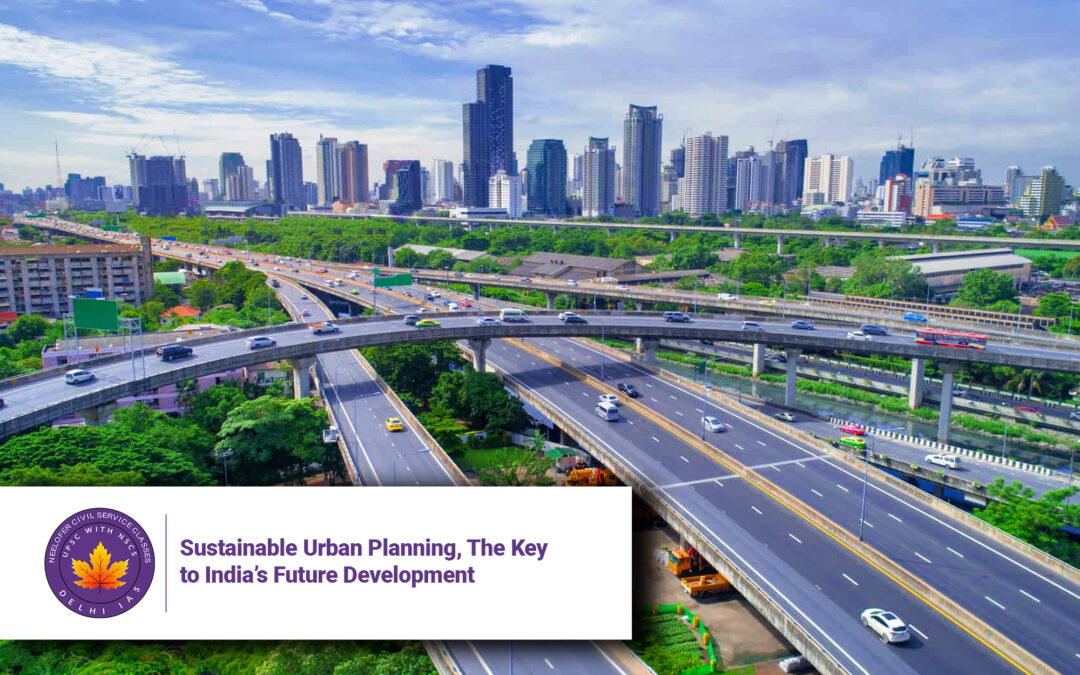
Sustainable Urban Planning, The Key to India’s Future Development
Why in News?
A recent World Bank Report (WBR) has highlighted that India’s urban population is set to nearly double by 2050, reaching 951 million people—about 40% of the country’s total population. This unprecedented growth will require a massive transformation in urban planning, infrastructure, and public service delivery. The report emphasizes that without sustainable urban planning, India could face serious challenges in managing its cities, which are vital for economic growth and development.
Introduction
India stands at a critical juncture in its development journey. Cities already contribute a staggering 60% of the GDP while occupying only 3% of the land. By 2030, the number of cities with populations exceeding one million will increase to 87, and these urban centers will generate 70% of all new employment opportunities. This urban expansion is expected to quadruple India’s per capita income by 2030 compared to 2008 levels.
However, with rapid urbanization comes significant challenges—housing shortages, infrastructure gaps, pollution, and strain on essential services such as water supply and sanitation. The World Bank’s findings make it clear that a well-integrated and sustainable urban plan is essential for achieving the vision of “Viksit Bharat” (Developed India).
Key Issues and Institutional Concerns
1. Structural Transformation and Economic Shift
Urbanization reflects a major structural transformation in India’s economy—shifting from agriculture to industry and services. This change signals:
-
Higher productivity levels.
-
Increased growth opportunities.
-
Emergence of new technologies.
Urban areas foster both forward and backward linkages. Forward linkages provide access to advanced infrastructure and global opportunities, while backward linkages benefit rural areas by offering better connectivity to markets, jobs, and urban infrastructure.
2. Benefits of Urban Development
Rural areas near urban centers see substantial income gains—10–20% higher monthly incomes than the national rural average. Around 200 million people in India benefit directly from urban economic growth. Moreover:
-
The urban sector contributes 80–85% of India’s tax revenue.
-
Urban areas act as hubs for financing development projects.
3. Challenges in Current Urban Planning
Despite the benefits, India’s urban planning faces serious limitations:
-
Inadequate Infrastructure: Urban infrastructure investment between 2011–2018 was only 0.6% of GDP—far below global standards.
-
Housing Shortages: Rising migration is creating a pressing need for affordable housing.
-
Poor Amenities: Many cities struggle with gaps in housing, water supply, sanitation, and sewage treatment.
-
Traffic Congestion & Pollution: High private vehicle ownership causes severe traffic jams and air pollution.
-
Deficient Public Services: Shortages in education and healthcare services fail to match urban population growth.
4. Investment Gaps
To meet infrastructure demands, India needs to invest $840 billion by 2036—about $55 billion annually, or 1.2% of GDP per year. This is double the previous decade’s investment levels.
Funding challenges include:
-
Central and State governments finance 72% of urban infrastructure.
-
Private sector participation remains minimal at just 5%.
-
Nearly 70% of urban infrastructure needed by 2047 still needs to be built.
5. Need for Public-Private Collaboration
The sheer scale of required investment makes public-private partnerships (PPP) critical. Unlocking private capital can bridge the infrastructure gap and accelerate the development of resilient cities.
Challenges and the Way Forward
Key Challenges
-
Rapid Population Growth in Cities: Migration from rural to urban areas is straining housing, water, transport, and healthcare services.
-
Environmental Stress: Traffic congestion and pollution levels are increasing, impacting quality of life.
-
Inequitable Development: Marginalized groups often lack access to basic amenities.
-
Weak Urban Governance: Inconsistent urban planning and poor coordination between agencies slow down infrastructure projects.
-
Climate Vulnerability: Many cities are unprepared for climate-related risks such as floods and heatwaves.
The Way Forward
-
Comprehensive Urban Master Plans: Cities must adopt long-term, data-driven plans integrating housing, transport, green spaces, and public services.
-
Increased Infrastructure Spending: Doubling annual investment in urban infrastructure is crucial to meet growing demands.
-
Public-Private Partnerships: Encouraging private investment through incentives, policy stability, and risk-sharing frameworks.
-
Smart Technologies: Leveraging digital solutions for efficient water use, waste management, and traffic monitoring.
-
Affordable Housing Projects: Expanding schemes like Pradhan Mantri Awas Yojana to accommodate low-income groups.
-
Sustainable Transport: Promoting mass transit systems to reduce congestion and emissions.
-
Climate-Resilient Design: Ensuring that infrastructure can withstand extreme weather events.
Government Initiatives
The Indian government is actively working to harness urbanization’s potential through programs such as:
-
Smart Cities Mission: Enhancing urban living with technology-based solutions.
-
ATAL Mission for Rejuvenation and Urban Transformation (AMRUT): Improving basic services like water supply and sewage.
-
Pradhan Mantri Awas Yojana: Providing affordable housing for all.
-
National Urban Transport Policy: Encouraging sustainable and integrated transport systems.
Conclusion
Urbanization is inevitable, and when managed sustainably, it can be the engine of India’s economic growth. With 70% of urban infrastructure yet to be built by 2047, India has a historic opportunity to shape its cities into sustainable, climate-resilient, and inclusive hubs. This requires not just higher investments but also integrated planning, innovative technologies, and strong governance. A balanced approach—combining forward and backward linkages—will ensure that urban growth benefits the entire nation, including rural communities.
If India can successfully implement sustainable urban planning strategies, the vision of a developed and prosperous nation by 2047 is well within reach.
Q&A Section
Q1. What does the World Bank Report project for India’s urban population by 2050?
A: The report projects India’s urban population will nearly double to 951 million, accounting for 40% of the country’s total population.
Q2. How much does the urban sector contribute to India’s GDP and tax revenue?
A: Cities contribute about 60% of GDP while occupying only 3% of the land, and the urban sector generates 80–85% of India’s tax revenue.
Q3. What is the estimated investment needed for India’s urban infrastructure by 2036?
A: India will need to invest $840 billion in infrastructure by 2036, averaging $55 billion annually.
Q4. What are some major government schemes aimed at improving urban infrastructure?
A: Key schemes include the Smart Cities Mission, AMRUT, and Pradhan Mantri Awas Yojana.
Q5. Why is public-private collaboration important in urban planning?
A: Because nearly 70% of required urban infrastructure is yet to be built, private sector participation is crucial to bridge the funding gap and speed up development.

