
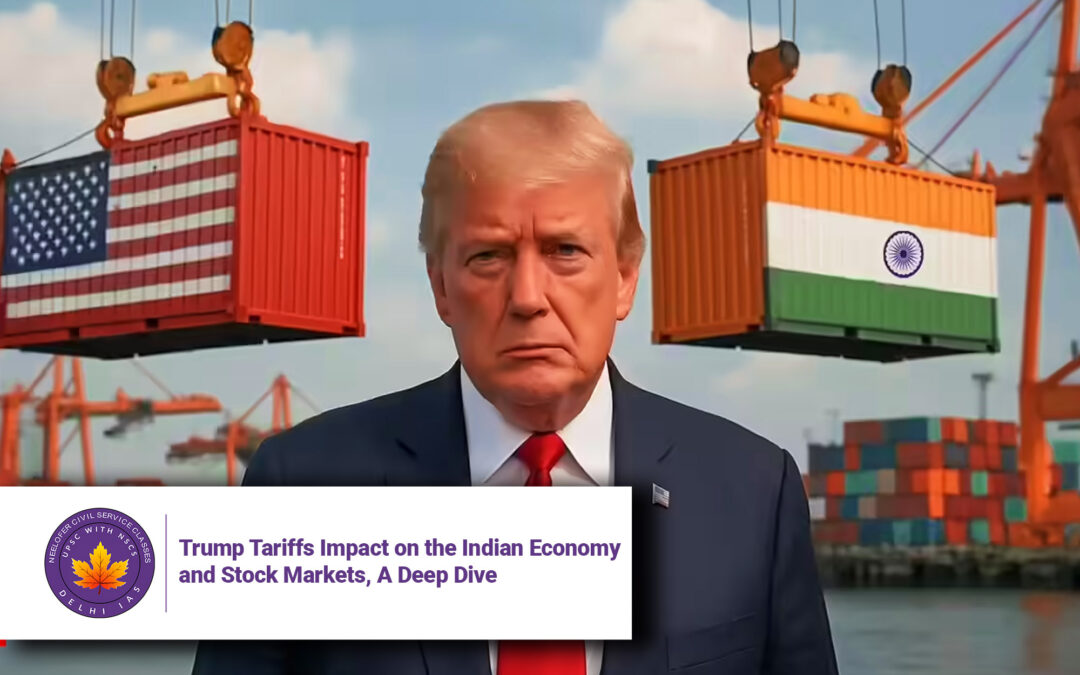
Trump Tariffs Impact on the Indian Economy and Stock Markets, A Deep Dive
The announcement of fresh tariffs by the United States under former President Donald Trump’s administration has opened a new chapter in the complex economic relationship between the two countries. On Wednesday, the US President revealed that an additional 25% penalty tariff would be imposed on goods imported from India as a consequence of India’s continued purchase of oil from Russia. This move builds upon an earlier announcement made on July 31, in which a 25% reciprocal tariff was already declared. With the two measures combined, the total tariff on certain Indian goods exported to the US now stands at an eye-watering 50%.
This escalation has stirred concerns among Indian exporters, policymakers, and economists alike. Given the scale of trade between the two countries, the implications are far-reaching—spanning exports, GDP growth, sectoral profitability, and the stock markets.
Background to the Tariffs
The US decision comes amid its broader geopolitical stance of penalizing countries that maintain significant trade with Russia, especially in the energy sector. India’s continued import of Russian crude oil has been a point of contention in Washington. By doubling the tariff rate from 25% to 50%, the Trump administration is aiming to exert additional economic pressure on India to reconsider its energy procurement strategy.
The reciprocal tariffs took effect on August 7, with the penalty applying 21 days from the announcement—meaning they will be in force starting August 27. Goods already in transit on August 27 but arriving before September 17 will be taxed at the earlier rate, providing a narrow window for exporters to mitigate losses.
Exemptions and Special Cases
Not all Indian exports are impacted by the new tariffs. The US Section 232 investigation exempts certain high-value sectors such as pharmaceuticals, semiconductors, and electronics from reciprocal tariffs. These categories together account for around 30% of India’s total exports to the US.
However, this exemption is not a permanent shield. If the Department of Commerce determines that imports from India in these categories pose a threat to US national security, further tariffs could be applied. At present, Section 232 tariffs already affect key materials like steel (50%), aluminium (50%), and autos and auto parts (25%).
Broader Economic Impact
India’s exports to the US stood at $86.5 billion in FY25, representing 19.5% of India’s total exports. The US remains India’s largest export destination. Historically, the tariff rate on Indian goods was around 3%, making them competitive in the US market. The sudden leap to 50% has the potential to fundamentally alter this dynamic.
With the US imposing such steep penalties, Indian goods will become significantly more expensive. This will make them less competitive compared to goods from rival exporters such as Vietnam, Indonesia, Malaysia, and the Philippines, many of whom face tariffs below 20% when exporting to the US.
Exporters in the textiles, chemicals, and gems & jewellery sectors—three of the worst-hit industries—predict a reduction of 50-70% in their shipments to the US. The Global Trade Research Initiative (GTRI) estimates that the new tariff regime could slash overall Indian exports to the US by 40-50%.
Given that exports to the US account for approximately 2.2% of India’s GDP, the Commerce Ministry warns that the GDP growth rate could drop by 30-40 basis points in FY26 if these tariffs remain in place.
Sectoral Impact Analysis
1. Textiles and Apparels
Accounting for 37% of Indian exports to the US in the affected tariff categories, the textiles sector faces a serious challenge. Price-sensitive American buyers may shift to cheaper sources such as Bangladesh or Vietnam, eroding India’s long-standing market share.
2. Chemicals
Comprising 15% of the affected exports, chemicals will see a substantial loss of orders, especially in specialty chemicals where India has been building a global reputation.
3. Electrical Machinery
With 32% share, this sector could see orders being diverted to other Asian suppliers. Given the capital-intensive nature of electrical goods production, even a moderate dip in exports can have a large impact on margins.
4. Gems and Jewellery
Making up 30% of the impacted exports, this sector—already facing global demand fluctuations—could be severely hit. Many small and medium firms in this industry operate on thin margins and may struggle to survive if export orders dry up.
Comparison with ASEAN and China
One of the more telling aspects of this tariff hike is its relative severity. With a 50% tariff, India’s goods will face a heavier burden than those from ASEAN economies, which average 19-20%, and will be on par with China in terms of trade barriers. This places Indian exporters at a significant disadvantage, especially in competitive product categories where pricing is the primary differentiator.
Impact on Stock Markets
From an investment standpoint, the sectors most affected—chemicals, textiles, gems, and jewellery—are not heavily represented by large-cap companies in India’s benchmark indices. Therefore, while the Sensex and Nifty may not suffer a direct large-scale impact, mid-cap and small-cap stocks in these industries could see sharp declines in revenue and profitability.
Companies such as Gokaldas Textiles, Kitex, Camlin, Aarti Industries, Atul, Bharat Forge, Suprajit Engineering, and Sona BLW are expected to bear the brunt. Reduced revenue from the US could weaken their financial performance, leading to lower share prices.
Furthermore, the broader stock market could still face secondary shocks from reduced investor sentiment and weakened export-driven earnings across the corporate sector.
Energy Imports and the Oil Factor
The tariffs are directly tied to India’s decision to continue purchasing Russian crude oil. If India were to reduce or halt these imports, the tariffs might be reconsidered. However, given the cost advantages of Russian oil, this is a politically and economically sensitive decision.
A reduction in Russian oil imports could open opportunities for domestic energy giants like Reliance Industries and other oil marketing companies (OMCs) to benefit from higher crude prices. However, such a shift could also raise domestic fuel costs, affecting inflation and household budgets.
Policy Options and Strategic Responses
India has several possible courses of action in response to these developments:
-
Diplomatic Negotiations – Engage the US in high-level trade talks to seek a rollback or reduction in the tariffs.
-
Diversification of Export Markets – Increase focus on the EU, Middle East, Africa, and ASEAN to offset the loss in the US market.
-
Value Addition and Branding – Move away from competing purely on price and focus on quality and niche products.
-
Domestic Support Measures – Offer subsidies, tax breaks, or low-interest loans to exporters in affected industries.
-
Energy Procurement Strategy – Evaluate the long-term benefits and risks of Russian oil imports in light of geopolitical and trade repercussions.
The Road Ahead
While the tariffs represent a serious challenge, they also serve as a wake-up call for India’s export sector to diversify and innovate. Overreliance on a single market—no matter how lucrative—can leave industries vulnerable to sudden geopolitical shifts. The coming months will test India’s ability to balance its economic interests with diplomatic pressures.
If history is any guide, trade tensions of this nature can sometimes be short-lived, especially if both sides see a mutual benefit in resolution. However, exporters, investors, and policymakers would be wise to prepare for a prolonged period of disruption.
Q&A Section
Q1: What is the total new tariff rate imposed by the US on certain Indian goods?
A1: The total tariff rate is now 50%, comprising an earlier 25% reciprocal tariff plus a new 25% penalty for India’s continued purchase of Russian oil.
Q2: Which sectors are exempt from these tariffs and why?
A2: Pharmaceuticals, semiconductors, and electronics are currently exempt due to ongoing US Section 232 investigations. These sectors together account for around 30% of India’s exports to the US.
Q3: What is the expected impact of the tariffs on India’s GDP?
A3: The Commerce Ministry estimates a 30-40 basis point drop in GDP growth in FY26 if the tariffs remain and US exports decline as expected.
Q4: Which industries are most vulnerable to the new tariffs?
A4: Textiles and apparels, chemicals, electrical machinery, and gems & jewellery—together forming the bulk of affected exports—are expected to face the steepest declines.
Q5: How will the tariffs affect Indian stock markets?
A5: While benchmark indices may not be directly hit, many mid-cap and small-cap companies in the affected industries could see significant drops in revenue and profitability, dampening investor sentiment.

