
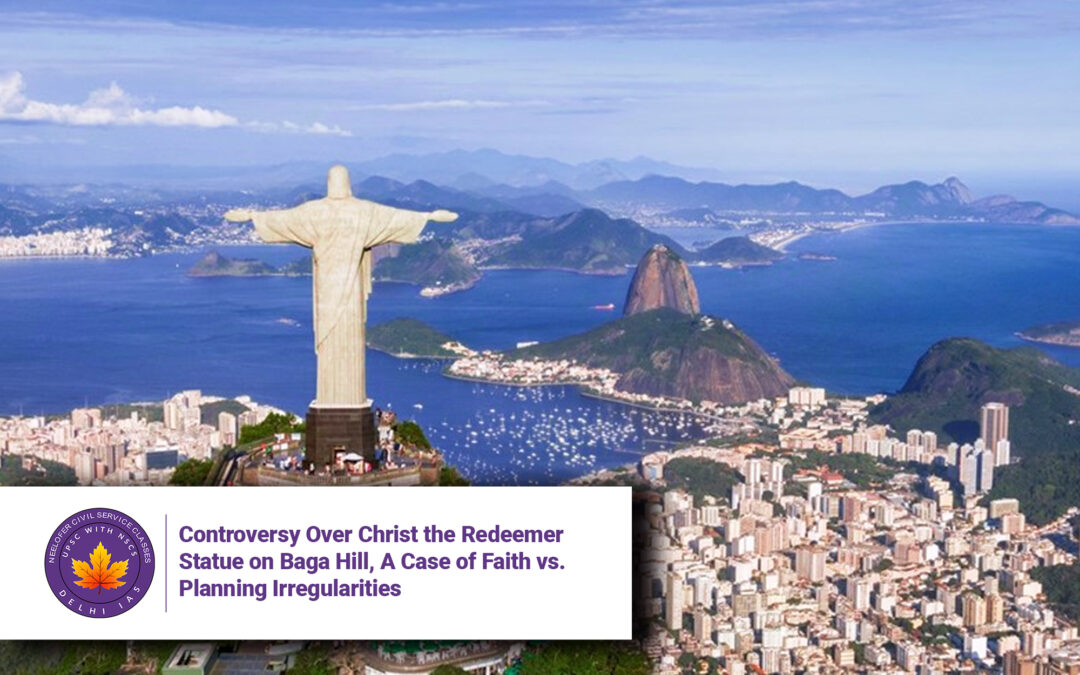
Controversy Over Christ the Redeemer Statue on Baga Hill, A Case of Faith vs. Planning Irregularities
Why in News
The Christ the Redeemer statue project atop Baga Hill in Goa has sparked renewed legal and public controversy, as its development has come under scrutiny for zoning violations, ecological threats, and misuse of land classification laws. What began as a religious symbol has now come to represent larger concerns around governance, environmental protection, and planning impropriety.
Introduction
The Christ the Redeemer project, inspired by Brazil’s iconic statue, was proposed to be built on Baga Hill in Goa. While initially celebrated by some as a symbol of religious devotion and tourism potential, the statue is now at the center of legal disputes and civic unrest. Residents, experts, and legal advocates argue that the statue’s development is marred by opaque land conversions, violations of forest laws, and misuse of the traditional Communidade land title system.
Key Issues and Background
Forest Converted into Settlement
The 2021 Regional Plan for Goa reclassified large parts of Baga Hill, once marked as forest, into “settlement zones,” enabling high-value real estate and infrastructure development. This shift from conservation to construction zones was made without clear ecological justification or participatory public input. The move contradicts the Supreme Court’s long-standing rulings that forest lands must be treated as such, regardless of ownership.
Disputed Deed and Historical Ownership
A key area where the statue is proposed falls under Survey No. 267, Sub Division I, which was formerly marked as forest. Although the government claimed the land was gifted by late Clarinmundo de Souza’s family, legal documents suggest continued ownership disputes. Despite a Deed of Partition that lists the land under private ownership, its classification remains unresolved, with further scrutiny needed to verify ownership under forest laws.
Misuse of Communidade Land Titles
The term Communidade land is increasingly being invoked to bypass standard legal procedures. In Baga Hill’s case, Communidade claims are based on unclear administrative notations rather than valid legal records. This has facilitated large-scale projects without judicial review, public consultation, or proper zoning clearance.
Specific Impacts or Effects
Ecological and Environmental Consequences
Baga Hill lies within the coastal lateritic plateau, crucial to Goa’s ecological balance. The transformation of this terrain into a tourism hub and statue site threatens the hill’s stability and biodiversity. Experts warn of increased erosion, slope instability, and damage to nearby forests and ecosystems. The construction also adds pressure on narrow roads and encourages unauthorized development.
Legal and Planning Violations
The Planning and Urban Development (PILWP 32/2019) petition pending before the High Court points to multiple illegalities:
-
Violation of forest protection laws
-
Misuse of zoning plans
-
Disregard for historical deed validity
The petition demands that forest lands be clearly demarcated, and the standing of illegal constructions reviewed thoroughly.
Challenges and the Way Forward
Corrective Actions Required
The Town and Country Planning Department must urgently declassify wrongly zoned land and make Survey No. 267’s ecological status public. Environmental impact assessments and community hearings must be mandated before progressing further on such projects. A full land classification and forest mapping exercise is needed to resolve overlapping claims between private ownership and conservation.
Legal and Civic Oversight
If left unchecked, the Baga Hill project may set a dangerous precedent for future land misuse across Goa. Increased judicial oversight, ecological planning, and transparency in title verification are necessary. Protecting Goa’s hills and coastlines must take precedence over opportunistic development.
Conclusion
The Christ the Redeemer statue on Baga Hill, rather than standing as a monument of faith, has now become a stark reminder of planning impropriety and governance failures. It exposes deep flaws in land classification, forest law enforcement, and community exclusion. Unless immediate corrective steps are taken, the hill could fall prey to irreversible ecological loss and legal erosion. What should be a symbol of hope risks becoming a cautionary tale of mismanaged development.
5 Questions & Answers
1. What is the main controversy around the Christ the Redeemer project in Goa?
The project faces criticism for being built on ecologically sensitive land reclassified illegally, ignoring forest laws, and violating planning norms.
2. What is Communidade land, and how has it been misused in this case?
Communidade land refers to traditional community-owned land in Goa. In this case, it’s been invoked without proper documentation to enable large-scale construction.
3. What environmental concerns are associated with the Baga Hill project?
The hill is part of a coastal plateau ecosystem. Construction could lead to deforestation, slope destabilization, and biodiversity loss.
4. What legal steps have been taken against the project?
Petition PILWP 32/2019 is pending before the High Court to resolve illegal forest conversion and zoning violations on Baga Hill.
5. What is the way forward for Baga Hill?
Immediate legal scrutiny, ecological reassessment, public consultation, and rollback of illegal zoning and construction permissions.
