
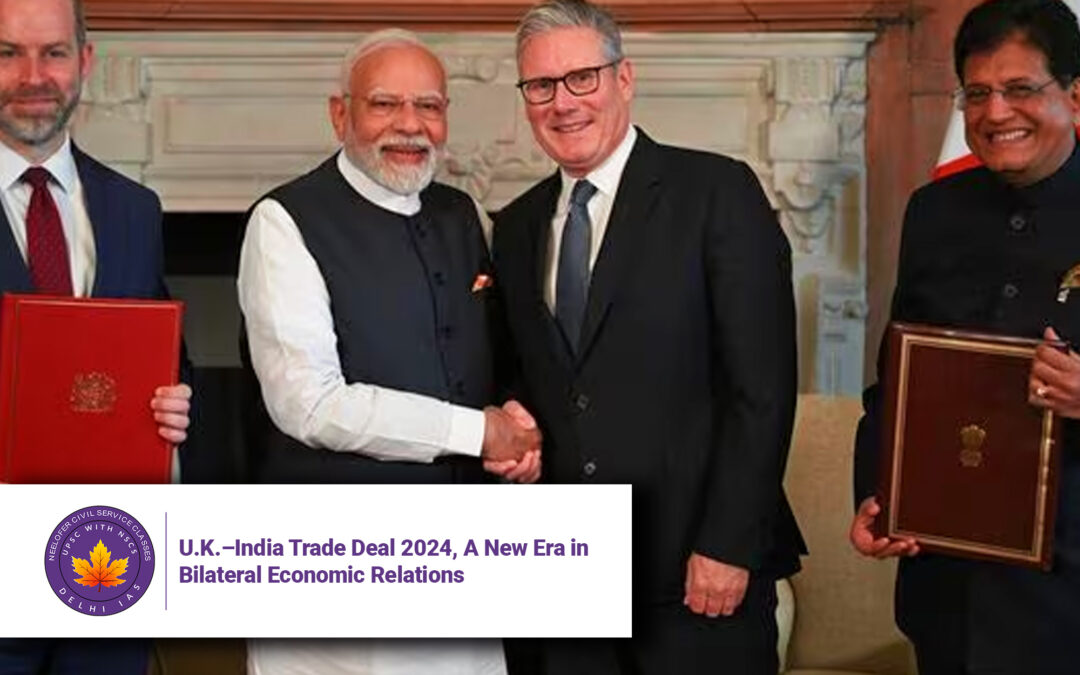
U.K.–India Trade Deal 2024, A New Era in Bilateral Economic Relations
Why in News
India and the United Kingdom have formally signed the Comprehensive Economic and Trade Agreement (CETA), concluding negotiations that began in January 2022. This landmark deal marks over three years of diplomatic and economic engagement aimed at boosting bilateral trade between the two nations.
Introduction
The new CETA between India and the U.K. promises to significantly deepen trade ties, both in goods and services, while also addressing critical regulatory and labor issues. The deal eliminates tariffs on a majority of goods and liberalizes services trade—making it one of the most significant trade agreements India has signed in recent years.
The deal includes several groundbreaking provisions: for the first time, India has agreed to cut tariffs on imported cars, and the agreement introduces labor mobility provisions under the Double Contribution Convention (DCC).
Key Issues and Background
What is the U.K.–India CETA?
The Comprehensive Economic and Trade Agreement is a free trade agreement (FTA) aimed at enhancing goods and services trade between the two countries. The negotiations began in January 2022 and concluded with the official signing in July 2024.
Why Was It Needed?
Though both nations share historical and political ties, the volume of trade was relatively low:
-
India accounted for only 1.2% of the U.K.’s imports
-
The U.K. made up 3.3% of India’s exports in 2024–25
With this deal, both countries aim to increase bilateral trade volumes, especially in textiles, automobiles, IT services, engineering goods, and fresh produce.
Specific Impacts or Effects
On Goods Trade
-
The U.K. has removed tariffs on 99% of its product lines
-
$6.5 billion worth of Indian exports (textiles, seafood, fruits, carpets, etc.) can now enter the U.K. duty-free
-
India has agreed to eliminate/reduce tariffs on 90% of its imports from the U.K.
-
For the first time ever, India has included import duty cuts on automobiles (British cars and engineering products)
Automobile Tariff Details:
-
Large-engine luxury cars: import duty will reduce by 10% over 15 years (starting at 10000 units and rising annually)
-
Mid-sized cars: duty may be cut up to 50% via a quota
-
Small cars: will also see similar cuts
On Services Trade
CETA covers major service sectors:
-
Accounting
-
Auditing
-
Financial
-
Telecom
-
Environmental services
India will now allow U.K. firms to enter these sectors with ease, including setting up local subsidiaries or operating without needing joint ventures.
This benefits Indian companies as well, since the U.K. will grant permanent commercial rights in areas like IT, green energy, and environmental services.
Challenges and the Way Forward
Unusual Aspects
This deal contains a few unique provisions:
-
India’s first-ever auto tariff cut in a trade deal
-
Quota-based approach for car imports, allowing phased tariff reductions
-
The Double Contribution Convention (DCC):
-
Allows 75,000 Indian workers to take short-term jobs in the U.K.
-
Workers won’t have to pay into U.K.’s social security, making it financially viable
-
Most Indian workers will return after short stints and won’t claim U.K. benefits, so both countries save money
-
Concerns
-
Certain sectors like law and accountancy remain restricted for foreign participation
-
Domestic industries must adapt to increased competition, especially in automotive and luxury goods
-
Implementation requires ratification by both governments, and domestic policy adjustments
Conclusion
The U.K.–India CETA is not just a trade agreement—it’s a strategic economic partnership. By opening new avenues in goods, services, and labor, the deal aligns with India’s ambition to become a global trade hub and reflects the U.K.’s post-Brexit push for diversified economic relations.
If implemented successfully, the agreement will reshape bilateral trade, generate jobs, enhance service sector collaboration, and reduce economic barriers. While challenges remain in terms of local industry competition and regulatory alignment, the deal is a strong foundation for long-term cooperation between the two democracies.
5 Questions and Answers
1. What is the U.K.–India CETA?
It is a free trade agreement that removes tariffs on most goods and liberalizes services and labor movement between India and the U.K.
2. What is the Double Contribution Convention (DCC)?
It allows 75,000 Indian workers to work in the U.K. short-term without contributing to U.K. social security, making it financially viable for both sides.
3. What is significant about car imports in this deal?
For the first time, India has agreed to reduce tariffs on imported cars, especially luxury and mid-sized vehicles, using a quota-based system.
4. How does the deal benefit the service sector?
U.K. firms can now more easily enter Indian service sectors like telecom, accounting, and auditing. Indian IT and green energy firms gain long-term rights in the U.K.
5. When will the deal come into effect?
The agreement takes effect immediately upon ratification by both parliaments, which may take 3–6 months.

