
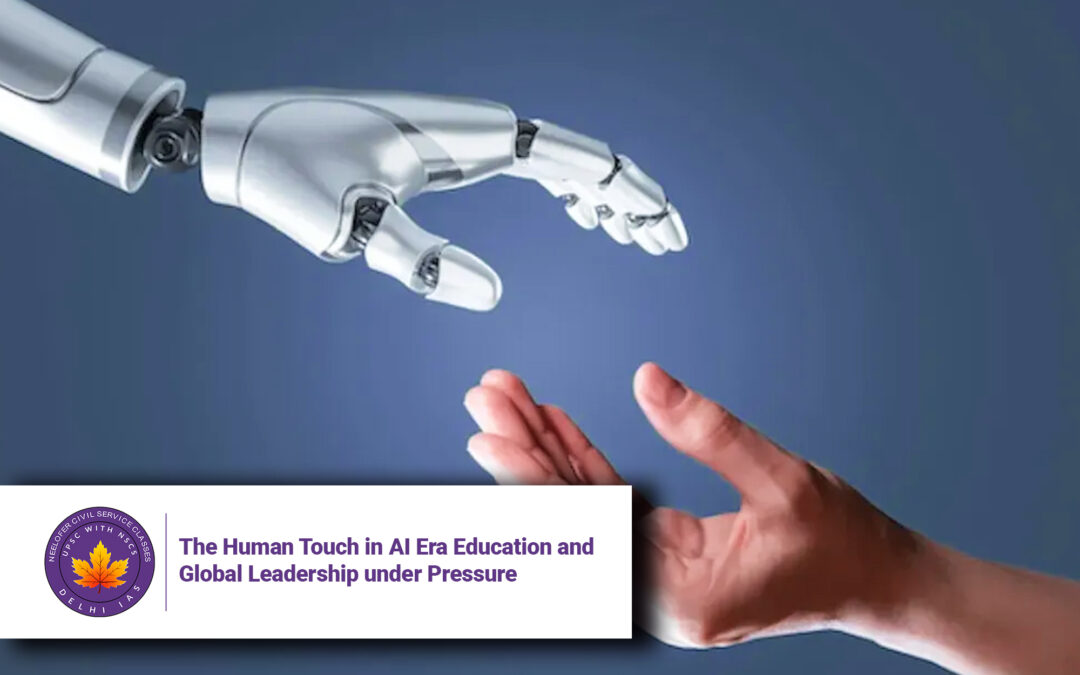
The Human Touch in AI Era Education and Global Leadership under Pressure
Why in News?
A recent opinion piece by Subir Kr Saha in The Telegraph titled “A Teacher’s Touch” emphasizes the irreplaceable role of human educators despite the rise of Artificial Intelligence (AI) in academic assistance. Additionally, another commentary titled “Adrift” analyzes the complex and bold leadership style of U.S. President Donald Trump, six months into his Oval Office tenure.
Introduction
As AI becomes more embedded in the education system, questions are arising about whether it can truly replace the human element in teaching. Simultaneously, global political leadership continues to draw attention, particularly the high-stakes and disruptive governance style of President Trump. These two distinct discussions—on the future of education and political decision-making—highlight the continued relevance of human wisdom, emotional intelligence, and personalized judgment.
Key Issues and Institutional Concerns
1. The Limitations of AI in Education
While AI tools efficiently assist students with assignments, concepts, and tests, they lack the emotional depth, inspiration, and personal warmth that human teachers provide. Prof. Anshuman Kar’s article, “Learning from AI,” is lauded as thought-provoking, yet the writer Subir Kr Saha and Mr. Sanjeev Sanyal agree that machines have their limits, especially in building human relationships.
2. Emotional Intelligence in Teaching
The affective domain—rooted in heart and inspiration—is essential for learning. As Subir Kr Saha points out, a teacher doesn’t just inform the intellect but inspires through emotion and connection, often becoming a guide and moral compass.
3. The Call for Tech-Savvy Educators
While emotional connection is key, modern teachers must still be techno-savvy to leverage AI effectively and engage digital-native students. The article suggests a balanced approach: heart-led teaching supported by technological tools.
4. Pressure-Based Political Leadership
In the “Adrift” piece, President Trump’s early tenure is dissected. Despite being bold and attention-grabbing, his leadership is portrayed as unpredictable and chaotic—filled with diplomatic and economic upheavals like engaging with North Korea, the Abraham Accords, and tariff wars.
5. Human Judgment in Complex Governance
The article highlights the need for clarity, consistency, and wisdom in leadership. As the global community watches Trump’s unpredictable moves, the emphasis remains on how human decision-making—like teaching—cannot always be replaced by strategy alone.
Challenges and the Way Forward
For Education:
-
Institutions must invest in blended models—combining human-led teaching with AI support.
-
Focus should remain on training teachers to use digital tools while nurturing students emotionally.
For Leadership:
-
Leaders must go beyond attention-grabbing strategies and embrace stable, inclusive diplomacy.
-
Policymakers should consider the long-term global implications of disruption-focused tactics.
Conclusion
Both education and leadership are evolving under the influence of technology and global pressures. However, whether in a classroom or a political office, human empathy, insight, and presence remain irreplaceable. The heart and mind must work together—be it teaching young minds or guiding nations.
Q&A Section
1. Q: What is the main argument of “A Teacher’s Touch”?
A: That while AI can assist in learning, it cannot replace the warmth, wisdom, and emotional connection of a real teacher.
2. Q: What educational role does Swami Vivekananda’s quote emphasize?
A: It stresses that true education builds character, strengthens the mind, and enables independence—things machines alone cannot provide.
3. Q: What is the article’s take on Trump’s leadership style in “Adrift”?
A: It describes his leadership as bold, disruptive, and unpredictable, with many high-stakes global moves.
4. Q: Why are tech skills important for today’s teachers?
A: To effectively use tools like AI and keep students engaged in a digital age.
5. Q: What unites both articles in their core message?
A: Both stress the importance of human touch and wisdom—in education and in leadership—especially when technology and power alone fall short.

