
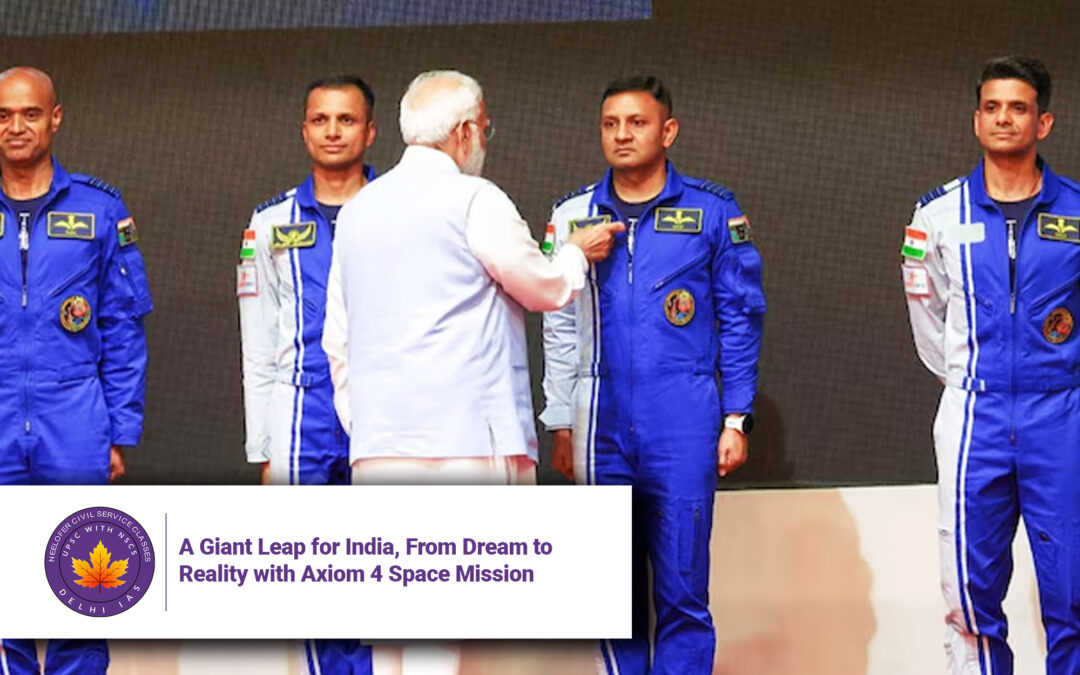
A Giant Leap for India, From Dream to Reality with Axiom 4 Space Mission
Why in News?
On 25 June, Group Captain Shubanshu Shukla, an Indian Air Force officer and ISRO-trained astronaut, soared into space aboard the Axiom-4 mission. His journey marked India’s next significant step not just into outer space, but into a future driven by human-centric science, technology, and innovation. This mission has been hailed as a turning point in India’s space diplomacy and its commitment to transforming science into public service. 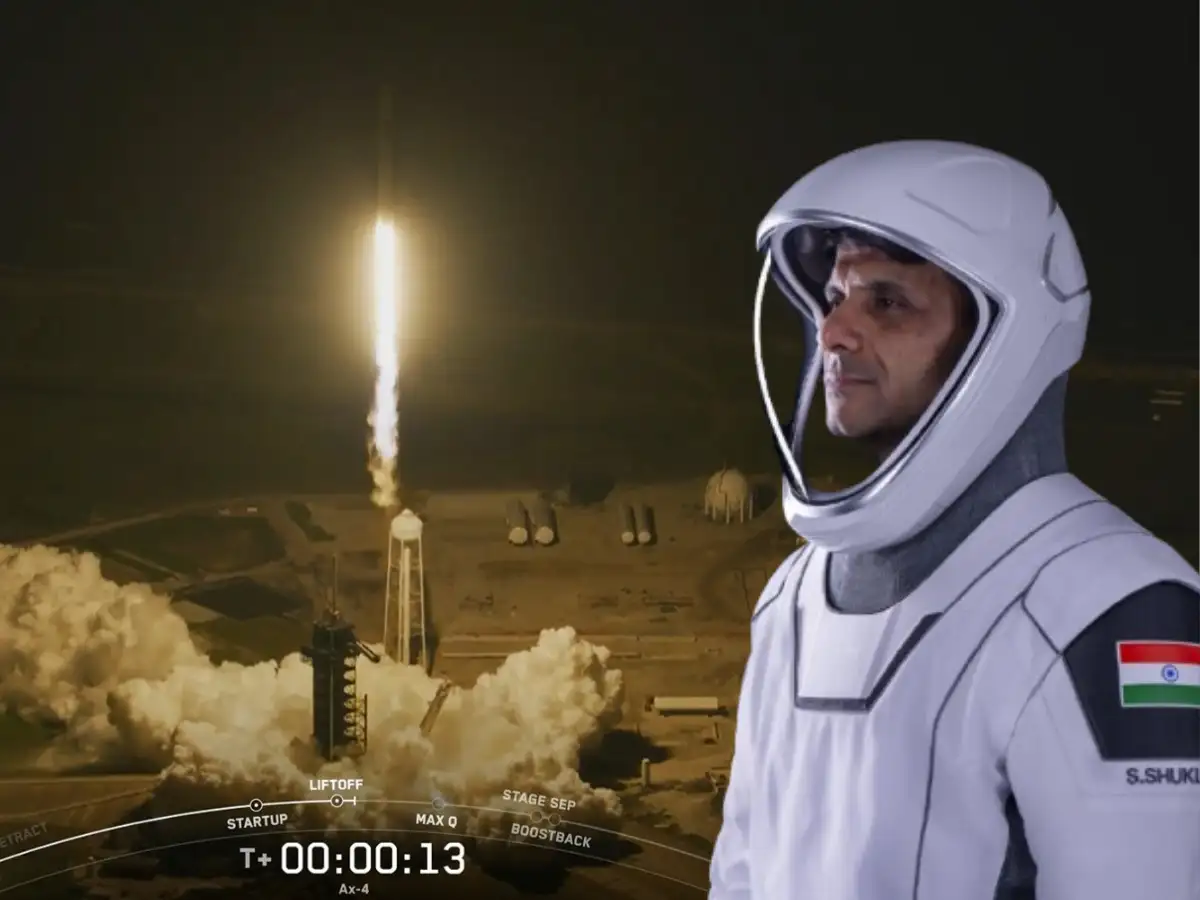
Introduction
India has entered a new era of space exploration, not merely as a participant but as a leader. With the successful participation of Wing Commander Shubanshu Shukla in the Axiom-4 mission, India has elevated its role in global space research. This mission is not about symbolism; it is a deeply scientific and strategic venture reflecting India’s growing capabilities in space science, medicine, agriculture, and international cooperation.
Key Highlights of the Mission
-
The Journey Begins:
The journey of Axiom-4 began under challenging circumstances. A minor crack in the Falcon-9 booster’s pressure feedline triggered a moment of reckoning. But ISRO’s scientists, known for their precision and vigilance, overcame the challenge and safeguarded the mission. -
Scientific Payload:
Shukla did not travel as a ceremonial figure but as a scientific crusader. He carried seven microgravity experiments, each carefully designed by Indian researchers to address issues ranging from healthcare and agriculture to human-machine interaction. -
Pathbreaking Experiments:
-
Agricultural Studies:
Experiments involved sprouting methi and moong seeds in microgravity. These studies could transform vertical farming, hydroponics, and food security on Earth, especially in arid and degraded regions. -
Myogenesis Study:
An experiment on muscle cell responses to space conditions could help develop regenerative treatments for muscular degeneration, benefiting astronauts and elderly patients on Earth. -
Cyanobacteria and Indian Crops:
Another set of experiments explored the possibility of using cyanobacteria as future life-support organisms in space, and the long-term viability of Indian crops like rice, brinjal, mustard, and moong in space, aiming at crop innovation and climate resilience. -
Tardigrade Research:
Studying Indian tardigrades, microscopic organisms known for survival in extreme environments, to decode resilience strategies for future human space exploration. -
Human-Machine Interaction:
Experiments tested the effect of microgravity on interaction with web-based systems and electronic displays, crucial for spacecraft design and operation.
-
India’s Global Space Diplomacy
This mission underscored India’s evolving stature in global space diplomacy. Indian insistence on safety protocols helped SpaceX identify and repair a potentially catastrophic flaw. The collaboration between NASA, ESA, Axiom Space, and ISRO demonstrated a new era of equal partnership where India is not just participating but leading.
ISRO’s Medical Vigilance
During the mission, ISRO flight surgeons closely monitored Shukla’s health and psychological well-being. He remained active and in high spirits, even interacting virtually with students from various Indian cities, including Lucknow, Trivandrum, Bangalore, Shillong, and more—igniting minds across the nation.
Linking Science to Society
These aren’t abstract experiments. Each carries immense potential to impact common lives:
-
Vaccines and immunity research
-
Climate-resilient farming
-
Muscle regeneration therapies
-
Satellite internet in villages
-
Improved hospital technologies
This mission carries the ethos of science for society — from tribal farmers in Odisha to doctors in Ladakh, and students in Shillong, the effects of these space experiments ripple far beyond the lab.
Challenges and the Way Forward
While the success of Axiom-4 is a matter of national pride, India still faces challenges:
-
Translating space science into scalable public services.
-
Increasing investment in research infrastructure.
-
Creating a pipeline of future astronaut-scientists.
-
Strengthening public-private space partnerships.
But the roadmap is clear. The Gaganyaan mission and Bharat Space Station are next in line. Axiom-4 serves as a rehearsal — a proof of concept — showcasing Indian expertise, discipline, and vision.
Conclusion
As Prime Minister Narendra Modi once said, “Gaganyaan is about placing an Indian in space by Indian means.” Shubanshu Shukla’s mission is the trailer of what lies ahead. Axiom-4 proves that the sky is no longer the limit — it is the laboratory. And in this laboratory, the dreams of a billion Indians are taking flight.
Five Questions & Answers
Q1. Who is Group Captain Shubanshu Shukla?
A1. He is an Indian Air Force officer and ISRO-trained astronaut who flew on the Axiom-4 mission to the International Space Station.
Q2. What kind of scientific experiments were carried out in Axiom-4?
A2. Seven microgravity experiments including crop sprouting, muscle regeneration, cyanobacteria studies, Indian tardigrades, and human-machine interaction were conducted.
Q3. How does Axiom-4 promote science for society?
A3. By exploring solutions for regenerative medicine, food security, vaccine development, and satellite internet for remote villages.
Q4. How did India contribute to the mission’s safety?
A4. Indian experts ensured strict safety protocols, which helped SpaceX detect and fix a critical flaw before launch.
Q5. What is the broader goal of India’s space journey as reflected in this mission?
A5. To establish India as a global space leader and to bring the benefits of space science into public service through missions like Gaganyaan and Bharat Space Station.

