
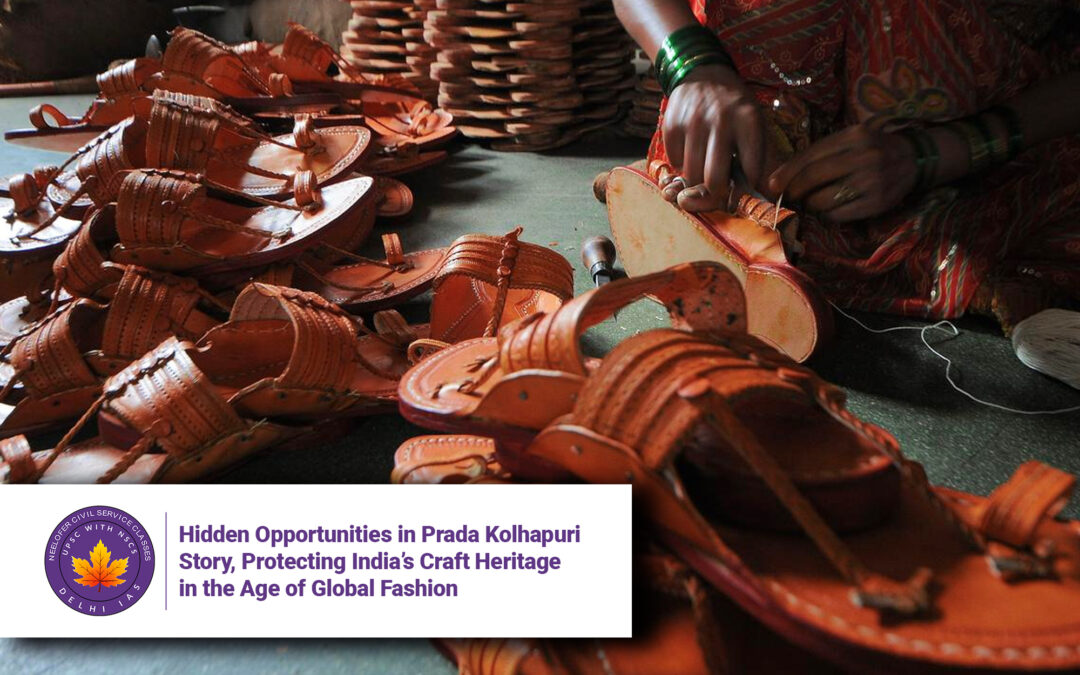
Hidden Opportunities in Prada Kolhapuri Story, Protecting India’s Craft Heritage in the Age of Global Fashion
Introduction
In an era of globalization and hyperconnectivity, the line between cultural appreciation and appropriation has become increasingly blurred. The recent controversy surrounding Prada’s near-identical replication of Kolhapuri chappals—a centuries-old, Geographical Indication (GI)-tagged craft from Maharashtra—has reignited debates about intellectual property rights, ethical fashion, and the economic exploitation of traditional artisans. While Prada’s actions exemplify a long history of Western brands profiting from Indian designs without fair compensation, the incident also presents an opportunity: a chance for Indian artisans to leverage global interest into sustainable collaborations that preserve their heritage while securing financial benefits.
This article explores the Kolhapuri-Prada controversy, the broader issue of cultural appropriation in fashion, the legal and ethical frameworks protecting traditional crafts, and actionable strategies to empower Indian artisans in the global marketplace.
1. The Kolhapuri-Prada Controversy: A Case of Cultural Appropriation
What Happened?
-
Prada’s Spring/Summer 2024 collection featured sandals strikingly similar to Kolhapuri chappals, a handcrafted leather footwear tradition from Maharashtra’s Kolhapur region.
-
The design was marketed as Prada’s “creative output,” with no acknowledgment of its Indian origins.
-
Kolhapuri chappals received a GI tag in 2019, legally recognizing their unique regional identity.
Why Is This Problematic?
-
Lack of Attribution: Prada did not credit or collaborate with Kolhapur’s artisans.
-
Economic Exploitation: The brand will profit from a design that local craftsmen struggle to monetize at scale.
-
Dilution of Craft Identity: When global brands mass-produce traditional designs, they risk eroding the cultural significance and exclusivity of the original craft.
2. Cultural Appropriation in Fashion: A Recurring Issue
Examples of Western Brands Borrowing Indian Designs
| Brand | Indian Design Appropriated | Response |
|---|---|---|
| Gucci | Copied traditional kurtas | No attribution, sold as “exotic” wear |
| Toteme | Sold “Scandinavian scarves” resembling dupattas | Marketed as original designs |
| Dior | 2022 show featured Indian embroidery | Collaborated with Indian artisans |
Appropriation vs. Appreciation
-
Appropriation: Taking elements of a marginalized culture without permission, credit, or compensation (e.g., Prada’s Kolhapuri sandals).
-
Appreciation: Ethical collaboration that respects origin, shares profits, and elevates artisans (e.g., Dior’s 2022 showcase).
3. Legal Protections: Can GI Tags and IP Laws Prevent Exploitation?
Geographical Indication (GI) Tag: A Double-Edged Sword 
-
What It Does:
-
Protects products originating from a specific region (e.g., Darjeeling tea, Kanchipuram silk).
-
Prevents unauthorized use of the product’s name.
-
-
Limitations:
-
Does not stop brands from replicating the design (only the label “Kolhapuri”).
-
Enforcement is weak globally; foreign brands can bypass GI rules.
-
Other Legal Frameworks
-
Copyright Law: Protects artistic works but rarely applies to functional crafts.
-
Design Patents: Expensive and time-consuming for artisans to file internationally.
-
Traditional Knowledge Digital Library (TKDL): Documents Indian crafts but lacks enforcement power.
Case Study: The Success of Kanchipuram Silk
-
Strong GI protection + weaver cooperatives = better market control.
-
Lessons for Kolhapuri artisans: Collective bargaining + legal awareness.
4. Turning Appropriation into Opportunity: A Blueprint for Artisans
1. Demand Collaboration, Not Just Credit
-
Prada’s Reported Interest: After backlash, the brand expressed willingness to work with Kolhapur’s artisans.
-
Model to Follow:
-
Dior x Chanakya Ateliers (2022): Partnered with Mumbai embroiderers, sharing profits.
-
Stella McCartney x SEWA: Collaborated with Gujarat’s Self-Employed Women’s Association.
-
2. Build Artisan Collectives for Scale
-
Problem: Individual artisans lack bargaining power.
-
Solution:
-
Form craft clusters (e.g., Kutch embroidery cooperatives).
-
Use platforms like GoCoop to connect with global buyers.
-
3. Leverage E-Commerce and Direct-to-Consumer Models
-
Success Story:
-
Jaipur Rugs: Bypassed middlemen, selling directly online.
-
Chumbak: Marketed traditional designs as contemporary lifestyle products.
-
4. Push for Stronger Legal Safeguards
-
Policy Demands:
-
Amend GI laws to cover design derivatives.
-
Create an international IP watchdog for traditional crafts.
-
5. Educate Consumers on Ethical Fashion
-
Initiatives Like:
-
#WhoMadeMyClothes (Fashion Revolution).
-
Craftmark (authenticates handmade Indian products).
-
5. The Road Ahead: A Call to Action
For the Government
-
Strengthen GI enforcement with harsher penalties for violations.
-
Fund artisan entrepreneurship programs.
For Brands
-
Adopt ethical sourcing policies (e.g., Fair Trade certification).
-
Ensure transparent profit-sharing with artisans.
For Consumers
-
Support authentic crafts (look for GI tags, Craftmark).
-
Boycott brands that appropriate without credit.
Conclusion: From Exploitation to Empowerment
The Prada-Kolhapuri incident is a wake-up call—not just about cultural theft, but about the untapped potential of India’s artisan economy. While legal battles and awareness campaigns are crucial, the real victory lies in transforming global demand into sustainable partnerships. By uniting under cooperatives, embracing digital markets, and demanding fair trade, India’s craftsmen can reclaim their heritage and their livelihoods.
As the saying goes, “Opportunities are often disguised as challenges.” For Kolhapur’s artisans, Prada’s faux pas may just be the catalyst for a revolution in ethical fashion.
Key Questions & Answers
-
What is a GI tag, and how does it protect Kolhapuri chappals?
A GI tag certifies the regional origin of a product, preventing misuse of the name but not the design. -
Can Indian artisans sue Prada for copying their design?
Only if they hold a design patent (rare for traditional crafts). GI tags alone don’t block replicas. -
How can consumers identify authentic Kolhapuri chappals?
Look for the GI tag, artisan signatures, or buy from certified sellers like GoCoop. -
What’s the difference between Dior’s and Prada’s approach to Indian crafts?
Dior collaborated with artisans; Prada copied without credit or compensation. -
What’s the best way for artisans to prevent future appropriation?
Form collectives, use e-commerce, and push for stronger IP laws.

