
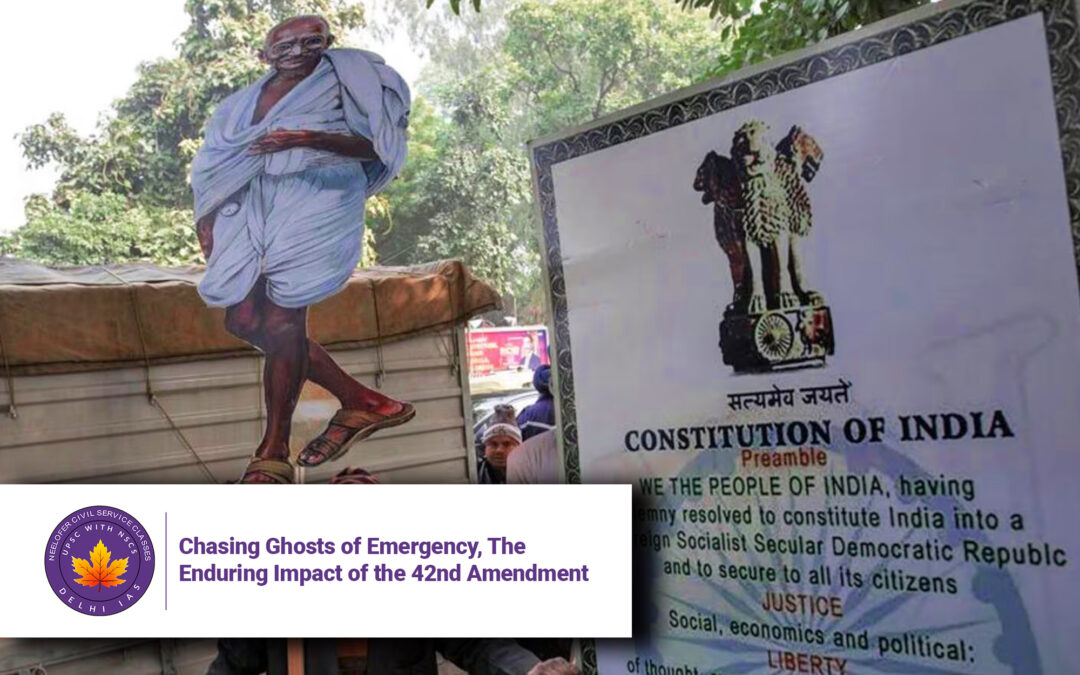
Chasing Ghosts of Emergency, The Enduring Impact of the 42nd Amendment
Why in News?
A political storm has erupted over the inclusion of the terms “secular” and “socialist” in the Constitution’s Preamble during the 1975 Emergency. UP CM Yogi Adityanath called it a “brutal assault on India’s soul,” while RSS leader Dattatreya Hosabale demanded a review, citing the amendment’s undemocratic origins. The debate has reignited discussions about the Emergency’s constitutional legacy and its relevance today. 
Key Issues and Background
-
The 42nd Amendment’s Controversial Legacy
-
Passed in 1976 during the Emergency, the amendment inserted “secular” and “socialist” into the Preamble, reflecting Indira Gandhi’s alignment with Soviet-style socialism and her claim to protect secularism from groups like the RSS.
-
Critics argue these additions were symbolic, masking deeper damage: weakening the judiciary, undermining federalism by centralizing power, and elevating Directive Principles over Fundamental Rights.
-
-
Political Firestorm
-
BJP leaders, including VP Jagdeep Dhankhar, have labeled secularism as “anti-Sanatana Dharma” and “Western,” while the Opposition accuses the government of undermining constitutional values.
-
The Janata Party’s 43rd and 44th Amendments (1977–78) reversed many Emergency-era changes but retained the Preamble’s additions, fearing backlash for being “anti-poor” or “anti-secular.”
-
-
Federalism Under Strain
-
The amendment altered the Seventh Schedule, skewing power toward the Centre—a shift that continues to fuel state-Centre conflicts today (e.g., Delhi vs. Centre).
-
Unresolved Tensions
-
Symbolism vs. Substance: While “secular” and “socialist” remain contentious, the amendment’s erosion of judicial independence and federal balance has had longer-lasting consequences.
-
Hypocrisy Across Parties: No post-Emergency government dared to remove the terms, revealing the political risks of challenging these loaded labels.
Way Forward
-
Focus on Restorative Reforms: Instead of debating semantics, revisiting the 42nd Amendment’s structural changes—especially its impact on federalism and fundamental rights—could strengthen democracy.
-
Depoliticizing the Preamble: A bipartisan review of the Constitution’s basic structure, led by legal experts rather than politicians, might prevent further polarization.
5 Key Questions & Answers
-
Why were “secular” and “socialist” added to the Preamble?
Indira Gandhi inserted them during the Emergency to legitimize her regime’s pro-Soviet, “secular” image, despite suppressing democratic institutions. -
What were the 42nd Amendment’s most damaging effects?
It weakened courts, centralized power, and prioritized state directives over citizens’ rights—changes only partially reversed post-Emergency. -
Why hasn’t any government removed these terms?
Fear of being branded “anti-poor” (socialism) or “anti-minority” (secularism) made parties avoid touching the Preamble, even as they critiqued the Emergency. -
How does this debate impact federalism today?
The amendment’s Seventh Schedule changes still skew power toward the Centre, fueling disputes like Delhi’s statehood demand. -
Is this debate about ideology or constitutional integrity?
While BJP frames it as anti-Dharma and Congress as pro-secularism, the real issue is the amendment’s undemocratic origins and institutional damage.

