
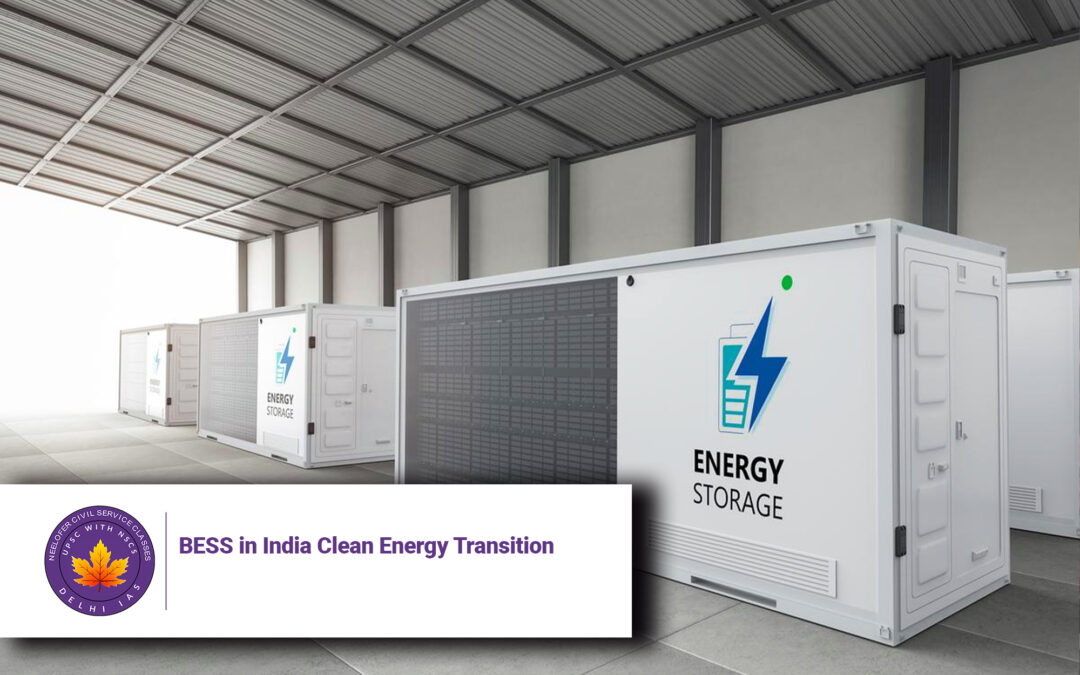
BESS in India Clean Energy Transition
Headline:
India Accelerates Clean Energy Shift with Battery Energy Storage Systems (BESS)
Why in News?
India is fast-tracking its transition to clean energy through the adoption of Battery Energy Storage Systems (BESS). With climate crises altering the very definition of energy security, BESS has emerged as a key solution to manage renewable energy variability, reduce peak demand stress, and build a stable, green-powered future.

Introduction:
In light of the ongoing climate emergency, India is redefining energy security by focusing on four pillars: availability, accessibility, affordability, and environmental acceptability. This shift demands solutions that reduce greenhouse gas emissions while also providing stable power at lower costs. One such game-changing innovation is the Battery Energy Storage System (BESS), which offers a powerful alternative to conventional grids by storing and supplying renewable energy efficiently.
Key Developments:
-
Rising Demand and Affordability:
Over the past 15 years, the cost of batteries has significantly fallen, driven by companies like BYD, Tesla, Panasonic, LG, Samsung, and others, making BESS viable for large-scale deployment. -
India’s Energy Storage Goals:
India’s national target is to add 47 GW of BESS by 2032. So far, the country has already deployed 250 MW across 10 projects. BESS plays a crucial role in managing renewable energy integration, reducing curtailment, and providing ancillary services. -
Key Policy Initiatives:
-
The Ministry of Power issued the first guidelines for BESS in August 2023.
-
Viability Gap Funding (VGF) scheme of ₹3,760 crore announced for 4,000 MWh capacity.
-
Private players like JSW, Tata, and ReNew have stepped in with battery projects.
-
-
Strategic Importance:
BESS helps balance the grid during demand spikes, ensures better renewable absorption, and provides long-duration storage solutions, thus supporting India’s clean energy and net-zero goals. -
India’s Global Leadership:
India aims to become a global leader in battery manufacturing and storage solutions by scaling production, investing in R&D, and creating indigenous technology ecosystems.
5 Key Takeaways:
-
BESS is essential for integrating renewable energy smoothly into India’s grid.
-
India targets 47 GW of BESS capacity by 2032 to meet its clean energy ambitions.
-
Declining battery costs and rising innovation have made energy storage affordable and scalable.
-
Government policies, private investments, and public-private partnerships are critical to BESS success.
-
India is positioning itself as a global manufacturing hub for clean energy storage technologies.
Challenges and the Way Forward:
While progress is commendable, challenges remain:
-
High upfront costs and regulatory uncertainties.
-
Need for faster deployment of manufacturing units and R&D infrastructure.
-
Need for enhanced grid synchronization and digital integration.
To overcome this, India must:
-
Foster international collaborations for technology transfer.
-
Expand domestic battery production capabilities.
-
Accelerate policy clarity and investment-friendly reforms.
Conclusion:
Battery Energy Storage Systems stand at the forefront of India’s clean energy future. As the country seeks to meet its ambitious renewable energy targets and reduce its carbon footprint, BESS will play a central role in grid stability, affordability, and reliability. With clear policies and determined investment, India is poised to lead the world into a greener, more secure energy future.
Q&A Section:
1. What is BESS and why is it important for India?
BESS stands for Battery Energy Storage Systems. It stores excess renewable energy and provides it when demand peaks or generation drops, helping balance the grid and reduce carbon emissions.
2. How much BESS capacity does India plan to install by 2032?
India aims to install 47 GW of BESS capacity by 2032.
3. What are the main benefits of BESS in energy transition?
BESS provides energy reliability, reduces emissions, supports renewable integration, manages peak demand, and improves grid flexibility.
4. What role is the government playing in promoting BESS?
The government has launched policies, viability gap funding schemes, and issued operational guidelines for BESS, encouraging both public and private sector investments.
5. How is India planning to become a global leader in BESS?
India is boosting domestic manufacturing, investing in research and development, fostering global partnerships, and aligning with its net-zero goals.
Disclaimer: This article has been written by an AI without any human modification or change.

