
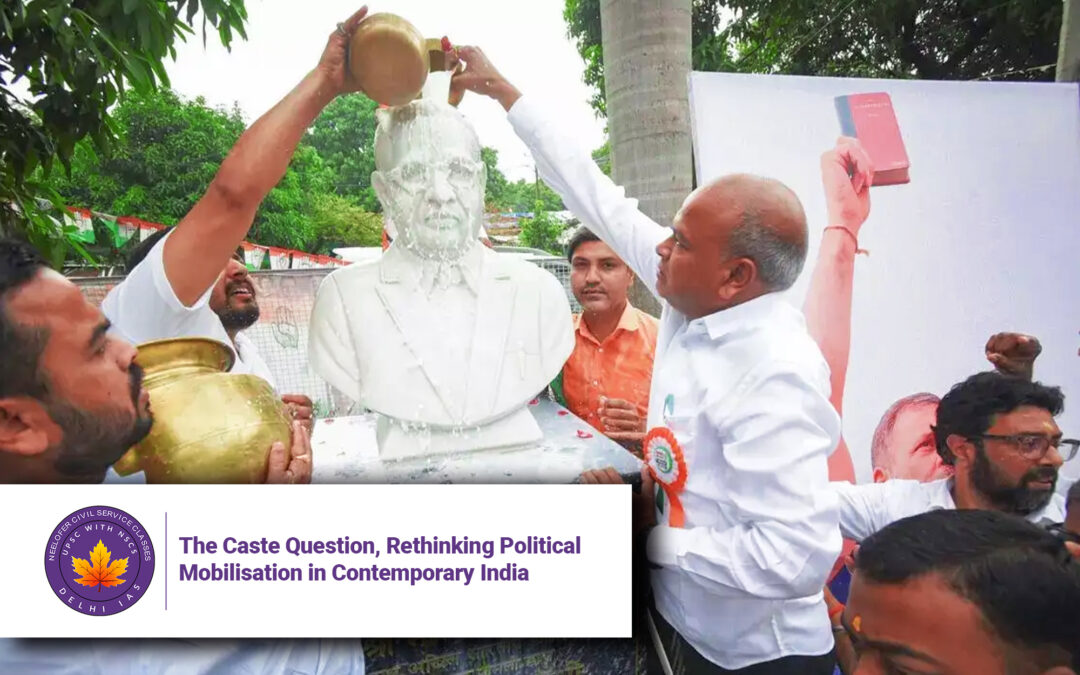
The Caste Question, Rethinking Political Mobilisation in Contemporary India
Why in News?
The article by Badri Narayan sheds light on the renewed importance of caste data and caste identities in India’s political discourse, especially in the context of BJP’s evolving stance. With the changing dynamics of electoral politics, caste has emerged not just as a social factor, but as a key tool of governance and empowerment.
Introduction
Indian society is deeply diverse — ecologically, culturally, socially, and politically. This diversity, when harnessed wisely, becomes a strength. However, politics often leans into identity-based mobilization to connect with the masses. The BJP, historically cautious about caste-based politics, seems to be re-evaluating its stance, signaling a strategic shift toward caste inclusion and representation.
Key Issues and Background
1. BJP’s Historical Stance
Traditionally, the BJP has positioned itself as a party advocating “development for all” (Sabka Saath, Sabka Vikas), staying away from caste-based appeals. Leaders like Sushma Swaraj, Rajnath Singh, and Amit Shah did not significantly emphasize caste in their political strategies until recently.
2. Recent Shift in Strategy
In the wake of elections and rising competition from regional and opposition parties that heavily bank on caste coalitions, BJP leaders have started making overt references to caste-based representation, both in rhetoric and policymaking.
3. Importance of Caste Census
The demand for a caste-based census, once viewed cautiously, is gaining traction. Many leaders believe that caste data can provide deeper insights into marginalisation and aid in targeted welfare delivery.
The Core of the Concern
Caste as a Tool of Empowerment
If handled inclusively and strategically, caste can be a tool for equity and justice, especially for the backward and marginalised sections. The BJP’s new approach seems to focus on horizontal inclusion, which involves connecting with caste groups across the board — from panchayats to Parliament.
Vision of Inclusive Politics
PM Modi has drawn from diverse ideological inspirations — including Ambedkar, Deendayal Upadhyay, and Swami Vivekananda — to build a holistic and inclusive governance framework that respects caste identities but does not let them fragment national unity.
Key Observations
-
Caste consciousness is deeply embedded in the Indian psyche and politics.
-
Electoral strategies are shifting towards caste representation and inclusion.
-
Caste data can provide insights that help deliver development schemes effectively.
-
BJP is focusing on grassroots outreach using caste-based micro-strategies.
-
There is a rising need to balance caste empowerment with national cohesion.
Challenges and the Way Forward
Challenges
-
Avoiding caste fragmentation that can weaken national integration.
-
Preventing identity politics from overshadowing development agendas.
-
Managing competing caste claims and demands within political parties.
Way Forward
-
Leverage caste identities to empower, not divide.
-
Use caste data for policy-oriented governance, not just electoral arithmetic.
-
Promote a new model of social justice that integrates caste inclusion with national progress.
Conclusion
The changing caste discourse reflects India’s complex democracy. As caste resurfaces in political dialogue, its treatment must be constructive, not divisive. The BJP’s shift signifies a broader transformation in Indian politics — one that aims to reconcile identity with development. The caste question, if addressed wisely, can shape a more inclusive and equitable India.
5 Questions and Answers
Q1. Why is caste data being considered important in today’s political context?
A: Caste data provides deeper information about marginalised groups, which can help design better welfare schemes and ensure social justice.
Q2. What change is being observed in the BJP’s stance on caste politics?
A: The BJP, earlier cautious about caste identity politics, is now embracing it more directly in electoral strategy and policymaking.
Q3. How does PM Modi envision caste inclusion?
A: PM Modi emphasizes a broad-based inclusion model that combines the thoughts of Ambedkar, Upadhyay, and others, focusing on unity and social justice.
Q4. What are the risks of caste-based political mobilisation?
A: Overemphasis on caste can fragment society, promote identity-based rivalry, and undermine national integration.
Q5. What is the recommended approach to caste politics?
A: Use caste as a tool for empowerment and policy-making, ensuring horizontal inclusion and development without deepening social divides.

