
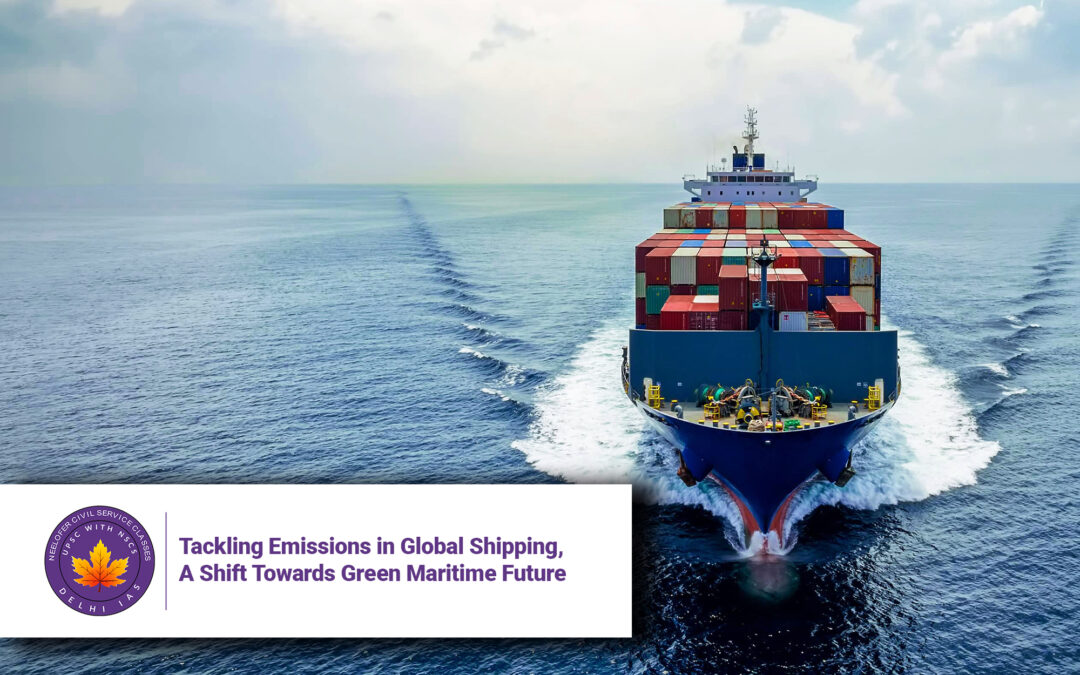
Tackling Emissions in Global Shipping, A Shift Towards Green Maritime Future
Why in News?
The 83rd session of the International Maritime Organization’s (IMO) Marine Environment Protection Committee (MEPC) was recently held, focusing on decarbonising the maritime sector, one of the world’s most polluting industries. The session brought together nations to negotiate and finalize frameworks to reduce greenhouse gas (GHG) emissions from ships. 
Introduction
The global shipping industry is responsible for about 2.8% of the world’s GHG emissions — equivalent to the emissions of some large developed countries. As climate change becomes a central global concern, the IMO and its members are under growing pressure to align shipping practices with international climate goals like the Paris Agreement and Sustainable Development Goals (SDGs).
Key Developments at the 83rd MEPC Session
Five Key Proposals
-
Various nations submitted five distinct proposals focusing on different approaches like carbon levies, fuel standards, and emissions caps.
-
The United Arab Emirates submitted a fuel levy proposal supported by oil-exporting nations.
-
The European Union advocated for emissions caps.
-
China and Singapore pushed for hybrid approaches like GHG Fuel Standards (GFS) and reward systems.
Major Divides
-
The United States and its allies supported hybrid market-based measures.
-
China, Brazil, and the African bloc wanted developmental equity, fearing trade restrictions and higher costs.
-
India, which has not ratified many IMO measures, urged for equitable treatment of developing nations.
The GHG Strategy & IMO Roadmap
-
IMO’s 2023 strategy sets ambitious GHG targets:
-
20-30% emissions reduction by 2030,
-
70-80% by 2040,
-
Net zero by 2050.
-
-
Includes technical and economic measures such as mandatory energy-efficiency rules, clean fuel mandates, and carbon pricing.
-
A fuel standard regulation is under discussion to ensure only cleaner fuels are used.
India’s Position & Challenges
-
India has not committed to net-zero for international maritime emissions.
-
India’s maritime logistics costs are among the highest (8-9% of GDP).
-
Major Indian ports are fossil-fuel heavy (coal, oil), creating a dependency challenge.
-
India is investing in green hydrogen, clean shipping corridors, and port decarbonisation as part of its National Hydrogen Mission and other sustainable efforts.
Conclusion
The shipping industry is slowly steering toward a greener horizon, but global disagreements persist on equity, carbon pricing, and developmental fairness. As IMO pushes for an inclusive and enforceable framework, India must balance climate ambition with trade and developmental needs. The outcome of these efforts could redefine the future of global maritime trade and climate justice.
5 Q&A Based on the Article
Q1. Why is the shipping industry under scrutiny for emissions?
A: Shipping contributes around 2.8% of global GHG emissions, which is comparable to some large countries, making it crucial in the climate change discussion.
Q2. What was the aim of the 83rd MEPC session of the IMO?
A: The session aimed to decarbonise the global shipping industry by discussing fuel standards, emissions caps, and carbon levies among member countries.
Q3. What stance did India take in the discussions?
A: India emphasized equity and fairness, resisting binding net-zero targets for international maritime emissions and focusing on cost-effective, development-oriented approaches.
Q4. What are some measures discussed to reduce emissions in shipping?
A: Measures include GHG Fuel Standards, carbon pricing, mandatory energy-efficiency rules, clean fuel usage, and reward-based systems for cleaner operations.
Q5. What is the IMO’s target for reducing GHG emissions by 2050?
A: The IMO aims to reduce emissions to net zero by 2050, with interim targets of 20-30% by 2030 and 70-80% by 2040.

