
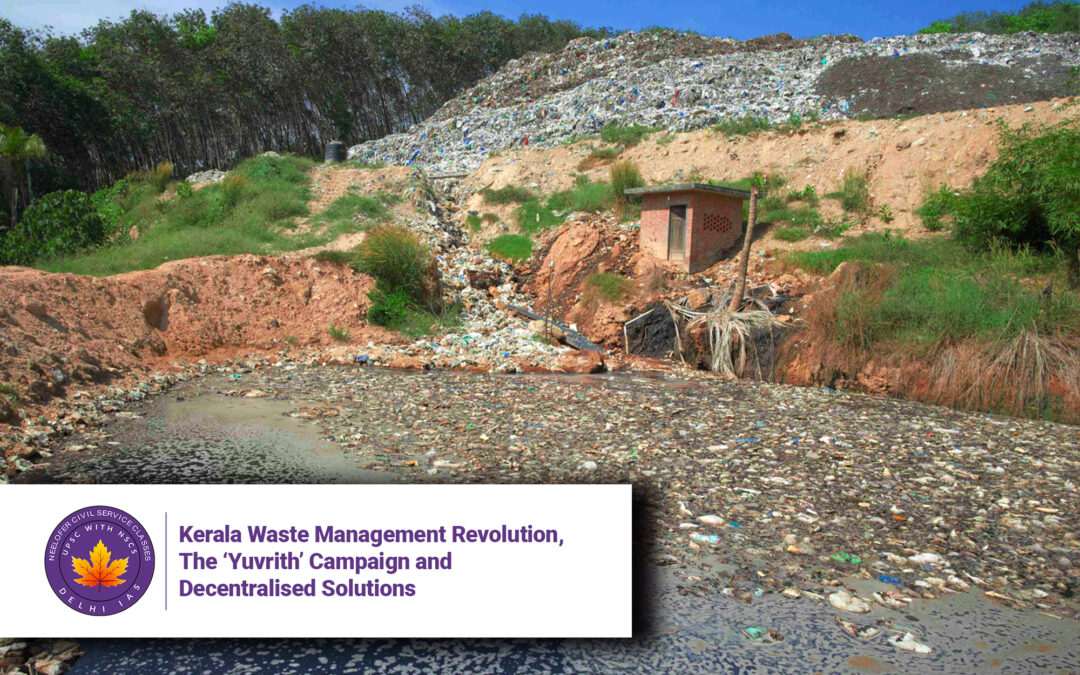
Kerala Waste Management Revolution, The ‘Yuvrith’ Campaign and Decentralised Solutions
Why in News?
Since October 2, 2024, Kerala has been actively promoting its latest campaign — ‘Yuvrith’, a people-powered initiative to combat the growing waste crisis in the state. With mounting garbage in public and private spaces and its impact on health, environment, and tourism, Kerala is now exploring decentralised and participatory solutions to manage its waste more effectively.
Introduction
Kerala, often lauded for its progress in health and education, is now addressing a new challenge: waste accumulation. Due to increased consumerism, poor waste segregation, and lack of sustained efforts post-liberalisation, the waste burden on local systems has surged. The Yuvrith campaign represents a shift towards sustainable, community-driven waste solutions that prioritize public health and participatory governance.
Key Issues and Institutional Concerns
1. The Rising Waste Burden
-
In urban Kerala, up to 75% of garbage is collected from houses, but only 40% is scientifically treated.
-
Open dumping of waste behind homes or in empty plots has become common.
-
Waste accumulation has led to major environmental and health concerns, including zoonotic diseases.
2. Trigger for the Yuvrith Campaign
-
Lack of hygiene during the COVID-19 pandemic exposed the state’s vulnerability.
-
The government launched Yuvrith to rebuild a culture of cleanliness and decentralised waste management, rooted in local responsibility.
3. Swachh Bharat vs. Yuvrith
-
Swachh Bharat Mission (SBM) was largely state-driven and centralised.
-
Yuvrith promotes decentralisation, empowering schools, colleges, panchayats, and local residents to co-design solutions.
Decentralised vs. Centralised Waste Systems
Kerala’s shift towards decentralised waste systems—like the Green Protocol, Haritha Karma Sena, and home composting—emphasizes community participation. These methods not only reduce dependence on state-driven initiatives but also promote local innovation and accountability.
Yet, challenges remain:
-
Sustaining the momentum once the government withdraws.
-
Ensuring institutional support through policies and local bodies.
-
Preventing the creation of waste in the first place—moving from management to minimisation.
Challenges and the Way Forward
1. Institutionalising Waste Awareness
-
Integrating waste management into the curriculum of schools and universities.
-
Promoting behaviour change through consistent public messaging and rewards.
2. Extended Producer Responsibility (EPR)
-
Making producers responsible for collecting and disposing of the plastic or packaging waste they generate.
3. Focus on Urban Local Bodies
-
Empowering urban panchayats and municipalities to create tailored solutions based on local geography and demographics.
Conclusion
Kerala’s Yuvrith campaign marks a bold step towards inclusive, decentralised, and sustainable waste management. But the journey doesn’t end with clean-up drives. It requires institutional backing, long-term vision, and active public participation to transform Kerala into a model state for environmental responsibility.
Q&A Section
Q1. What is the Yuvrith campaign and why was it launched?
The Yuvrith campaign is Kerala’s public waste management initiative launched in October 2024 to address the growing waste crisis through decentralised, participatory solutions.
Q2. How is Yuvrith different from the Swachh Bharat Mission (SBM)?
While SBM was a centrally-driven, top-down mission, Yuvrith is a locally-led, community-centric campaign that encourages co-creation of waste solutions.
Q3. What are some key problems Kerala faces in waste management?
Unscientific dumping, rise in consumption, lack of segregation, poor infrastructure, and health threats from accumulated garbage.
Q4. Are decentralised solutions better than centralised ones?
Yes. Decentralised solutions such as home composting, local green protocols, and public engagement have proven more sustainable and effective in Kerala’s context.
Q5. What’s the biggest challenge going forward?
Maintaining momentum and community ownership once government support or public attention fades, and institutionalising long-term behavioural change.

