
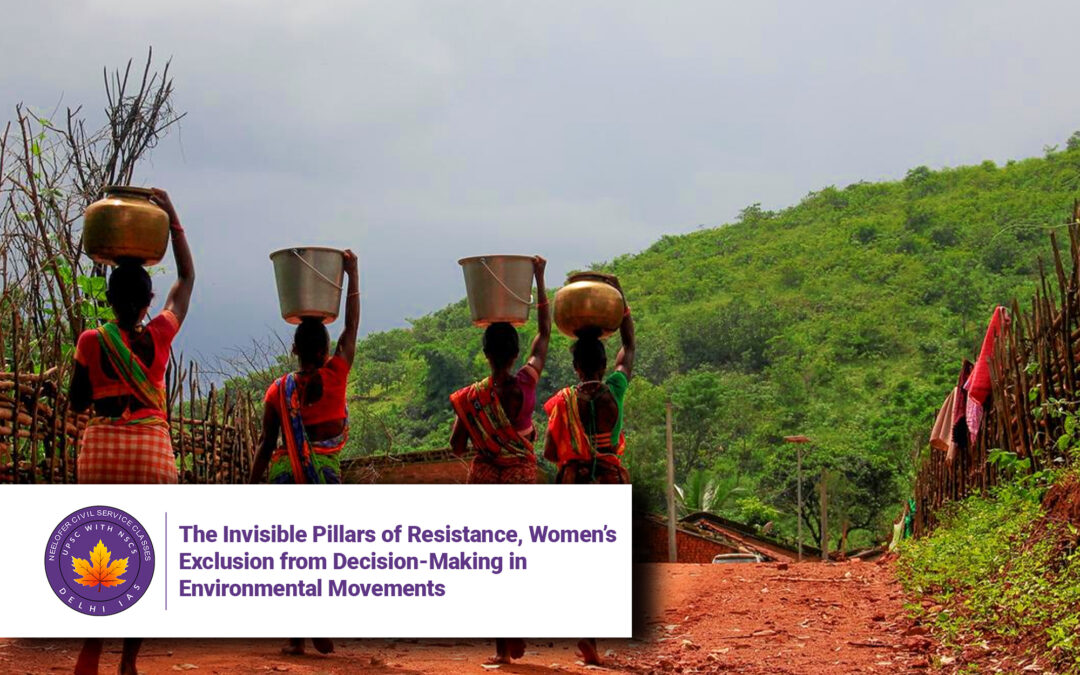
The Invisible Pillars of Resistance, Women’s Exclusion from Decision-Making in Environmental Movements
Why in News?
Across India and South Asia, women have been at the forefront of resistance movements against unjust development, extractivism, and environmental degradation. Despite their active roles in organizing and sustaining protests, they remain largely invisible in leadership and decision-making processes. A structural change is urgently needed to acknowledge their contributions and ensure gender-sensitive governance. 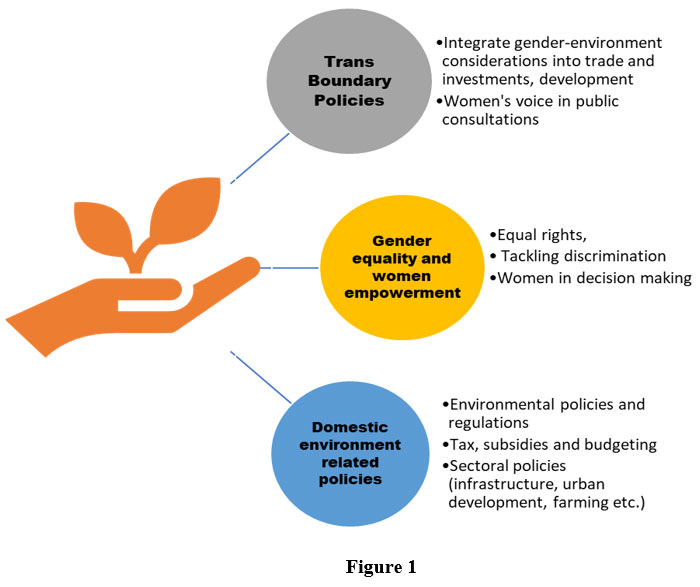
Introduction
From the forests of Odisha to the coastlines of Tamil Nadu, women have led sustained and powerful resistance movements against destructive mining, dams, and power projects. Yet, when it comes to decision-making tables, they are systematically excluded. This invisibility is not just a matter of representation—it threatens the integrity, justice, and inclusiveness of environmental and developmental policies.
Key Issues and Institutional Concerns
1. Women Lead, But Are Not Heard
-
In Odisha, Tamil Nadu, and Jharkhand, women fight for ancestral land and ecological protection.
-
Despite their leadership in ground-level mobilizations, they are excluded from consultations and decisions that impact them directly.
2. Gender Bias in Land Rights and Rehabilitation
-
Legal frameworks like the Forest Rights Act (2006) and PESA Act (1996) recognize women’s roles, but implementation is poor.
-
Women often lack land titles, making them ineligible for compensation or rehabilitation.
-
Gram Sabhas, meant to be inclusive, are often male-dominated.
3. Customary Laws and Patriarchy
-
In many tribal regions, customary inheritance laws and patriarchal systems override statutory rights.
-
Widows, women without documentation, or women heads of households are routinely excluded from land redistribution programmes.
4. Consultation Without Representation
-
Mechanisms like Free, Prior, and Informed Consent (FPIC) are compromised when women feel unsafe or are absent from public consultations.
-
“Consultation” loses meaning when it excludes women or occurs in male-only spaces.
Challenges and the Way Forward
1. Gender-Sensitive Governance
-
Land and environmental policies must address the gendered impact of displacement and ensure co-ownership of land titles.
2. Legal Reform and Awareness
-
State and national policies need enforceable guidelines to protect women’s land and resource rights.
3. Inclusive Consultation Processes
-
Meetings must be held in women-only spaces, with translation and legal aid, ensuring safe participation.
4. Acknowledging Women’s Leadership
-
Governments, NGOs, and policymakers must amplify women’s roles—not only at the grassroots, but also in negotiations, laws, and policy-making.
Conclusion
If development is to be democratic, and if climate policy is to be just, then the voices of women must not only be heard but must lead. Their resistance is not only about livelihood—it is about life itself. Structural reforms are essential to transform this invisibility into visible, powerful leadership in environmental justice.
Q&A Section
Q1. What is the main issue highlighted in the article?
Despite their leadership in resistance movements, women in South Asia are often excluded from decision-making and consultation processes.
Q2. Which laws support women’s rights, and where do they fall short?
India’s Forest Rights Act (2006) and PESA Act (1996) recognize women’s roles but fail in implementation, often leaving women without legal claims to land or resources.
Q3. Why are women excluded from land redistribution programs?
Women often lack formal documentation or are not listed as heads of households, leading to exclusion from rehabilitation or compensation.
Q4. What is the problem with current consultation frameworks like FPIC?
FPIC fails when held in unsafe or male-dominated settings, making it impossible for women to voice their concerns or participate meaningfully.
Q5. What is suggested as the way forward?
To ensure justice, gender-sensitive laws, inclusive consultations, and recognition of women’s leadership in policies and governance are essential.

