
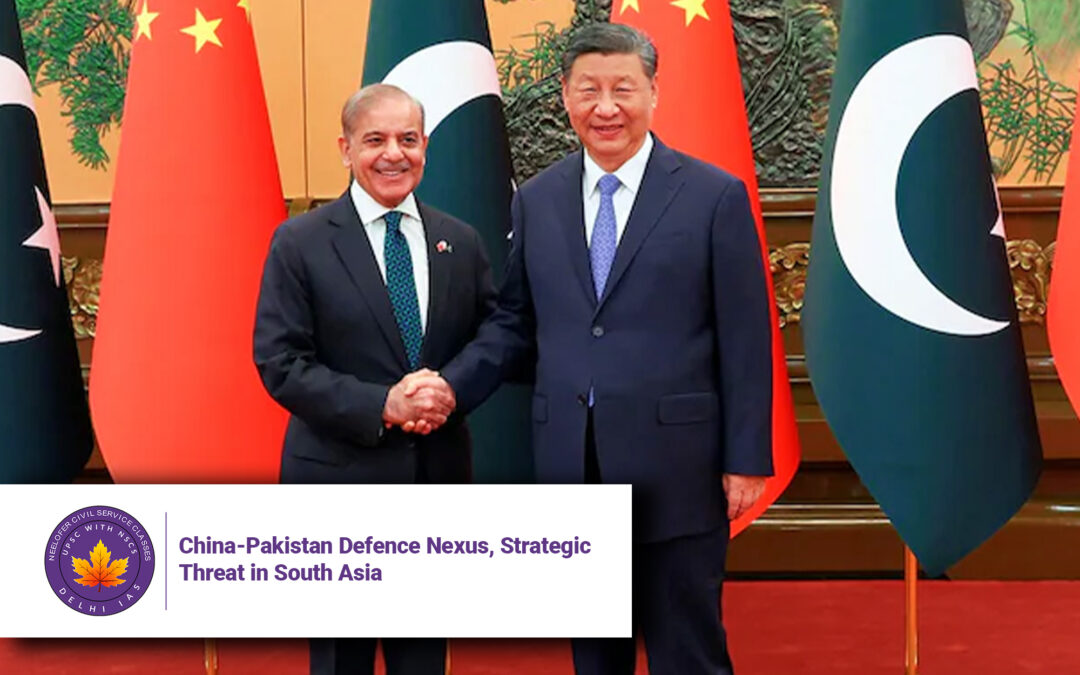
China-Pakistan Defence Nexus, Strategic Threat in South Asia
Why in News?
Amid rising tensions in South Asia, China’s deepening defence cooperation with Pakistan has emerged as a major geopolitical concern for India and its allies. Recent military and technological support from Beijing to Islamabad is reshaping the regional power balance. 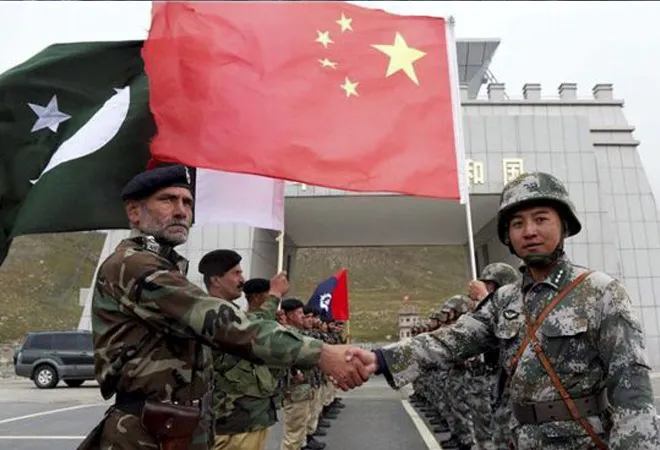
Introduction
Over the last two decades, China has become the largest supplier of military hardware to Pakistan, accounting for more than 80% of Pakistan’s military imports. From fighter jets to submarines and missile systems, the military partnership between the two nations has intensified significantly, particularly under the framework of the China-Pakistan All-Weather Strategic Cooperative Partnership.
Key Features of the China-Pakistan Defence Cooperation
-
Massive Military Supplies:
China has delivered various advanced military systems to Pakistan, including the J-10C fighter jets, PL-15 missiles, Type 054A/P frigates, and Hangor-class submarines. -
Joint Military Exercises & Trust:
Bilateral military cooperation is not limited to hardware. Both sides frequently hold joint training, military exchanges, and high-level dialogues, which have built deep mutual trust and operational compatibility. -
Shared Technology and Co-Production:
Many of these deals are structured as “co-production” or “joint programmes,” allowing Pakistan access to Chinese R&D, though mostly led by China. -
Stockholm Report Data:
According to the SIPRI (Stockholm International Peace Research Institute), 72% of Pakistan’s arms imports came from China in 2021. This heavy dependence reflects the strategic alignment of their defence goals. -
Recent Strategic Deliveries:
-
Type 054A/P Frigates: Highly advanced multi-role warships with anti-submarine, anti-air, and anti-ship capabilities. All four ordered units have been delivered.
-
Hangor-class Submarines: Advanced diesel-electric attack submarines that include air-independent propulsion, sonar stealth, and long endurance.
-
Recovery of PL-15 Missile: Recently recovered from an Indian battlefield, raising concern over Chinese missile presence in South Asia.
-
Implications and Strategic Challenges
-
For India:
This growing China-Pakistan nexus poses a direct strategic and tactical threat to India, complicating regional security calculations. India’s maritime and aerial preparedness may need urgent upgrades. -
For Regional Stability:
As Pakistan relies heavily on Chinese weapons, any escalation could quickly involve advanced Chinese tech, altering the rules of engagement in any conflict. -
For Global Players:
Western countries must monitor the proliferation of Chinese arms in volatile regions like South Asia, especially when they influence balance in conflict zones.
Conclusion
China’s support to Pakistan’s military has moved beyond traditional diplomacy. It has become a cornerstone of South Asia’s military dynamics. For India, this partnership demands greater self-reliance in defence manufacturing, faster modernization of the armed forces, and proactive diplomatic engagement to counterbalance the growing China-Pakistan axis.
5 Questions and Answers
Q1. What percentage of Pakistan’s military imports came from China in 2021?
Answer: 72% of Pakistan’s military imports in 2021 came from China.
Q2. What is the significance of the Type 054A/P frigates?
Answer: These are advanced multi-role warships equipped with anti-submarine, anti-aircraft, and anti-ship missile capabilities, enhancing Pakistan’s naval power.
Q3. What does the China-Pakistan All-Weather Strategic Cooperative Partnership entail?
Answer: It includes defence, economic, and strategic cooperation, including joint military exercises, high-tech arms transfers, and strategic alignment against mutual adversaries.
Q4. Why is India concerned about the China-Pakistan defence collaboration?
Answer: The collaboration significantly boosts Pakistan’s military capabilities and introduces Chinese advanced weaponry into a region already fraught with tension, posing a direct security challenge to India.
Q5. What are the Hangor-class submarines, and why are they important?
Answer: These are stealthy, long-range diesel-electric submarines equipped with torpedoes, anti-ship missiles, and advanced sonar, significantly enhancing Pakistan’s underwater warfare capacity.

