
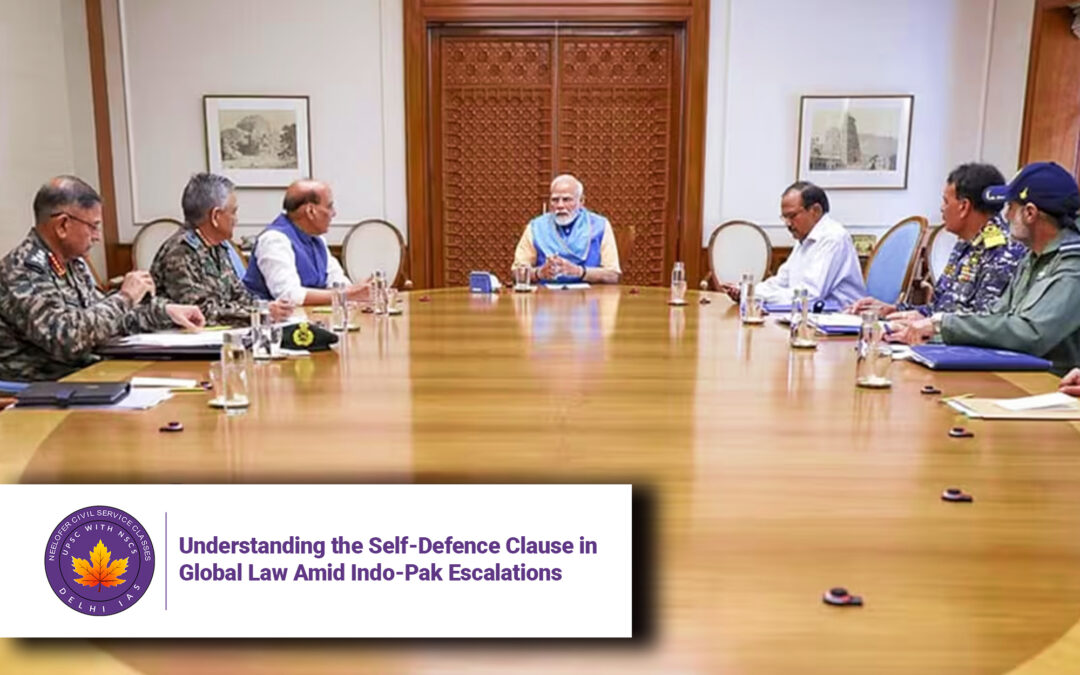
Understanding the Self-Defence Clause in Global Law Amid Indo-Pak Escalations
Why in News?
On May 10, India and Pakistan agreed to halt “all firing and military action” after Indian Air Forces conducted 24 precision strikes on May 7, targeting terrorist infrastructure in Pakistan and Pakistan-Occupied Kashmir (PoK). This came as a response to the killing of Indian soldiers in Poonch, which escalated tensions. The strikes reignited debate over the “self-defence” clause under international law and the “unwilling or unable doctrine.” 
Introduction
India’s military retaliation in PoK has drawn international scrutiny, raising critical questions about the legality of self-defence under Article 51 of the UN Charter and whether such operations against non-state actors are justifiable. The debate also touches upon the unwilling or unable doctrine, a controversial concept invoked when states cannot or will not deal with terrorists within their borders.
Key Concepts and Background
What is the Self-Defence Clause?
-
Article 51 of the UN Charter allows nations the inherent right of self-defence in case of an armed attack, until the UN Security Council (UNSC) takes necessary actions to maintain peace.
-
The article requires member states to report to the UNSC immediately about any military measures taken.
-
India appears to rely on this principle, arguing its right to self-defence following terror attacks emanating from across the border.
The Core of the Concern
Can Self-Defence Be Used Against Non-State Actors?
-
There is legal uncertainty here. The UN Charter does not explicitly cover self-defence against non-state actors.
-
However, post-9/11, many countries including the U.S. have invoked the self-defence clause against terror groups.
-
The International Court of Justice (ICJ) has discouraged broad interpretation unless the threat is imminent, serious, and attributable to a state.
India’s Justification
-
India argues that the Pakistani state has been “unable or unwilling” to curb terrorism and thus bears responsibility for terror activities within its territory.
-
The airstrikes targeted groups like Jaish-e-Mohammed, whose members were allegedly behind recent soldier killings.
Key Observations
Unwilling or Unable Doctrine
-
Used by countries like the U.S., U.K., and Israel, the doctrine claims that if a state is unable or unwilling to prevent non-state actors from operating within its territory, another state has the right to act in self-defence.
-
However, this principle lacks universal recognition and is not officially codified in international law.
Proportionality and Necessity
-
Any self-defence measure must be proportional and necessary.
-
Critics argue that military operations must not violate sovereignty unless there’s clear and immediate threat.
-
International reactions have been mixed, with Russia and China criticizing India, while the U.S. remains cautious but sympathetic to India’s security concerns.
Conclusion
The India-Pakistan ceasefire agreement has brought temporary calm, but the international debate on the legality of India’s airstrikes under the self-defence clause continues. The issue underscores the need for clearer global norms regarding the use of force against non-state actors, especially in regions plagued by terrorism and political instability.
5 Questions and Answers
Q1. What does Article 51 of the UN Charter state?
Answer: It allows any UN member state to take self-defensive action if an armed attack occurs, but such actions must be reported immediately to the UN Security Council.
Q2. Can self-defence be used against non-state actors like terrorist groups?
Answer: While traditionally Article 51 applies to state actors, post-9/11 interpretations have allowed its use against non-state actors in some cases, though this remains controversial.
Q3. What is the ‘unwilling or unable doctrine’?
Answer: It is a principle that allows a country to act in self-defence on foreign territory if the host state is unable or unwilling to prevent terrorist attacks emanating from its land.
Q4. Has India invoked the self-defence clause in the recent strike on PoK?
Answer: Yes, India cited the killing of soldiers and continued terrorist threats as a justification for its precision strikes under Article 51.
Q5. What are the global reactions to such actions?
Answer: Reactions vary—countries like Russia and China oppose it citing sovereignty issues, while Western nations have not openly condemned India, hinting at conditional support.

