
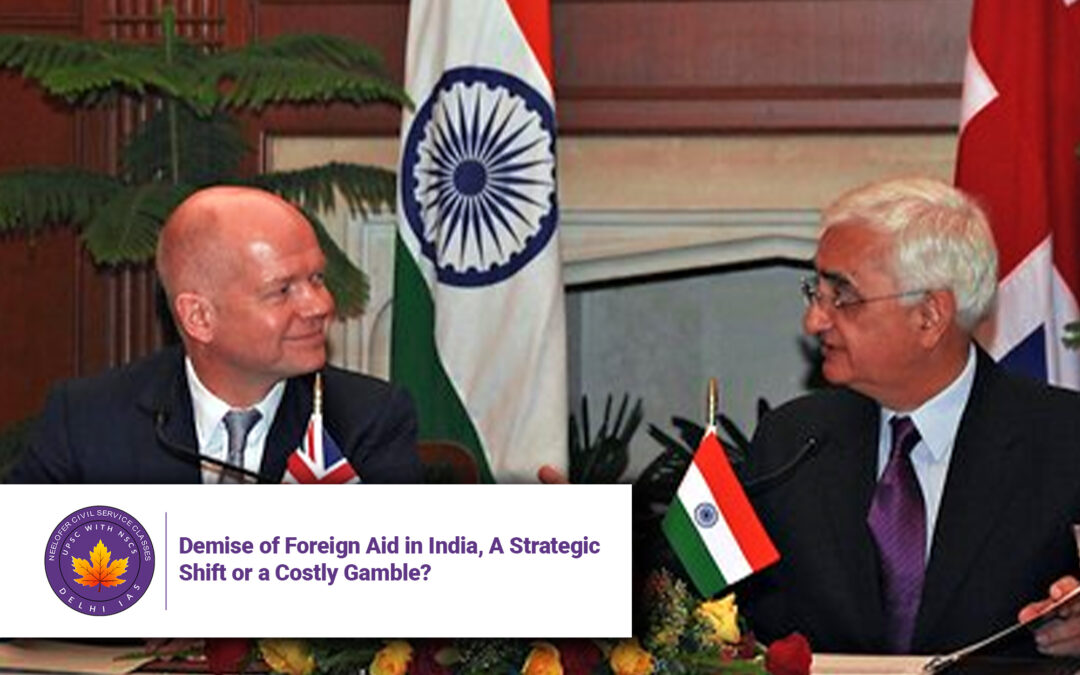
Demise of Foreign Aid in India, A Strategic Shift or a Costly Gamble?
Why in News?
The flow of foreign aid to India—both official and private—has significantly declined in recent years. With India emerging as a rising economic power, and the government tightening regulations through the Foreign Contribution Regulation Act (FCRA), the country is witnessing a near-death knell for foreign aid, particularly to NGOs. 
Introduction
India’s attitude toward foreign aid has always been ambivalent. While once reliant on it for development, the nation is now seen as a rising global power seeking to position itself as a donor, not a recipient. However, the decline in foreign aid—especially to NGOs—has sparked concerns about its impact on the voluntary sector, public welfare, and democratic space.
Key Issues and Institutional Concerns
1. Historical Dependence and Evolution
-
From 1955 to 1965, India relied heavily on aid from Western countries to drive development.
-
Since the 1990s, Official Development Assistance (ODA) has become negligible due to India’s growing economy and political shift toward self-reliance.
2. NGOs as Crucial Development Actors
-
NGOs have traditionally filled governance gaps at the grassroots.
-
With declining aid—both official and private—NGOs now struggle with unemployment, lack of flexibility, and resource constraints.
-
FCRA amendments (in 2010, 2011, 2020, 2023, and again in 2024) have made the regulations increasingly strict and difficult to navigate, forcing many NGOs to shut operations or limit their work.
3. Changing Donor Dynamics
-
Major donors like Ford Foundation and Oxfam are either exiting or scaling back.
-
Aid is now being diverted to countries with higher needs or better flexibility.
4. Shift from Aid to Trade and Investment
-
India now prefers Foreign Direct Investment (FDI) and technology cooperation in climate and health, over traditional aid.
-
There is a strong nationalist narrative equating foreign aid with a threat to sovereignty and internal affairs.
Challenges and the Way Forward
1. Humanitarian and Development Setbacks
-
The drying up of aid affects healthcare, education, environment, and women’s empowerment.
-
NGOs working in remote areas are unable to adapt to rigid FCRA rules and diminishing donor interest.
2. Need for Regulatory Balance
-
While oversight is necessary to prevent misuse, overly rigid laws have stifled legitimate and impactful work.
-
A balance must be struck between national security and enabling civil society to function effectively.
3. Corporate Responsibility Alone Is Not Enough
-
Post-2013, mandatory Corporate Social Responsibility (CSR) has substituted some funding—but cannot replace the flexibility and innovation that foreign funding often enabled.
Conclusion
India’s move to reduce foreign aid dependency may align with its aspirations of becoming a global economic leader, but the collateral damage to NGOs, civil society, and vulnerable populations is substantial. The narrative of self-reliance is noble, but complete withdrawal of foreign aid without sufficient domestic replacement may hurt developmental goals and social equity. A balanced approach, rather than an outright rejection, is necessary to ensure progress and inclusivity.
Q&A Section
Q1. What is the main reason behind the decline of foreign aid in India?
India’s shift towards self-reliance, tighter FCRA regulations, and growing nationalism around foreign funding have significantly reduced aid inflow.
Q2. How has the Foreign Contributions Regulation Act (FCRA) affected NGOs?
It has made compliance difficult, reduced flexibility in fund usage, and caused many NGOs to shut down or reduce operations.
Q3. What role have NGOs played in India’s development?
NGOs have filled gaps in governance, provided health, education, and social welfare services, and held governments accountable.
Q4. What are the drawbacks of cutting off foreign aid entirely?
It could lead to unemployment, unfinished social development work, and loss of external innovations and global cooperation.
Q5. Is foreign aid completely harmful to India’s national interest?
No. While it has downsides, foreign aid has supported critical sectors, allowed experimentation, and empowered grassroots change.

