
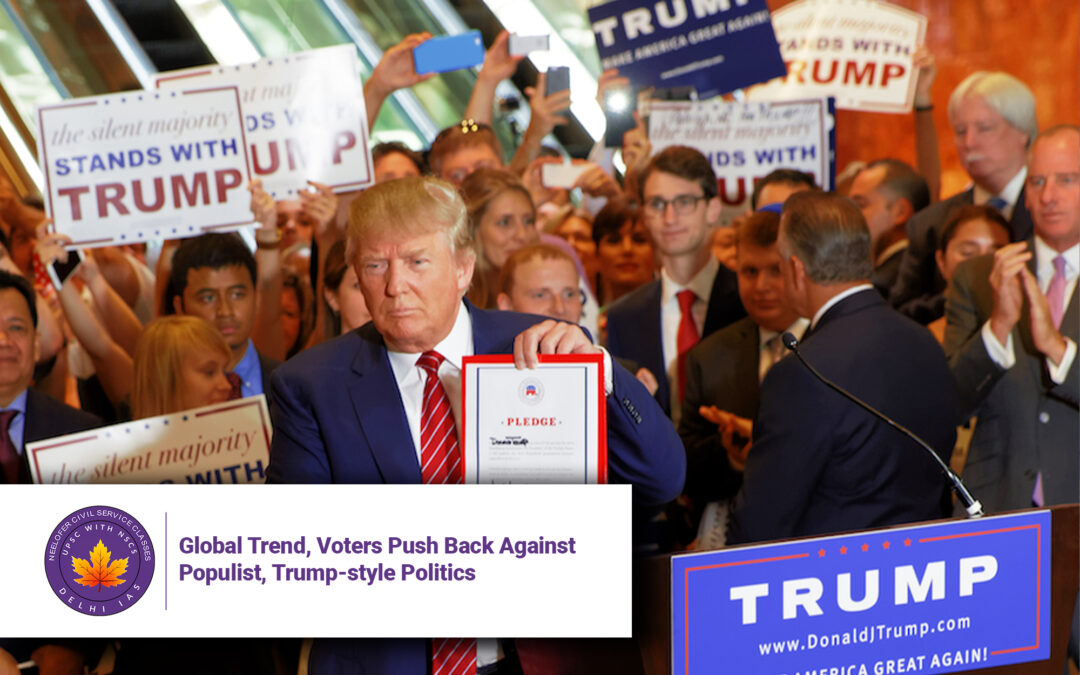
Global Trend, Voters Push Back Against Populist, Trump-style Politics
Why in News?
The re-election of Australian Prime Minister Anthony Albanese and the global shift in voter behavior suggest a growing resistance to Trump-style populist leadership. This pattern is being observed across democracies, where voters seem to favor more centrist, pragmatic governance over divisive rhetoric. 
Introduction
In a significant political victory, Australian Prime Minister Anthony Albanese became the first leader in over two decades to secure a second term. His centre-left Labor Party won 77 of the 151 seats, defeating the centre-right Liberal-National coalition. This victory was not only domestic but also reflective of a larger global political trend, where electorates are rejecting extreme, hardline leaders, often modeled on or inspired by former U.S. President Donald Trump.
Key Issues and Developments
1. India-Australia Relations Strengthen
-
Albanese’s win reinforces continuity in India-Australia relations.
-
PM Modi congratulated Albanese and emphasized advancing Indo-Pacific cooperation.
-
The two countries are working on a Comprehensive Economic Cooperation Agreement (CECA) by end-2025 and had earlier signed a partial FTA (ECTA).
2. Domestic Challenges in Australia
-
Albanese’s win comes despite tough conditions: high inflation, rising immigration concerns, and cost-of-living pressures.
-
A recent poll indicated public dissatisfaction, but the opposition’s Trump-style politics may have contributed to their loss.
3. Global Examples of Populist Rejection
-
In Canada, the Liberal Party’s Mark Carney won amid opposition from hardline conservatives.
-
In Australia, opposition leader Peter Dutton’s harsh anti-immigration and anti-woke stance failed to resonate.
-
In Singapore, the ruling party retained power, resisting populist swings.
4. The Trump Shadow
-
Trump’s political style—rhetoric-heavy, anti-globalist, anti-immigrant—has inspired similar leaders globally.
-
However, recent elections show that such tactics are increasingly unpopular among mainstream voters.
Challenges and the Way Forward
1. A Divided Electorate
Even though extreme rhetoric rallies a section of voters, it alienates moderates, who are now proving decisive in elections.
2. Geopolitical Consequences
The rejection of divisive leaders bodes well for global cooperation, especially in sensitive regions like the Indo-Pacific, where unity is crucial to counter Chinese assertiveness.
3. Lessons for Democracies
Political parties may need to recalibrate, focusing on real issues like the economy, environment, and social welfare rather than inflammatory speeches.
Conclusion
The electoral success of Anthony Albanese is not an isolated event—it mirrors a broader global democratic correction. Voters are sending a clear message: rhetoric without results won’t win elections. The decline of Trump-style politics in democratic nations suggests a maturing electorate that values cooperation, moderation, and practical solutions over divisiveness and theatrics.
Q&A Section
Q1. Who won the recent Australian general election?
Prime Minister Anthony Albanese of the centre-left Labor Party was re-elected.
Q2. How does Albanese’s re-election impact India-Australia relations?
It ensures continuity in ties, especially in advancing the Indo-Pacific strategy and the Comprehensive Economic Cooperation Agreement (CECA) by 2025.
Q3. What trend is being observed in global politics according to the article?
Voters in various countries are rejecting Trump-style populist leaders who rely on harsh rhetoric and divisive politics.
Q4. Which global leaders or candidates have faced rejection due to hardline positions?
Australia’s Peter Dutton and Canada’s conservative candidates were among those whose Trump-like rhetoric backfired.
Q5. What lesson does this trend offer for global democracies?
It underscores the need for inclusive, moderate, and pragmatic leadership, focusing on real-world issues rather than populist slogans.

