
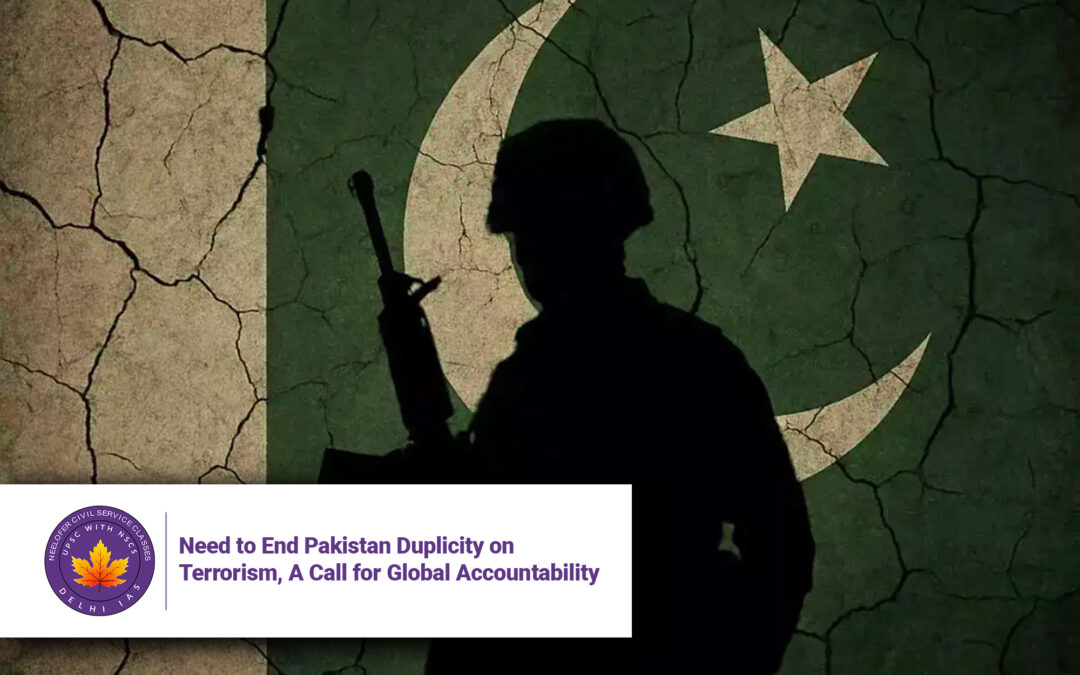
Need to End Pakistan Duplicity on Terrorism, A Call for Global Accountability
Why in News?
The recent terror attack in Pahalgam, Jammu & Kashmir, has reignited India’s demand for a global crackdown on Pakistan-sponsored terrorism. As images of civilian deaths and destruction circulate, calls for exposing Pakistan’s duplicity on terrorism have grown stronger. 
Introduction
Terrorism in India, particularly in Jammu & Kashmir, remains a persistent challenge. Pakistan’s repeated denial of its role in such attacks, despite concrete evidence, reflects a pattern of state-sponsored duplicity. The recent tragedy in Pahalgam adds to a long list of terror events—like the 2008 Mumbai attacks and Pulwama 2019—traced back to Pakistani soil.
Key Issues and Background
-
History of Pakistan-Backed Terrorism
-
Pakistan has been a safe haven for terror groups, including those responsible for the 26/11 Mumbai attacks, Pathankot, Uri, and Pulwama.
-
Despite global warnings, it continues to provide ideological, logistical, and financial support to these groups.
-
-
India’s Clear Stand
-
Prime Minister Modi’s leadership has drawn a clear line: no negotiations with terrorism and no tolerance for duplicity.
-
India’s responses are no longer reactive, but strategic and bold, targeting terror networks and calling for international solidarity.
-
-
Media and Public Perception
-
Pakistan actively runs anti-India propaganda through various media, including state-controlled news outlets and social media.
-
Yet, the truth of its role in enabling and harboring terrorism is undeniable and increasingly exposed.
-
-
International Awareness and Action
-
India’s diplomatic offensive now extends to major capitals like Washington, Paris, Tokyo, and London.
-
There is a growing consensus in the international community that Pakistan must face consequences for its actions.
-
-
The Duplicity of Victimhood
-
Pakistan presents itself as a victim of terrorism while simultaneously sponsoring and sheltering terrorists.
-
This double game has eroded its credibility on the global stage.
-
5 Key Takeaways
-
Pahalgam is the latest grim reminder of Pakistan’s long history of proxy warfare.
-
India’s strategy is now offensive and unapologetic, based on strong diplomacy and public exposure of Pakistan’s tactics.
-
Pakistan continues to play a dangerous double game—condemning terrorism while enabling it.
-
There’s an urgent global need to treat terrorism as a shared threat, beyond regional boundaries.
-
India is leading a coordinated international push to isolate states that support cross-border terrorism.
Challenges and the Way Forward
Challenges:
-
Pakistan’s continued use of terrorism as state policy under the nuclear umbrella.
-
The lack of consistent pressure from some global players who prioritize geopolitical interests.
-
Pakistan’s use of denial and propaganda to evade responsibility.
Way Forward:
-
India must continue its multi-pronged approach: diplomatic, economic, and military.
-
The global community needs to institutionalize sanctions against state-sponsored terrorism.
-
Nations must stop giving moral and financial space to countries that harbor extremist ideologies.
-
Strengthen international cooperation through platforms like FATF, UN, and QUAD to monitor and act on terror funding and logistics.
-
Maintain public awareness to prevent Pakistan’s misinformation campaigns from influencing global narratives.
Conclusion
India’s message is clear—terror and talks cannot go hand-in-hand. The world must no longer indulge Pakistan’s hypocrisy and deceit. As India steps up its diplomatic campaign, the focus must remain on truth, justice, and accountability. The cost of ignoring terrorism now will only be a heavier price tomorrow.
Q&A Section
1. What triggered the renewed criticism of Pakistan in the recent article?
The terror attack in Pahalgam, which killed innocent civilians, added another grim chapter to the long history of Pakistan-backed terrorism in India.
2. How has India responded to such attacks in recent years?
Under Prime Minister Narendra Modi, India has adopted a clear and assertive approach, refusing to accept double standards on terrorism and launching a diplomatic and strategic offensive globally.
3. What is the nature of Pakistan’s duplicity mentioned in the article?
Pakistan presents itself as a victim of terrorism while funding, training, and sheltering terror groups targeting India—exposing its double standards.
4. What steps has India taken internationally to counter Pakistan’s terror narrative?
India has built a global consensus by reaching out to countries like the US, UK, France, and Japan, urging them to isolate states that support terror. It has also worked to expose Pakistan’s propaganda internationally.
5. What message does the article send about India’s future stance?
India will no longer turn the other cheek. Instead, it will respond with determination and demand international accountability for all forms of terrorism.

