
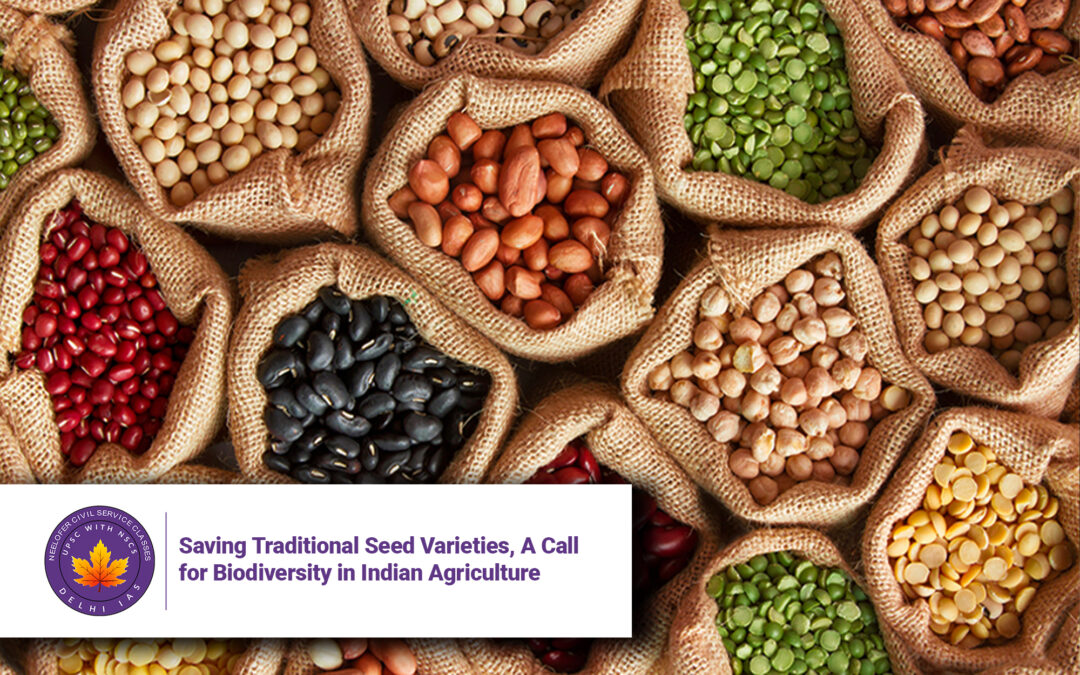
Saving Traditional Seed Varieties, A Call for Biodiversity in Indian Agriculture
Why in News?
With rising climate change impacts, depleting soil health, and increasing dependence on chemical fertilizers and monocultures, the focus has shifted to conserving India’s traditional seed varieties. Experts from MSSRF (M.S. Swaminathan Research Foundation) emphasize the urgent need to preserve these seeds for a resilient and sustainable food future. 
Introduction
India, known for its rich agricultural biodiversity, is witnessing the disappearance of thousands of traditional seed varieties. For centuries, these seeds have supported food security and cultural heritage. However, policies prioritizing high-yielding, hybrid varieties are leading to a trade-off—loss of biodiversity, nutritional quality, and climate resilience.
Key Issues and Institutional Concerns
1. Structural Problems in the Food System
Indian food systems, driven by supermarkets and government programs, favor uniform, high-yielding varieties of wheat and rice. Traditional varieties like millets and indigenous rice are sidelined due to low demand and market invisibility.
2. Lack of Community-Based Seed Networks
Unlike hybrid seeds, traditional seeds thrive on community exchange and local knowledge. India lacks a well-funded network of community seed banks, making conservation difficult.
3. Policy Focus on Yield over Diversity
Government policies have long promoted high-yield varieties to address food security. While well-intentioned, this has led to a decline in seed diversity and nutritional quality. Programs like the Odisha Millet Mission offer hope but remain under-implemented.
Challenges and the Way Forward
-
Support for Traditional Crop Cultivation: Farmers won’t grow crops they can’t sell. Policies must include traditional crops in school meals, hospitals, and government procurement.
-
Seed Banks and Knowledge Sharing: A network of regional seed conservation centers is needed, where scientists and farmers co-create improved traditional varieties.
-
Awareness and Market Creation: Educating consumers on the nutritional and climate benefits of traditional crops will drive demand and revive production.
-
Inclusive Agricultural Systems: Stakeholder consultation is key. MSSRF’s Tribal Agrobiodiversity Centre recently led a successful model in Odisha to discuss climate-resilient farming systems, showing the importance of local action.
-
Long-Term Vision for Resilience: The future of agriculture must be rooted in diversity. This includes strengthening community seed rights, alternative seed systems, and national coordination for preserving India’s agricultural heritage.
Conclusion
India stands at a crossroads. Continued dependence on a few high-yield crops may increase vulnerability to climate shocks and food insecurity. The country must shift toward a sustainable, diverse food system that honors both productivity and heritage. This involves policy support, community participation, and consumer awareness to safeguard India’s rich seed legacy for future generations.
Q&A Section
Q1. Why are traditional seed varieties disappearing in India?
Due to consumer demand for uniform high-yield crops, supermarket preferences, and lack of support systems for traditional seeds, many varieties are being lost.
Q2. What are the main issues caused by high-yielding hybrid varieties?
While they offer high yields, they depend heavily on chemicals and water, reduce biodiversity, increase climate vulnerability, and often have lower nutritional value.
Q3. What is the role of seed banks in saving traditional seeds?
Well-funded, local seed banks can conserve traditional varieties, offer farmers better access to seeds, and help adapt to climate challenges.
Q4. What policy changes are needed to protect seed diversity?
Governments must support traditional seeds through procurement, school meal inclusion, Minimum Support Prices (MSP), and consumer awareness campaigns.
Q5. How can consumers help in preserving traditional seeds?
By choosing traditional crops, consumers create demand, encouraging farmers to grow them and thus maintaining the cycle of conservation and consumption.
