
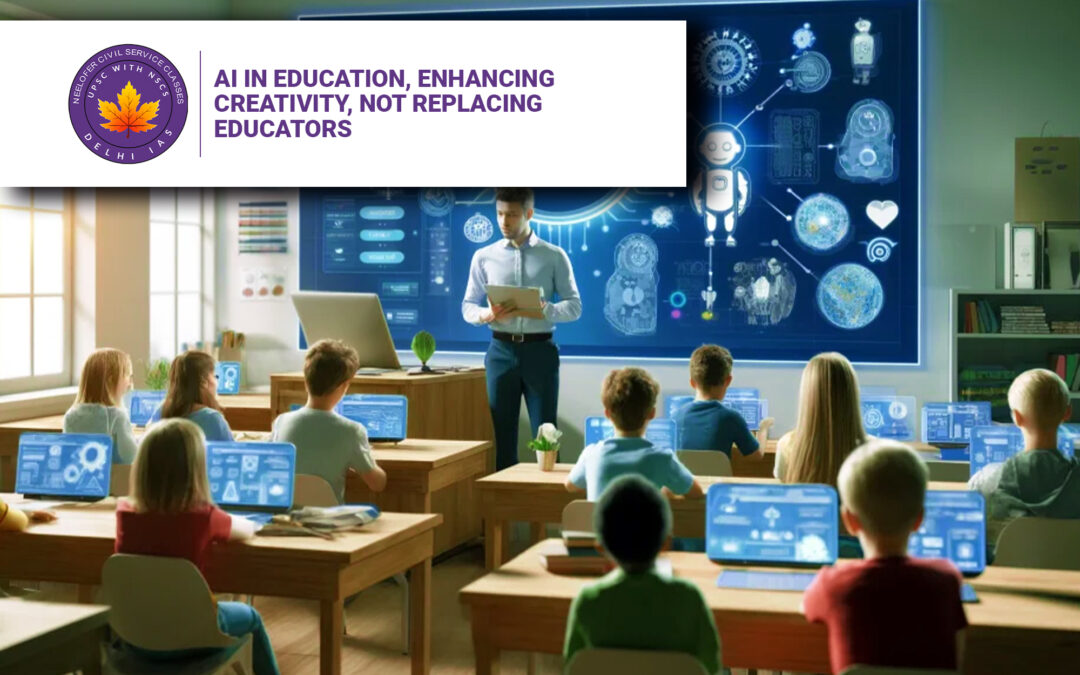
AI in Education, Enhancing Creativity, Not Replacing Educators
Why in News?
The growing use of AI in education, especially generative AI tools, has sparked debates about its impact on creativity, classroom learning, and the role of teachers. Recent discussions, including those at institutions like the National Law School in Bengaluru, reflect both the promise and the challenges of AI’s presence in academic environments. 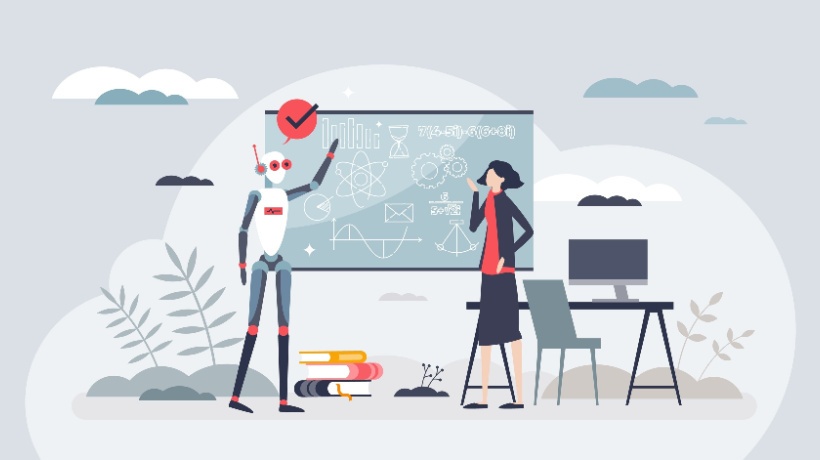
Introduction
With AI becoming increasingly capable of generating creative and academic content, concerns have arisen about its influence on student learning, originality, and the relevance of human educators. However, as argued by Ammel Sharon, the disruption caused by AI in classrooms opens up new opportunities for rethinking education and deepening student engagement.
Key Issues and Background
1. The AI Creativity Debate
-
Writers like Jeanette Winterson and Kamila Shamsie reflected on a recent AI-generated story that deeply moved readers.
-
Winterson referred to AI as “Alternative Intelligence” and acknowledged its narrative on grief as “beautiful and moving.”
-
At the same time, concerns were raised about AI’s lack of genuine emotion and memory — crucial aspects of human storytelling.
2. Emotional vs Mechanical Learning
-
While AI can convincingly mimic style and structure, its mechanical emptiness and inability to hold memory or mourn highlight its limitations.
-
The story’s line “I have to begin somewhere” reflects AI’s nature as a placeholder, not a protagonist.
The Core of the Concern
1. AI in Student Work
-
The National Law School in Bengaluru drafted a policy to manage AI use in academic submissions.
-
Strategies included:
-
Total prohibition
-
Selective integration (e.g., grammar checks only)
-
Encouragement for improving clarity, not content creation
-
2. Misuse vs. Meaningful Use
-
The policy doesn’t ban AI but recommends selective use.
-
Students are allowed to use AI for brainstorming, research, and project development — but not for composing final assignments or exams.
3. Rethinking Assessments
-
AI can match hours of student preparation depending on the mode of assessment.
-
When assessments are brief and mechanical, AI-generated summaries may seem equally effective.
-
This highlights the need for assessments that demand interpretation, creativity, and real understanding.
Key Observations
-
Educators should focus on creating learning environments where AI complements rather than replaces student effort.
-
The rise of AI should encourage alternative pedagogies that build imagination, empathy, and connection.
-
Institutions are experimenting with small-group discussions and sociological imagination exercises to preserve meaningful education.
Conclusion
AI’s entry into classrooms is inevitable and even welcome — when used responsibly. Rather than fearing redundancy, educators and institutions must reshape learning goals and cultivate deeper engagement. Teachers remain vital in guiding students to interpret, critique, and create — tasks far beyond AI’s current reach.
Q&A Section
Q1. Why are educators concerned about AI in classrooms?
They fear AI-generated summaries may replace student effort and diminish the teacher’s role in creative learning.
Q2. What policy has the National Law School in Bengaluru proposed?
It includes selective AI integration—permitting AI for grammar checks but restricting its use in composing full assignments.
Q3. How can AI be used positively in education?
It can assist in brainstorming, refining presentation, and clarifying concepts, but should not substitute core learning.
Q4. What is the role of assessments in this debate?
If assessments are mechanical, AI may outperform students; thus, assessments should be designed to test deeper understanding and creativity.
Q5. What is the future role of teachers in an AI-enhanced classroom?
Teachers will guide students in imaginative, analytical, and interactive learning — areas where human insight still surpasses AI.
