
India’s Startup Ecosystem Needs a Deep-Tech Pivot for Long-Term Growth
Why in News?
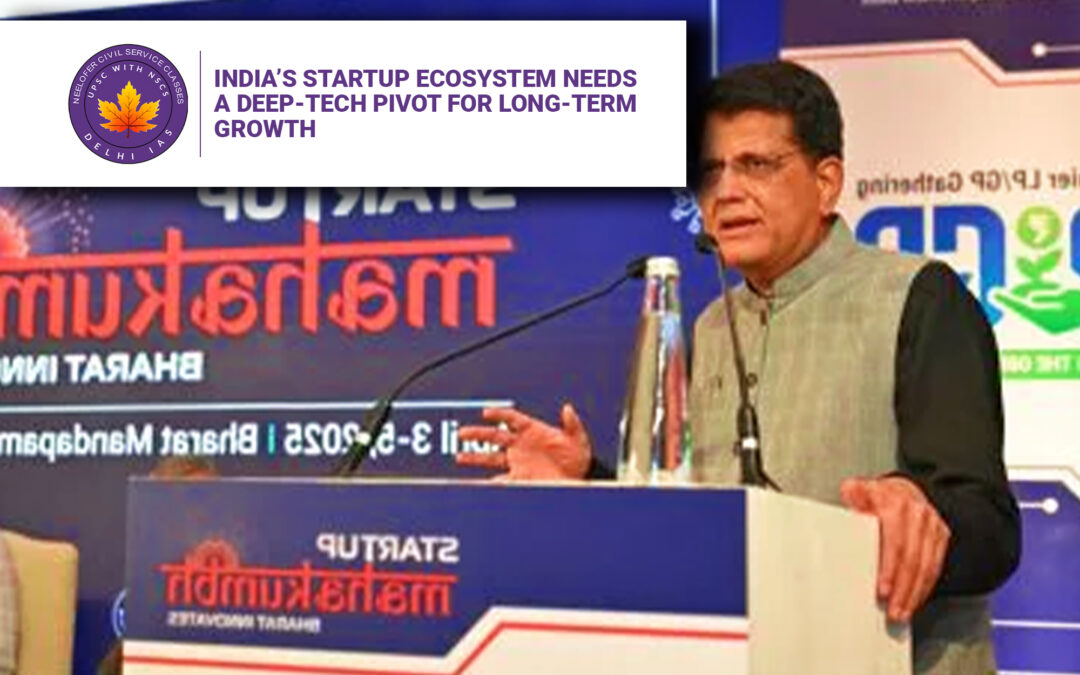
At the Startup Mahakumbh, Commerce and Industry Minister Piyush Goyal called for Indian startups to shift focus from low-value ventures to high-impact sectors like deep tech, semiconductors, and robotics. This marks a critical moment for introspection in India’s innovation strategy. 
Introduction
India’s startup ecosystem has witnessed rapid growth, with $2.5 billion raised in Q1 FY25 and an 8.7% YoY increase in funding. Despite being the world’s third-largest startup hub, there’s growing concern that most ventures focus on short-term consumer services rather than long-term innovation in transformative areas.
Key Issues and Background
1. Limited Focus on Deep-Tech
-
Indian startups heavily invest in instant delivery, e-commerce, and other low-value areas.
-
Contrast with China: Chinese startups lead in semiconductors and EV tech.
2. Risk of Intellectual Property (IP) Drain
-
Startups sell undervalued innovative ideas to foreign companies due to lack of domestic support.
-
Leads to brain drain and loss of national competitiveness.
The Core of the Concern
1. Need for Sectoral Shift
-
India has only around 1,000 deep-tech startups.
-
Critical sectors include:
-
Artificial Intelligence (AI)
-
Robotics
-
Semiconductors
-
Clean tech
-
Healthcare solutions
-
2. Sustainability and Global Impact
-
Deep-tech ventures address systemic challenges.
-
They are more sustainable and less vulnerable to market volatility than consumer-focused startups.
Key Observations
-
IPO activity is rising: 23 startups are preparing for listing this year.
-
Startup decentralisation is accelerating in Tier 2 and Tier 3 cities, solving local problems in health, agri, and education.
-
India’s deep-tech startup count is significantly low despite its global potential.
Way Forward
1. Encourage Deep-Tech Funding
-
Currently, late-stage funding dominates ($1.8 billion in Q1 FY25).
-
More early-stage investment in deep-tech is needed.
2. Strengthen Policy Support
-
Recent removal of the Angel Tax has boosted investor confidence.
-
Further R&D incentives are needed in deep-tech sectors.
3. Promote IP and Innovation
-
Startups must build original IP rather than copying models.
-
Protection and promotion of IP is essential for global competitiveness.
4. Leverage Tier 2 and 3 Cities
-
Use regional diversity to build deep-tech solutions for local challenges.
-
Foster collaboration with universities and research institutions.
Conclusion
India’s startup journey must evolve from consumer-centric ventures to high-impact, innovation-driven businesses. Minister Goyal’s remarks are a timely wake-up call to align startup ambitions with national priorities. Deep-tech is not just a buzzword — it is India’s gateway to becoming a global tech leader while securing long-term economic resilience.
Q&A Section
Q1. What was the key message from Piyush Goyal at the Startup Mahakumbh?
He urged startups to shift focus from consumer services like food delivery to high-impact areas like deep tech and semiconductors.
Q2. What is deep tech and why is it important?
Deep tech includes sectors like AI, robotics, and semiconductors — pivotal for innovation, national competitiveness, and solving systemic challenges.
Q3. How has India performed in startup funding?
India raised $2.5 billion in Q1 FY25 and ranks 3rd globally, behind the US and UK. IPO activity is also increasing.
Q4. What are the key challenges identified?
Over-reliance on short-term ventures, low early-stage investment in deep-tech, brain drain, and limited IP protection.
Q5. What are the recommended policy actions?
Boost early-stage deep-tech funding, provide more R&D incentives, promote IP generation, support decentralised innovation, and link startups with academia.
