
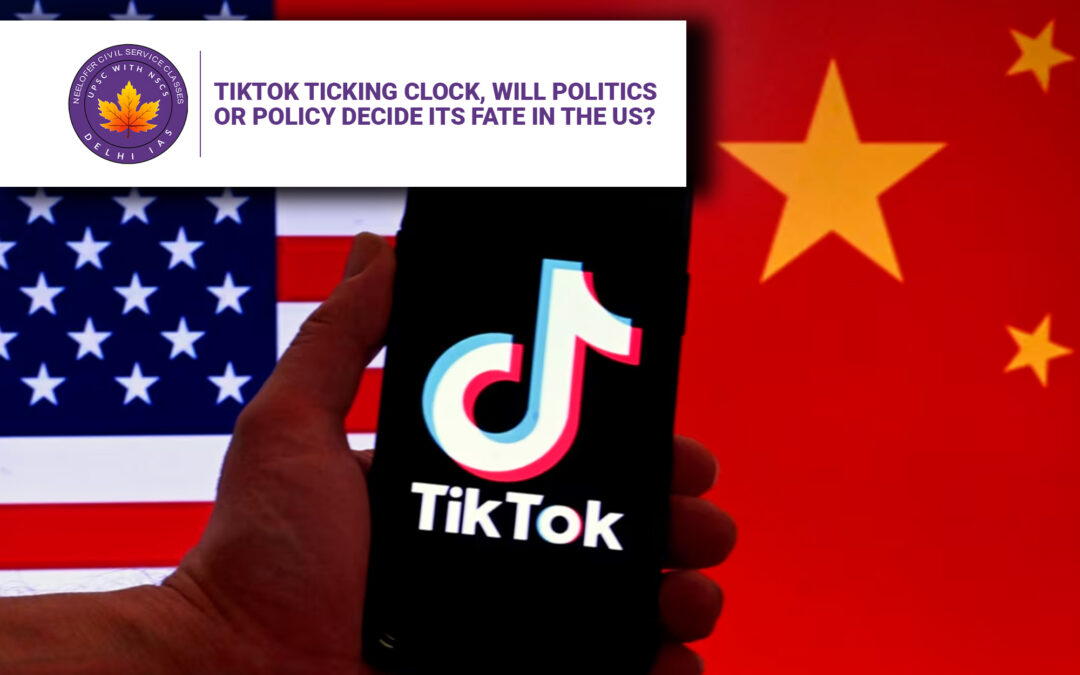
TikTok Ticking Clock, Will Politics or Policy Decide Its Fate in the US?
Why in News?
The US government has extended the deadline for TikTok’s Chinese parent company, ByteDance, to divest its ownership or face a potential ban. The saga underscores the intertwining of national security, trade policy, and political drama in the digital age. 
Introduction
TikTok’s fate in the US remains uncertain as the Biden administration inherits a controversial deal initiated under Donald Trump. The core concern—national security risks posed by Chinese ownership—has taken a backseat amid geopolitical bargaining, tariff talks, and last-minute investor frenzy. With a new 75-day extension, the app’s survival continues to hang in the balance.
Key Issues / Background
1. Deadline Drama and Investor Interest
The original 5 April 2025 deadline for ByteDance to divest TikTok was extended by 75 days. A wave of last-minute interest emerged from major players like Amazon, Andreessen Horowitz, and Blackstone, signaling growing appetite despite regulatory uncertainty.
2. Unresolved National Security Concerns
The key issue behind the potential ban remains unaddressed: ByteDance’s algorithm and recommendation engine could be used to manipulate content viewed by TikTok’s 170 million American users. If ByteDance retains control of the algorithm, fears of surveillance and data misuse persist.
3. Geopolitical Bargaining Chip
Former President Trump appeared to use the TikTok ban as leverage in tariff negotiations with China, even admitting that reducing tariffs in exchange for a TikTok deal was on the table. This turned a national security matter into a geopolitical trade pawn.
4. Beijing’s Silence and Strategic Maneuvering
China, viewing this as a precedent-setting dispute, remained largely silent while tweaking export rules to protect sensitive tech like recommendation algorithms. State-backed media has framed US demands as economic “plunder.”
5. Inconsistent Policy from Washington
Despite bipartisan concern over Big Tech and social media’s influence, the US has lacked a unified strategy. Lawmakers have yet to introduce serious reforms on algorithmic transparency or digital safety, instead resorting to a whack-a-mole approach targeting individual platforms like TikTok.
The Core of the Controversy
At the heart of the TikTok saga is a critical policy question: Can a foreign-owned app operate in the US without compromising national security? The US claims ByteDance’s access to TikTok’s data and algorithms poses espionage risks. However, potential deals circulating still allow ByteDance to retain technical control, raising doubts over whether the ban—if implemented—would truly solve the issue. Meanwhile, Douyin (TikTok’s Chinese counterpart) is under pressure from its own regulators to be more transparent about its algorithms, setting an example the US has yet to follow.
Missed Perspectives
-
Lack of Holistic Tech Policy: The US still lacks comprehensive laws around data privacy and algorithm accountability.
-
Bipartisan Delay on Regulation: Lawmakers rallied around TikTok but have failed to act decisively on broader digital safety.
-
Power Shift to Beijing: Trump’s tariff-driven negotiation ironically gave leverage back to China in the TikTok deal.
-
Inconsistent Global Standards: While China clamps down on Douyin, the US has no equivalent regulatory clarity.
-
Youth Voices Ignored: With TikTok wildly popular among American youth, their interests remain excluded from the policymaking narrative.
Conclusion
The TikTok standoff illustrates the convergence of national security, trade, and digital sovereignty. Yet, despite all the noise, little structural progress has been made. Pushing deadlines without resolving core issues—algorithm control, data transparency, and bipartisan tech policy—risks turning a genuine security concern into political theatre. As it stands, the US government’s fragmented response leaves TikTok’s future unresolved and millions of American users caught in geopolitical crossfire.
Q&A Section
Q1. Why is TikTok under scrutiny in the US?
The US government fears that TikTok’s Chinese parent company, ByteDance, could exploit the app’s algorithm and data to influence or surveil American users, posing a national security threat.
Q2. What was the original deadline for TikTok to be divested from ByteDance?
The deadline was 5 April 2025, but it has now been extended by 75 days to allow more time for a potential sale or resolution.
Q3. Why has the issue become politically charged?
Former President Trump linked the TikTok deal to US-China tariff negotiations, offering to reduce tariffs in exchange for a deal—turning a security concern into a trade bargaining chip.
Q4. Has China responded to US pressure?
Beijing has been largely silent but altered its export laws to restrict the transfer of algorithms, signaling that it considers the issue strategically important.
Q5. What are the broader implications of this controversy?
The situation highlights the urgent need for the US to establish clear tech governance policies, including algorithmic transparency, digital privacy laws, and a more coherent approach to foreign-owned platforms.
