
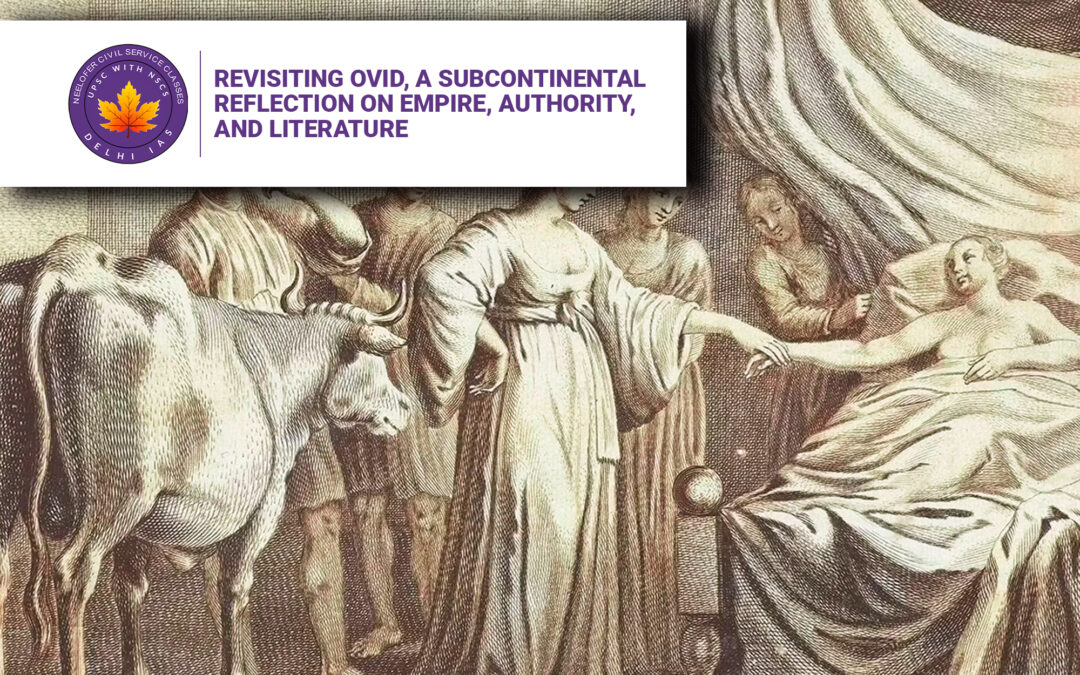
Revisiting Ovid, A Subcontinental Reflection on Empire, Authority, and Literature
Why in News?
As part of their literature curriculum, first-year undergraduate students in India have been reading Ovid’s Metamorphoses not only as a poetic text but as a critical lens through which to examine empire, authority, and the fragility of power—especially from a postcolonial and subcontinental context.
Introduction
Ovid, the Roman poet famously exiled by Emperor Augustus, becomes an unlikely but powerful figure in understanding the dynamics of empires—from ancient Rome to modern political structures. In the classrooms of Indian universities, especially before changes in national syllabi, Metamorphoses served as a gateway to unpacking narratives of dominance, transformation, and dissent.
Ovid’s Legacy and the Roman Empire
Ovid was part of a literary triad with Virgil and Horace, the so-called “voice of empire” during Augustus Caesar’s rule. But unlike Virgil’s Aeneid—a glorification of empire—Ovid’s Metamorphoses offered a subversive, anti-epic stance. It was not a celebration of conquest, but a chaotic, fantastical commentary on power, morality, and divine absurdity.
Ovid’s banishment to Tomis by Augustus—possibly for his poem’s provocative content or a personal scandal—further cemented his image as a literary rebel. His works symbolized resistance against state-sanctioned narratives and were later championed by generations seeking to question authority.
Postcolonial Perspectives from the Subcontinent
In the subcontinent, particularly in Delhi University, Metamorphoses was more than a classical text—it was a mirror. It enabled students to critically evaluate empire, morality, and social order. The narratives of transformations were interpreted not just as fantastical events but as metaphors for change, instability, and resistance.
Writers like Edward Gibbon, and artists like Jean-Paul Laurens, also used Roman history as a parable for decay, warning that empires, no matter how grand, were ultimately fragile. These warnings deeply resonated with students analyzing colonial legacies and the abuse of centralized power.
Reading Ovid Today
The current socio-political context—marked by debates over immigration, sexual morality, and rising authoritarianism—has brought Ovid’s themes back to relevance. His depiction of disorder, forced silence, and punitive exile echo with contemporary anxieties.
In India, where the new National Education Policy has shifted syllabi away from Western classical texts, many lament the loss of these literary tools that once encouraged questioning and critique. To read Ovid from the Global South is to dismantle the myth of Western superiority and reclaim shared narratives of human vulnerability.
Conclusion
Ovid’s writing did not simply narrate myths—it revealed the contradictions within power structures. His exile, his poetic defiance, and his refusal to flatter the empire became symbolic acts of literary resistance. For students in the subcontinent, Ovid has not only been a poet but a companion in decoding tyranny, challenging absolutism, and appreciating the fragility of certainty.
5 Q&A on Ovid and His Relevance Today
Q1. Why is Ovid relevant to students in the subcontinent?
Ovid helps students understand how literature can challenge authority and reveal the fragility of empire—making him a powerful tool in postcolonial critique.
Q2. What themes in Ovid’s Metamorphoses resonate most today?
Themes of transformation, exile, divine absurdity, and resistance to authoritarian rule remain strikingly relevant in current political climates worldwide.
Q3. Why was Ovid exiled by Augustus Caesar?
Though the exact reasons are unclear, it is believed Ovid was exiled for moral or political reasons—possibly due to his provocative poetry or association with a scandal.
Q4. How did Indian universities use Ovid in the classroom?
Before curriculum changes, universities like Delhi University used Metamorphoses to examine empire, power, and morality through a critical and postcolonial lens.
Q5. What is the broader message Ovid imparts through his work?
Ovid exposes that literary greatness doesn’t always support power—it often questions it. His work urges readers to challenge order, predictability, and blind allegiance.
