
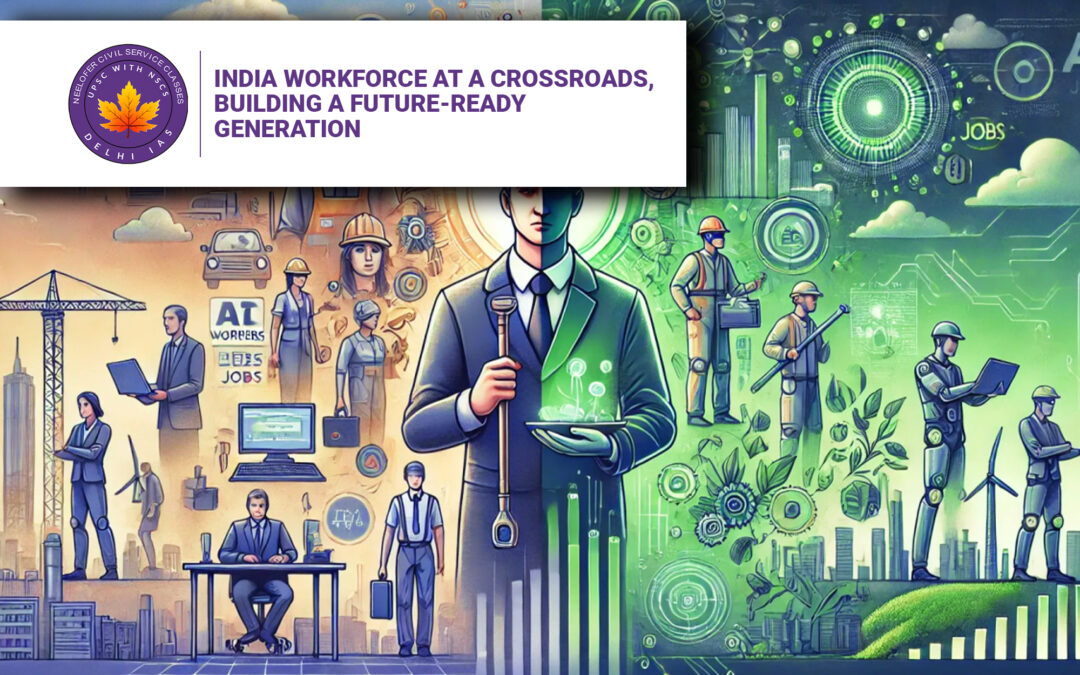
India Workforce at a Crossroads, Building a Future-Ready Generation
Why in News?
The World Economic Forum’s Future of Jobs Report 2025 and QS’s World Future Skills Index provide critical insights into India’s workforce preparedness. These reports highlight both the challenges and opportunities in reshaping India’s education and employment strategies to meet the rapidly evolving global job market. 
Introduction
India stands at a critical juncture where global trends such as AI, green technologies, and digital disruption are rapidly transforming industries. While India ranks high in some future skills categories, significant skill gaps and structural issues continue to hinder the nation’s ability to build a truly future-ready workforce.
Key Findings and Background
1. The Changing Nature of Jobs
-
60% of employers see technological advancements, climate change, and digital access as key forces transforming the job market.
-
By 2030, it’s projected that 170 million new jobs will be created, but 92 million existing jobs could be displaced due to automation and evolving demands.
2. Skill Shifts
-
50% of employers expect job displacement to reshape industries.
-
49% of roles will require advanced skills in areas such as analytical thinking, AI, resilience, and emotional intelligence.
-
Roles such as Big Data Specialists and AI Engineers will see substantial growth.
India’s Global Standing
1. World Future Skills Index (QS)
-
India ranks 2nd globally in AI and green skills readiness.
-
However, in the ‘Skills Fit’ parameter, which measures the alignment of workforce skills with job market needs, India scored only 59.1, placing it behind many other nations.
2. Other Rankings
-
India ranks 26th in Academic Readiness.
-
In future-oriented innovation and sustainability, India scores just 15.6 out of 100, revealing an alarming lack of preparedness.
Challenges and Gaps
-
Supply-side skill gaps, especially in future-centric areas.
-
Limited integration of soft skills like adaptability, emotional intelligence, and leadership into the curriculum.
-
Lack of industry-academia collaboration, especially in R&D and innovation.
-
Weak rural-urban connectivity in skill-building infrastructure.
Recommendations and Way Forward
1. Curriculum Overhaul
-
Emphasize creativity, critical thinking, problem-solving, and entrepreneurship.
-
Adopt interdisciplinary courses, project-based learning, and green curriculums.
2. Infrastructure & Investment
-
Promote faculty capacity building and provide certifications and global exposure opportunities.
-
Establish more sustainability research centers, hackathons, and design-thinking workshops.
3. Strengthen Industry Partnerships
-
Encourage internships, industry tie-ups, and job-readiness training.
-
Build urban-rural infrastructure to bridge the employment divide.
Conclusion
The reports make it clear that India must urgently transform its education system to meet future workforce demands. While India shows promise in areas like AI and green skills, it must address deep-rooted issues in academic readiness, innovation, and skill alignment. A collaborative, future-focused, and equitable education framework will be key to unlocking India’s full workforce potential.
Q&A Section
Q1. What are the two major global reports discussed?
The World Economic Forum’s Future of Jobs Report 2025 and QS’s World Future Skills Index.
Q2. What percentage of employers believe technological change and digital access are key job market drivers?
60% of employers see these as significant forces.
Q3. What is India’s global ranking in AI and green skills?
India ranks 2nd globally in terms of preparedness for AI and green skills.
Q4. What is India’s score in ‘Skills Fit’ and what does it indicate?
India scores 59.1 in ‘Skills Fit’, showing a misalignment between workforce skills and job market demands.
Q5. How many jobs are expected to be displaced by 2030 due to changes in the job market?
About 92 million roles could be displaced.
