
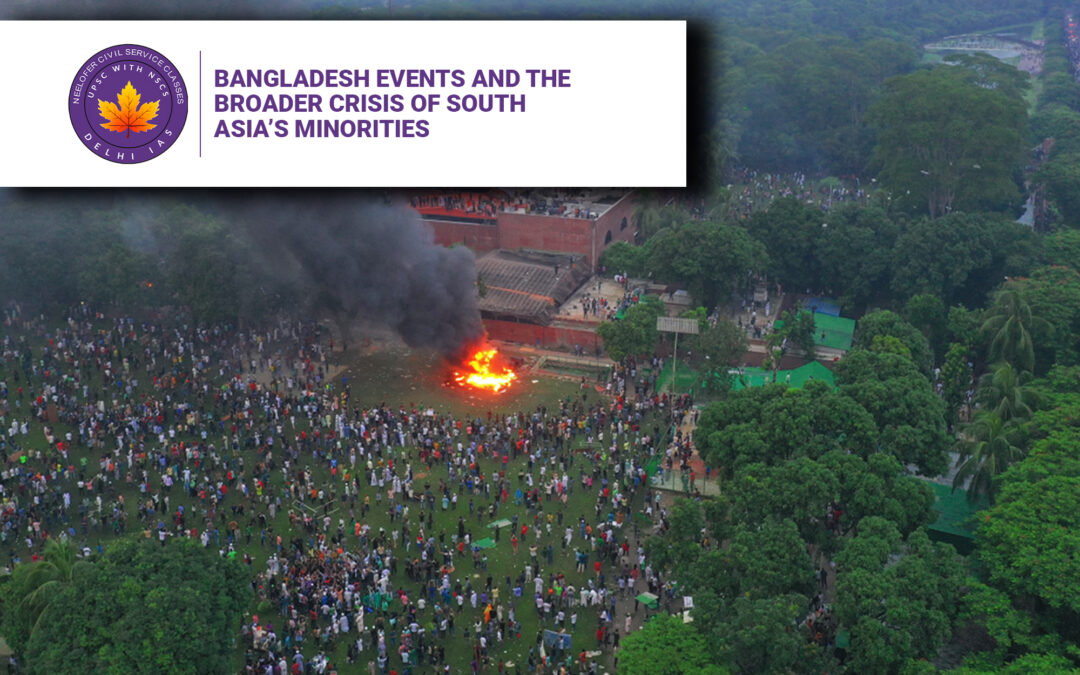
Bangladesh Events and the Broader Crisis of South Asia’s Minorities
Why in News?
The political upheaval in Bangladesh following the deposition of Prime Minister Sheikh Hasina in August 2024, and the subsequent violence against Hindus, has reignited concerns over the status and safety of religious minorities in South Asia, particularly in India, Pakistan, and Bangladesh. 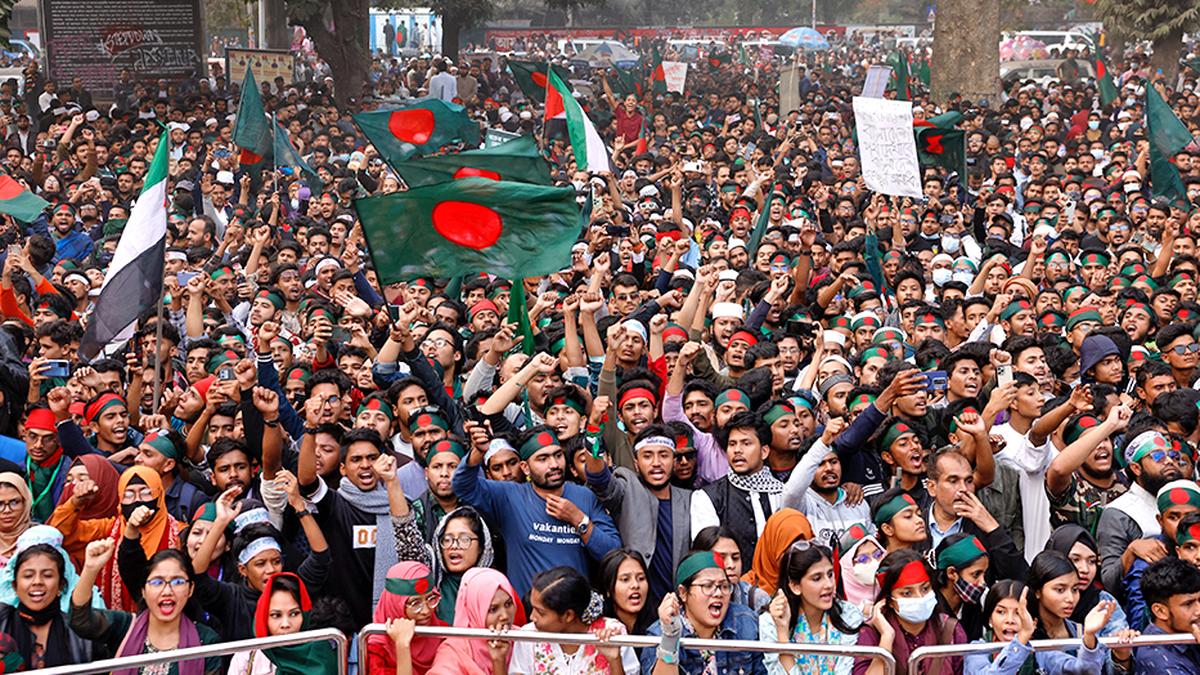
Introduction
The fate of religious minorities across South Asia has come under the spotlight once again, spurred by events in Bangladesh that have highlighted a trend of marginalisation and persecution. From the vantage point of India’s post-Partition trajectory, the current status of minorities signals a persistent and unresolved tension rooted in historical decisions and communal divides.
Key Issues / Background
-
Legacy of Partition: The 1947 Partition was intended to resolve communal tensions, especially between Hindus and Muslims. However, it entrenched communal fault lines and created new minority dynamics in all successor states—India, Pakistan, and later Bangladesh.
-
Changing Nature of Minorities: In Pakistan and Bangladesh, Hindus, Sikhs, and Christians face systemic marginalisation, while in India, Muslims and other minorities experience growing insecurity amidst rising majoritarian politics.
-
Events in Bangladesh: The removal of Sheikh Hasina from office and the ensuing violence against Hindus reflect deep-rooted tensions and a weakening of secular, democratic structures.
-
India’s Response and the Diplomatic Angle: India’s reaction to Bangladesh’s internal crisis, focusing largely on Hindu persecution, has drawn criticism for narrowing a broader regional issue into a communal or bilateral concern.
-
Nehru-Liaquat Pact Revisited: The 1950 Nehru-Liaquat Pact, a milestone for minority rights in both India and Pakistan, remains an underexplored reference point. Historical accounts suggest that renewed efforts at such bilateral cooperation may offer a blueprint for present times.
The Core of the Controversy
Religious minorities have become pawns in nationalistic politics across South Asia. The current crisis in Bangladesh, if viewed solely through the lens of Hindu victimhood, overlooks the broader pattern of deteriorating protections for all minority groups in the region. India’s foreign policy must walk a fine line between advocating for co-religionists and upholding democratic and secular norms. Selective outrage not only weakens moral legitimacy but also deepens sectarian divides.
Missed Perspectives
-
Beyond Religious Identity: Most responses lack a focus on democratic erosion, institutional failure, and socio-economic insecurities that affect all communities.
-
Recalibration Needed: Discussions on Partition and its aftermath have become stale. There is a pressing need to reframe them with an emphasis on inclusive governance and regional cooperation.
-
The Role of Civil Society: Engagement by civil society actors in all three countries could help restore trust and build bridges across divided communities.
-
Shared Historical Memory: Despite a common history, national narratives have diverged sharply. The Nehru-Liaquat Pact model could inspire new mechanisms of minority protection.
-
Institutional Innovations: New institutions are needed in all three nations to monitor and protect minority rights, ensuring that political changes do not translate into communal violence.
Conclusion
The intertwined destinies of India, Pakistan, and Bangladesh require mutual recognition of each other’s diversity and respect for minority rights. Political leaders must resist the temptation to use religion as a tool of populism or diplomacy. A reframed approach, grounded in democratic values and regional solidarity, can better address the persistent crisis of minorities in South Asia.
5 Q&A: Understanding the South Asian Minority Crisis
Q1. Why have the Bangladesh events drawn international concern?
The violence against Hindus following Sheikh Hasina’s deposition highlights the fragile position of religious minorities and raises fears about escalating sectarianism.
Q2. How does Partition still affect religious minorities today?
Partition created new minorities and entrenched communal divisions. Its legacy continues to influence political discourse and minority treatment across India, Pakistan, and Bangladesh.
Q3. What was the Nehru-Liaquat Pact and why is it relevant now?
Signed in 1950, it was a bilateral agreement to protect minority rights in India and Pakistan. Revisiting its principles can offer guidance on contemporary challenges.
Q4. Why is India’s response to the Bangladesh crisis seen as limited?
India’s focus on Hindu victims may narrow the issue into a communal matter, sidelining the broader implications for democracy and minority rights in the region.
Q5. What is the broader takeaway for the region?
The minority question in South Asia is interconnected. Ensuring rights and safety requires new institutional frameworks, democratic engagement, and regional cooperation.
