
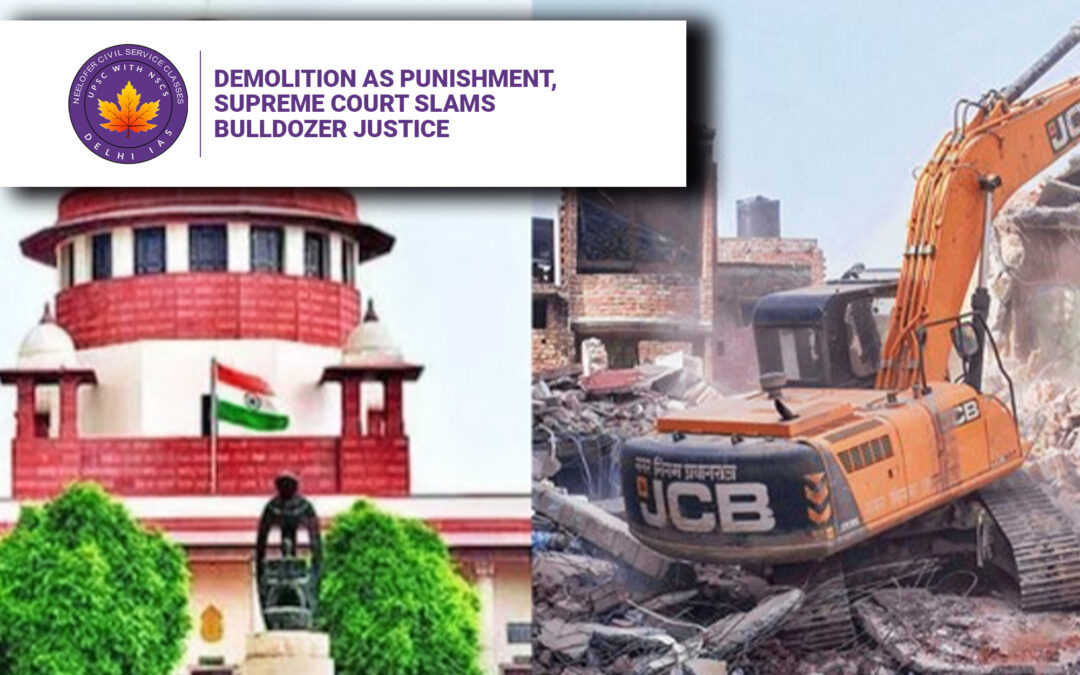
Demolition as Punishment, Supreme Court Slams Bulldozer Justice
Why in News?
The Supreme Court of India has strongly condemned the arbitrary demolition of residential properties by state authorities, particularly criticizing the Prayagraj Development Authority’s actions in 2021. The apex court’s ruling reaffirms the foundational principles of rule of law, due process, and the right to shelter under Article 21 of the Constitution. 
Introduction
The unchecked use of demolition as a punitive tool by law enforcement and civic authorities is increasingly becoming a cause for concern in India. While originally perceived as measures to tackle illegal encroachments or criminal elements, these acts have often been deployed without proper legal procedures—undermining the rule of law and constitutional guarantees.
In a recent landmark ruling, the Supreme Court criticized the Prayagraj authority’s illegal demolition of six properties, labeling it as an affront to justice. The judgment has re-ignited national debate on the state’s growing mimicry of mob-like tactics.
Key Issues / Background
-
Rule of Law Undermined: Arbitrary demolitions without trial or legal notice violate the basic tenets of justice and due process.
-
Judicial Censure: The Supreme Court, led by Justice A.S. Oka, ruled that the demolitions “shocked the conscience” of the Court and ordered ₹10 lakh compensation per affected family.
-
Political and Partisan Use: States across political lines, including BJP-ruled Uttar Pradesh and AAP-ruled Punjab, have used demolition as a political tool or to show force against alleged criminals.
-
Public Endorsement of High-Handedness: Social approval of such state actions signals a worrying decline in democratic and governance standards.
-
Supreme Court’s Role: The Court reaffirmed that no punishment can be inflicted without a fair trial and that guilt cannot be assumed by association—emphasizing the importance of due process.
The Core of the Controversy
This issue highlights a dangerous trend where the state borrows from the mob’s playbook—acting with impunity, bypassing legal safeguards, and punishing based on suspicion rather than evidence. The Prayagraj case was marked by demolitions carried out without even issuing show-cause notices, violating basic rights to shelter and legal recourse.
The use of demolitions as a form of collective punishment—often targeting political opponents or alleged criminals—has found acceptance in several states, despite earlier judicial objections. The politicization of this practice threatens India’s constitutional commitment to individual liberty and justice.
Missed Perspectives
-
Lack of Accountability: Authorities often face no repercussions for unlawful actions, creating an environment of impunity.
-
Delayed Judicial Remedies: Though the Supreme Court has intervened, the delay means that victims endure years of trauma and disruption before receiving justice.
-
Impact on Innocents: Collective punishment through demolition affects entire families, including children, who may not be involved in any wrongdoing.
-
Absence of Policy Reform: Despite repeated incidents, there is no uniform legal framework governing property demolition and citizen rights.
-
Role of Public Opinion: Social approval of extrajudicial actions is indicative of a larger crisis in civic education and democratic values.
Conclusion
The Supreme Court’s verdict on the Prayagraj demolition is a much-needed reaffirmation of constitutional values. It reiterates that justice cannot be reduced to show of strength, and no state—regardless of party affiliation—should be allowed to act above the law. The judgment is both a warning and an opportunity: to return to due process, protect citizens’ rights, and end the normalizing of bulldozer justice.
5 Q&A: Understanding the Supreme Court’s Ruling on Illegal Demolitions
Q1. What triggered the Supreme Court’s intervention in this case?
The illegal demolition of six residential properties in Prayagraj, Uttar Pradesh in 2021, without serving show-cause notices, prompted the Court to act.
Q2. What was the Supreme Court’s key observation?
The Court remarked that the demolitions “shocked the conscience” of the judiciary and reiterated that punishment without trial violates Article 21 of the Constitution.
Q3. What compensation was ordered by the Court?
The top court directed that each affected house owner be paid ₹10 lakh as compensation for the unlawful demolition of their homes.
Q4. Why is this ruling significant?
It reaffirms the core principles of the rule of law, such as due process, individual rights, and the presumption of innocence until proven guilty.
Q5. How has this trend affected governance across India?
Despite judicial disapproval, the practice has spread to other states and parties, reflecting both political opportunism and troubling public support for authoritarian methods.
