
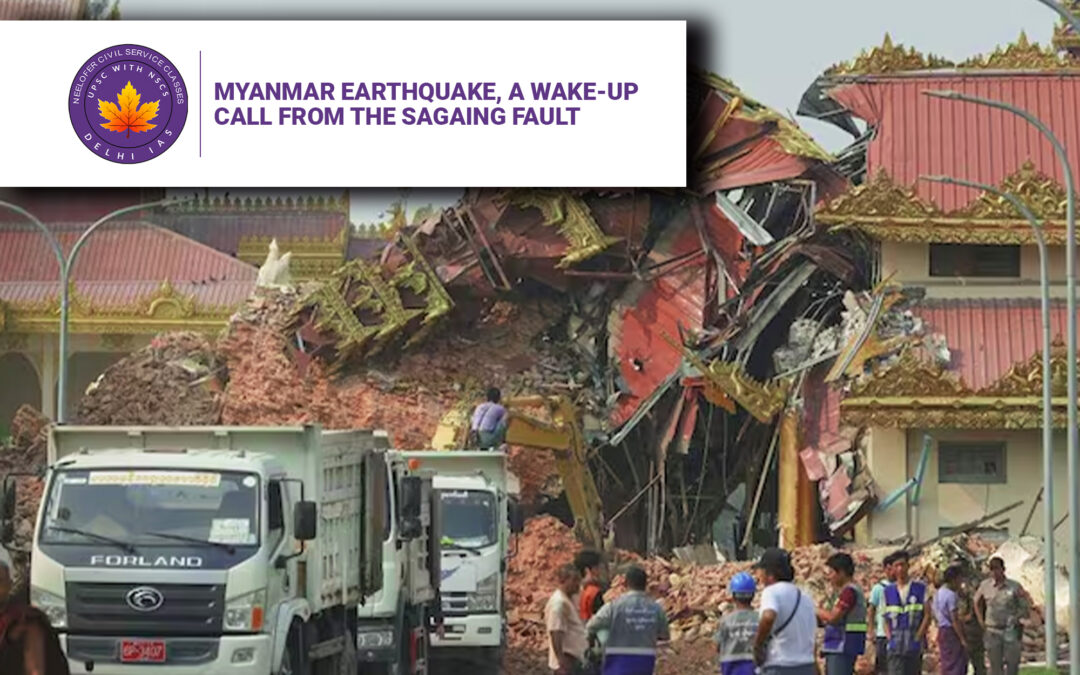
Myanmar Earthquake, A Wake-up Call from the Sagaing Fault
Why in News?
A powerful earthquake hit central Myanmar on March 28, 2024, with severe tremors felt as far as Bangkok. With a magnitude of 7.0 and several aftershocks, this seismic event drew attention to the Sagaing Fault and its dangerous potential. The quake’s effects, geological context, and implications have sparked urgent conversations on seismic preparedness in Southeast Asia.

Introduction
Earthquakes are no strangers to Myanmar, particularly around the Sagaing Fault — one of Southeast Asia’s most seismically active regions. The March 28 quake, with its epicenter near Mandalay, shook Myanmar and nearby countries, raising alarms over potential future quakes along this historically volatile fault line.
What Happened?
-
The earthquake struck near Mandalay, Myanmar’s second-largest city, around 2:50 p.m. local time.
-
It registered a magnitude of 7.0, followed by a major aftershock of 6.4.
-
It damaged homes, temples, and infrastructure, and was felt in Bangkok, around 1,000 km away.
-
The U.S. Geological Survey estimated that the total death toll could rise to 10,000 if the situation worsens.
Understanding the Tectonics: Why Myanmar is Prone to Earthquakes
The Sagaing Fault:
-
A strike-slip ridge transform fault running north-south through Myanmar.
-
Connects the Indian and Sunda plates.
-
The Sagaing Fault moves at a rate of 18–49 mm per year, making it highly active.
-
Earthquakes here are caused by horizontal movement, as the Indian Plate collides obliquely with the Eurasian Plate.
Other Contributing Factors:
-
The Burma microplate, wedged between India and Southeast Asia, adds complexity.
-
Recent tectonic stress accumulation due to the collision of the Indian Plate with both the Eurasian and Sunda Plates.
Impact on the Region
-
Bangkok experienced minor tremors due to its soft sediment base, which amplifies seismic waves.
-
Despite being closer, eastern India was not impacted significantly because seismic energy was directed along the fault and not radiated outward.
-
Ancient temples in Mandalay, Bagan, and Amarapura were damaged.
-
Concerns have been raised over the potential for future megaquakes and the urgent need for building retrofits.
Is This a Warning?
-
Experts believe this quake is a precursor to a much larger seismic event, especially near Bagan, a UNESCO World Heritage site.
-
Previous major quakes: 1930 (magnitude 7.3), 1956, 1991, and 2016.
-
The 2024 quake highlights the need for seismic zoning, urban planning, and early warning systems across Southeast Asia.
Conclusion
Myanmar’s March 2024 earthquake was a reminder of the region’s tectonic volatility. While damage was widespread, it also served as a call to action for regional governments to prepare better for future earthquakes by enforcing resilient infrastructure, improving disaster awareness, and investing in scientific monitoring of fault lines like the Sagaing Fault.
5 Q&A: Understanding the Myanmar Earthquake
Q1. What caused the Myanmar earthquake?
It was triggered by movement along the Sagaing Fault, a major strike-slip fault where the Indian and Sunda tectonic plates interact.
Q2. Why was Bangkok affected despite being far away?
Bangkok’s soft sedimentary ground amplified the seismic waves, making tremors felt even 1,000 km from the epicenter.
Q3. Why did eastern India not feel the earthquake?
Because of the direction of fault movement and the geological structure, the seismic energy didn’t propagate westward effectively.
Q4. Is the Sagaing Fault dangerous?
Yes. It is one of Southeast Asia’s most active faults, moving up to 49 mm/year, and has a long history of major earthquakes.
Q5. What can be done to reduce earthquake damage in the region?
Governments should prioritize building codes, retrofitting historic structures, public awareness, and early warning systems to prepare for future quakes.
