
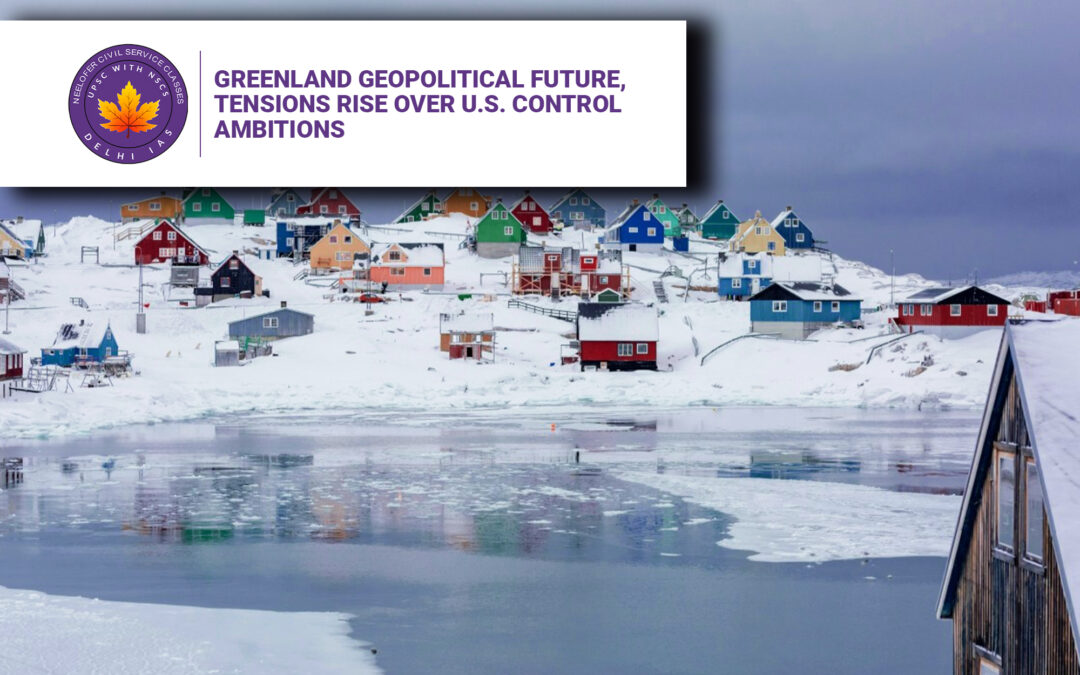
Greenland Geopolitical Future, Tensions Rise Over U.S. Control Ambitions
Why in News?
U.S. Vice President J.D. Vance recently visited Greenland to reaffirm former President Donald Trump’s controversial plan to assert U.S. control over the Arctic island, reigniting global debate over territorial sovereignty, national autonomy, and climate-driven geopolitics. 
Introduction
Greenland, a semi-autonomous territory of Denmark with a population of about 56,000, is again at the center of U.S. geopolitical ambitions. The recent visit by VP Vance and President Trump’s renewed proposal to “go as far as we have to” for acquiring the island has triggered backlash from Greenlandic leaders and the Danish government. This marks a new low in U.S.-Greenland relations.
Key Issues Highlighted
-
Historic and Recent U.S. Attempts to Acquire Greenland
-
The U.S. has repeatedly attempted to buy Greenland:
-
In 1867 (after Alaska purchase)
-
In 1946 (offering Denmark $100 million)
-
In Trump’s first and now second term
-
-
All attempts were rejected by both Denmark and Greenland.
-
-
Strong Opposition from Greenland and Denmark
-
Local leaders and the Danish government have reiterated Greenland’s sovereignty.
-
Trump’s aggressive approach has drawn criticism across the Atlantic.
-
-
Greenland’s Evolving Political Identity
-
Gained autonomy in 1979 (still under Denmark in foreign affairs and defence).
-
Over 80% of Greenlanders support full independence in polls.
-
85% oppose becoming part of the U.S.
-
-
Climate Change and Arctic Geopolitics
-
Melting Arctic ice opens new navigation and resource extraction zones.
-
Only five countries have Arctic seabed access:
-
Canada, Russia, Norway, Denmark (via Greenland), and U.S. (via Alaska).
-
-
-
Militarization and Strategic Competition
-
Russia already has a strong Arctic military presence.
-
The U.S. views Greenland as key to Arctic claims and untapped resources.
-
Expansionist actions risk undermining international order based on territorial integrity.
-
Five Key Takeaways
-
The U.S. has made multiple historic and modern efforts to buy Greenland, all of which were rejected.
-
Greenland’s population increasingly desires full independence, not U.S. control.
-
Geopolitical competition is intensifying in the Arctic due to climate change.
-
The American push reflects resource and military interests, not the will of the Greenlandic people.
-
Any status change must be democratic and local, not a result of external coercion.
Challenges and the Way Forward
-
Respect for Sovereignty: U.S. policy must align with international norms, not unilateral ambitions.
-
Diplomatic Sensitivity: Avoid aggressive rhetoric and engage in respectful dialogue with Greenlandic leaders.
-
Environmental Stakes: Treat the Arctic not just as a resource base but a fragile ecosystem.
-
Military De-escalation: Avoid militarizing the Arctic and respect its demilitarized history.
-
Support for Self-Determination: Facilitate Greenland’s path, whether toward independence or continued Danish affiliation.
Conclusion
Greenland is no longer a passive territory open to transactional acquisition. With a growing sense of identity and desire for independence, its people must have the final say on their future. As Arctic tensions rise, respecting democratic processes and sovereignty is critical for maintaining global peace and order.
Q&A Section
Q1. What sparked the latest tensions between the U.S. and Greenland?
Vice President J.D. Vance reaffirmed Trump’s plan to assert U.S. control over Greenland, which drew criticism from Greenlandic leaders and Denmark.
Q2. Has the U.S. tried to buy Greenland before?
Yes, the U.S. attempted to purchase Greenland in 1867, 1946 ($100 million offer), and during Trump’s previous term, all of which were rejected.
Q3. What is the political status of Greenland today?
Greenland is an autonomous territory of Denmark since 1979, with Denmark managing its foreign affairs and defense.
Q4. Why is Greenland important to the U.S. strategically?
It offers access to Arctic routes and resources, crucial for navigation, military strategy, and resource extraction amid climate change.
Q5. What do the people of Greenland want?
Surveys show over 80% want independence and 85% oppose U.S. control, favoring self-determination and democratic decision-making.
