
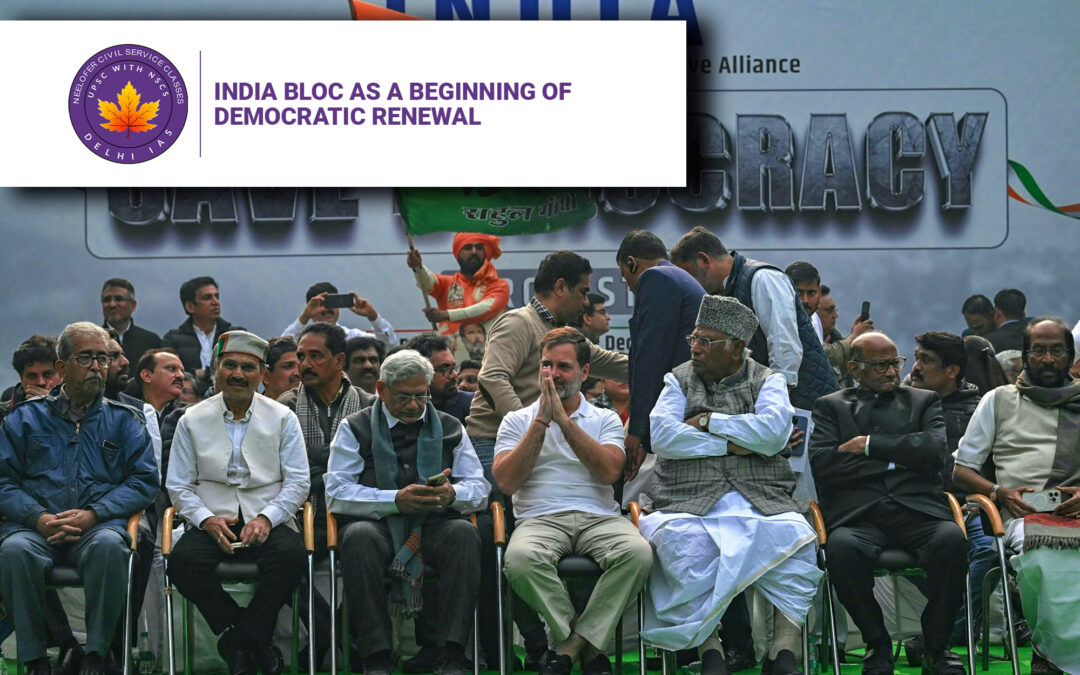
INDIA Bloc as a Beginning of Democratic Renewal
Why in News?
The INDIA bloc (Indian National Developmental Inclusive Alliance) has been emerging as a political coalition aiming to safeguard India’s democracy, decentralize power, and restore public trust in institutions. The article by Varun Santhosh, a Congress party member and Vice-Chairman for the 2024 Lok Sabha campaign, outlines how the bloc may present a renewed democratic alternative. 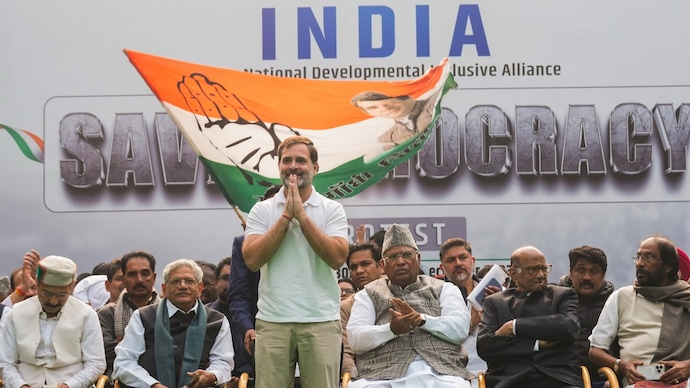
Introduction
In response to the growing centralisation and narrative control by the ruling party, the INDIA bloc is proposing a bottom-up political model focused on listening, dialogue, decentralisation, and democratic rejuvenation. By emphasizing participation, inclusivity, and respect for dissent, the bloc seeks to revive constitutional values and public trust.
Key Highlights from the Article
-
Bharat Jodo and Bharat Jodo Nyay Yatras: Dialogic, Not Commanding
-
Unlike traditional campaigns, these yatras involved open-ended conversations, public listening, and community engagement.
-
The model contrasted with the ruling party’s centralised command-control approach.
-
-
Gandhian Inspiration: Samvad over Slogans
-
Rahul Gandhi’s approach of “Samvad” (dialogue) reflected a trust-building method, not mere narrative creation.
-
Displaying the Constitution and engaging in speeches about public rights was meant to rebuild faith in democracy.
-
-
Coordination of Regional and National Movements
-
The INDIA bloc focuses on diverse regional partnerships, where grassroots and regional actors lead the charge.
-
It aims to be a platform for local leadership, federal values, and issue-based unity.
-
-
Listening as Strategy & Principle
-
The bloc wants to listen to marginalised communities, young entrepreneurs, and gig workers—groups often neglected in policymaking.
-
Listening is positioned not just as a strategy, but as a political ethic.
-
-
Challenge to Top-down Politics
-
The ruling party’s dominance stems from top-down narrative control and electoral machinery.
-
The INDIA bloc seeks to offer a people-centered alternative, powered by issue-led campaigns and participatory democracy.
-
Five Key Observations
-
The INDIA bloc represents a shift from centralised power to decentralised democratic renewal.
-
Emphasis is placed on dialogue, not diktats, and listening, not instructing.
-
The yatras have shown how local movements can shape national narratives.
-
The coalition aims to build a broad-based electoral alliance against authoritarian tendencies.
-
The real test lies in whether it can translate its ethical values into electoral victories.
Challenges and the Way Forward
-
Coordination Difficulties: Aligning different parties and interests across states is a continuous challenge.
-
Transforming Disillusionment into Action: Many voters are skeptical or apathetic. Listening must lead to mobilisation.
-
Representation Gaps: Women, farmers, workers, and marginalised communities must not just be heard, but empowered.
-
Avoiding Sloganism: The INDIA bloc must avoid mere symbolism and ensure substantive policy commitments.
-
Turning Ethics into Votes: Listening must convert into strategic electoral performance.
Conclusion
The INDIA bloc, if it stays true to its ethos of dialogue, decentralisation, and democratic integrity, could represent a real alternative to the dominant political model. In doing so, it offers a path for democratic renewal—a much-needed step in restoring constitutional values, political trust, and public participation in governance.
Q&A Section
Q1. What is the central idea behind the INDIA bloc’s political model?
The INDIA bloc emphasizes decentralisation, dialogue, public participation, and respect for constitutional norms, contrasting the ruling party’s top-down command style.
Q2. How were the Bharat Jodo Yatras different from traditional campaigns?
They featured open-ended engagements, focused on listening rather than delivering pre-scripted speeches, and emphasized trust-building over vote-seeking.
Q3. What does the article say about ‘listening’ in politics?
Listening is not just a political tool but an ethical necessity. It must lead to engagement with marginalised voices, workers, and youth and guide policymaking.
Q4. What major political shift is the INDIA bloc attempting to bring?
It aims to replace top-down control with bottom-up democracy, empowering regional actors and social movements to co-create political agendas.
Q5. What are the major risks for the INDIA bloc’s strategy?
The main risks include incoherence among alliance partners, inability to transform public discontent into votes, and over-reliance on symbolism without clear policy delivery.

