
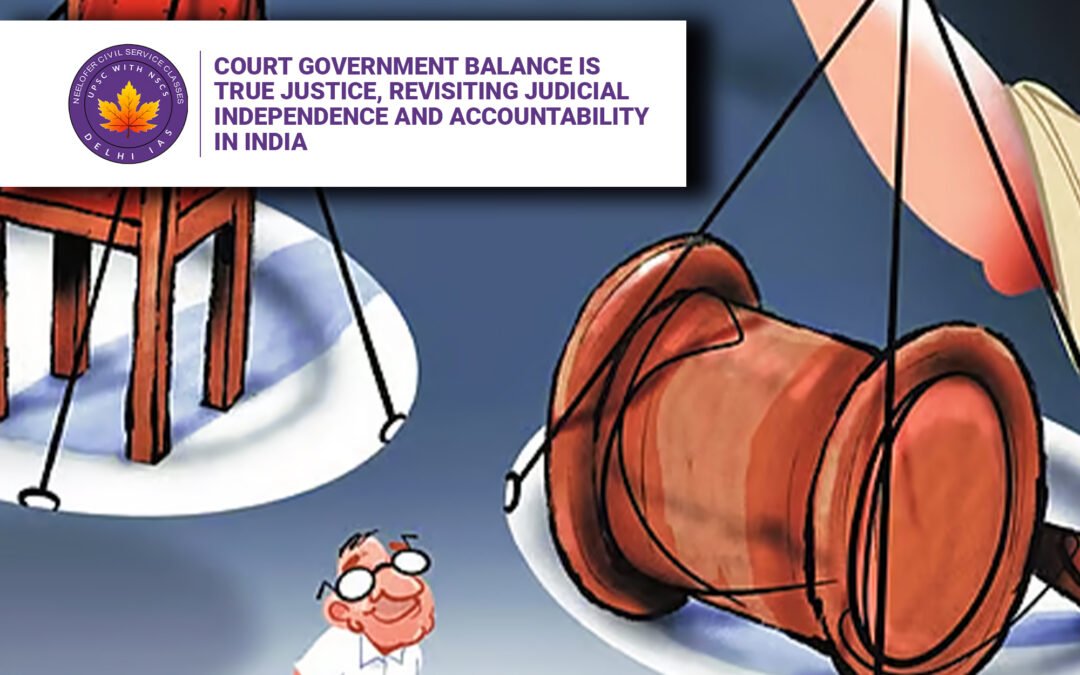
Court Government Balance Is True Justice, Revisiting Judicial Independence and Accountability in India
Why in News?
A renewed debate has surfaced over the appointment process of judges in India, sparking conversations about the balance of power between the executive and the judiciary. The question remains whether the collegium system ensures judicial independence or if it veils a lack of transparency and accountability. With rising political interference and the history of confrontations between the two pillars of democracy, calls for reform have resurfaced. 
Introduction
Judicial independence is a cornerstone of democracy, yet the appointment and transfer of judges in India have long been under scrutiny. The tug-of-war between the executive’s desire for influence and the judiciary’s claim to autonomy has raised critical questions about transparency, checks and balances, and the public’s faith in the legal system. The National Judicial Appointments Commission (NJAC), the collegium system, and various Supreme Court judgments lie at the heart of this debate.
Key Issues
-
Collegium vs Executive Conflict
The collegium system, where judges appoint judges, has been critiqued for being opaque. Executive governments, especially during and after the Emergency (1975), have tried to influence or override this system. -
Constitutional Interpretation and Tensions
The Supreme Court emphasized “consultation” with the CJI, which evolved into “concurrence” in later judgments, meaning the executive’s role was significantly curtailed. -
Judicial Supremacy in Appointments
With cases like the Three Judges Cases and the Second and Third Judges Cases, the judiciary gained supremacy in appointments, setting a precedent of collegium dominance. -
NJAC and Its Striking Down
The NJAC Act (2014), intended to replace the collegium with a six-member panel, was struck down in 2015 by the Supreme Court for violating the basic structure of the Constitution, especially judicial independence. -
Lack of Transparency and Criteria
The public remains unaware of the specific reasons for the selection or rejection of judicial candidates. Recent instances, including delays in judicial appointments or rejections, have deepened skepticism.
Five Key Observations
-
The judiciary’s independence must be preserved but with built-in accountability mechanisms.
-
The collegium system lacks transparency; decisions are made without public disclosure of selection criteria.
-
Political interference in judicial appointments has persisted post-Emergency.
-
Striking down the NJAC was seen both as judicial triumph and missed reform opportunity.
-
The system suffers from a ‘trishanku’ dilemma—neither fully transparent nor fully accountable.
Challenges and the Way Forward
-
Transparency vs Independence: While protecting judicial independence is crucial, opacity in appointments breeds distrust.
-
Need for Balanced Reforms: A restructured NJAC or similar mechanism that includes broader consultation and transparency is needed.
-
Depoliticizing the Process: Avoid executive overreach while ensuring that judicial decisions are not immune to scrutiny.
-
Restoring Public Confidence: A clearer, more participatory process will rebuild trust in judicial institutions.
Conclusion
As Montesquieu envisioned, democracy flourishes when its three branches check and balance one another. In India, judicial appointments remain a contested arena. The current collegium system, though protecting independence, risks losing public trust if it continues to lack transparency. The need of the hour is a hybrid model—one that balances autonomy with accountability, and secrecy with openness.
Q&A Section
Q1. What is the collegium system?
It is the system where judges appoint other judges through consultation among the senior-most judges, mainly led by the Chief Justice of India.
Q2. Why was the NJAC struck down by the Supreme Court?
The NJAC was struck down in 2015 as it was seen to violate the “basic structure” of the Constitution by threatening judicial independence.
Q3. What role does the executive currently play in judicial appointments?
The executive can delay, reject, or return collegium recommendations, but cannot unilaterally appoint judges.
Q4. What is the main criticism of the collegium system?
Lack of transparency and public reasoning for appointments and rejections, which can lead to favoritism or nepotism.
Q5. What is the proposed way forward in this debate?
A balanced mechanism, possibly a reformed NJAC or a transparent collegium model, that maintains judicial independence while ensuring public accountability.

